


Philip K. Dick claimed to have mapped the multiverse from a Santa Ana apartment. The map may turn out to be a treasure in the coming times.
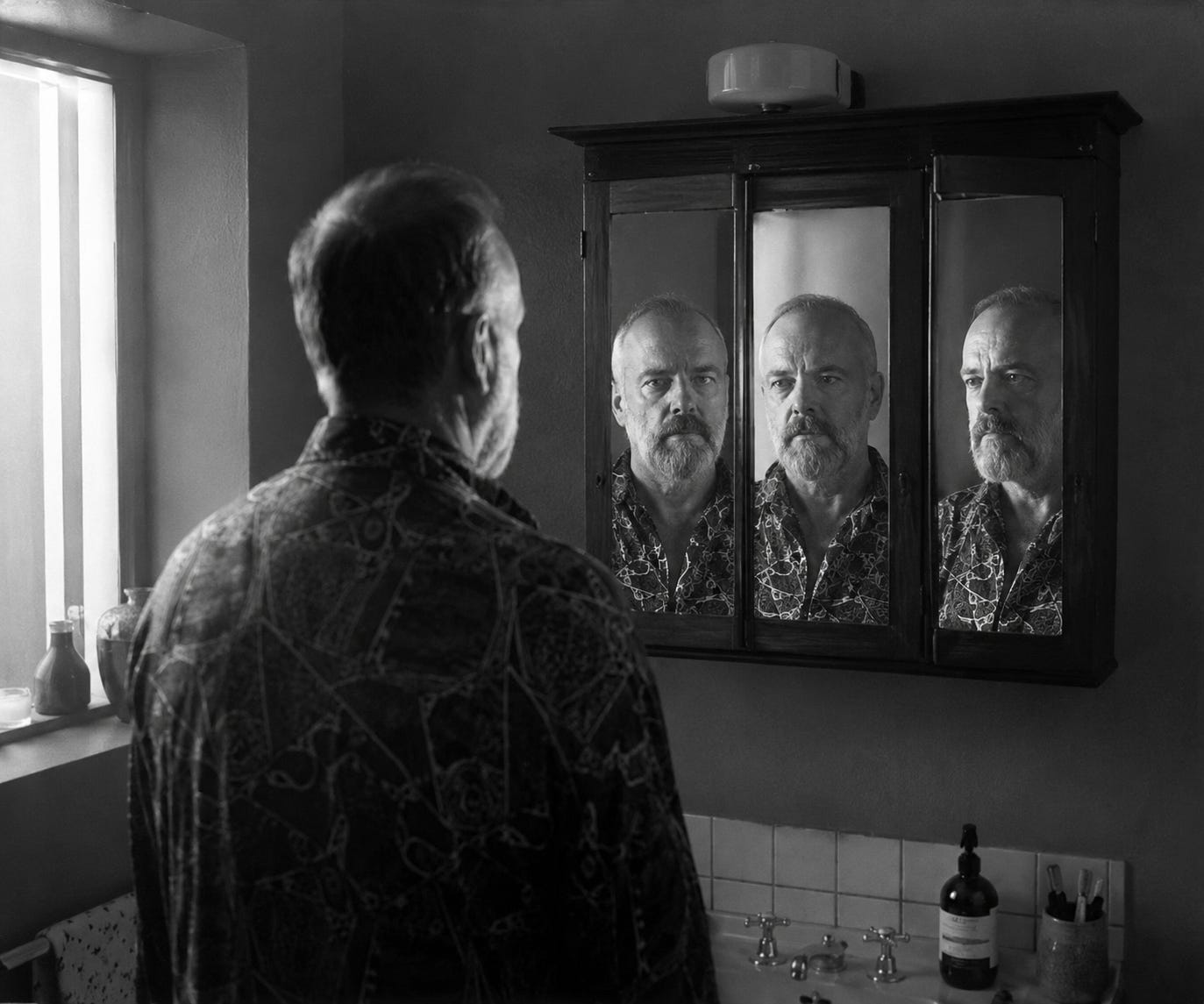
I'm a 1966 model, Gen X, incepted three decades before mobile phones or the internet. That makes me a lucky fossil. Lucky because I was conditioned to hoover books instead of memes. The writer I imbibed with more passion than any other was Philip K. Dick, later known for half a dozen Hollywood adaptations that put him on the map, most notably Blade Runner. He died penniless in 1982 and was, depending on your frame of reference, either out of his mind or ahead of it. Probably both. The distance between those two diagnoses is what this piece is about.
PKD didn't just write about parallel realities. He claimed to have lived inside one — morphing his worldview in the same way it reshaped the worldview of ancient Gnostics, Hermetic philosophers, Lakota warriors, quantum physicists, and every mystic who ever pressed their thumb into the backdrop of consensus reality and felt it give. A curious alignment that deserves a closer look.
In a world plummeting straight down the wormhole of the surreal, where religion and conventional spirituality offer about as much hope as a slippery bandaid, is there a mental framework that helps us plot the journey with a sense of oomph?
Dick may be one of the few science fiction writers in history whose futuristic visions of tyrannical technocratic control were based not on imagination but on direct personal experience. His darkest imaginings have since materialized, more or less on schedule, as the evening news.
Manufacturer of Chaos
Philip Kindred Dick was born in December 1928 in Chicago with a twin sister, Jane Charlotte, who died six weeks later from malnutrition, allergic to her mother's milk. If you've ever met a twin who lost a twin, you know how fractured their world can get — the sense that half of you has been ripped out of your chest. That chestbuster was PKD's first imprint.
Dick became a catastrophe in human form who occasionally produced genius between the catastrophes. His five marriages all landed in the junkyard, producing three children he tried to be a father to amidst the chaos. Mostly the chaos won. He picked up an amphetamine habit early on that had become part of his operating system by the 1960s, cranking out eleven novels in two years during the peak years — which sounds productive until you factor in the biochemistry. The pills most likely deepened his paranoia, wiring his threat-assessment neurons to the point where you couldn't be sure if an intergalactic spy or a postman was knocking on the door, or whether there was any meaningful difference between the two.
Dick allegedly tried to push his third wife Anne off a cliff in a car. She was later involuntarily committed to an asylum on his petition. Another time he tried to kill himself driving off a road with a girlfriend in the passenger seat. In February 1972, he got onstage at a Vancouver science fiction convention and declared his eternal love for a woman he had met forty-eight hours earlier. A week after accepting lodging from a convention attendee, he was asked to leave. The woman was gone. He overdosed on potassium bromide alone in his room and was found by the people he was staying with, barely conscious — then entered a Canadian recovery program called X-Kalay and started over.
The man who spent thirty years mapping the architecture of parallel realities, who could describe the geometry of worlds running alongside this one with the precision of a surveyor, could not navigate the distance between himself and the person standing directly in front of him.
He may sound like a nutty player — until you dig deeper.
The Work
Dick dropped out of Berkeley in 1948 with anxiety he could not name, worked in a record store, spun classical records on a local radio station, and started sending stories to science fiction magazines in 1951. First sale in 1952. First novel, Solar Lottery, in 1955. From there, the output was staggering — nearly a hundred short stories and twenty-five novels in two decades, including Do Androids Dream of Electric Sheep?, The Man in the High Castle, Time Out of Joint, The Three Stigmata of Palmer Eldritch, Ubik, A Scanner Darkly. Works that look, in retrospect, less like science fiction than like dispatches from the ether.
The central obsession from the very beginning: is any of this real. Not as a philosophical exercise but as a survival question. His protagonists don't fight evil — they discover that the universe has been swapped out beneath them, replaced while they were distracted, and nobody will confirm it, and they can't entirely confirm it themselves. The horror lives in the gap between what they remember and what they're being told. He was writing that story twenty years before he understood it was autobiography.
In 1962, The Man in the High Castle won the Hugo Award — a novel imagining a United States that lost World War II to the Axis powers. In 1974, he published Flow My Tears, The Policeman Said, set in a near-future American police state where a man wakes up with no identity in a surveillance apparatus that owns everything. He had been writing both as fiction. He would later claim they were something else.
By the early 1970s, Dick's career had partially stalled under the combined weight of the drugs and the personal chaos. Then, in February 1974, a dentist extracted two impacted wisdom teeth using sodium pentothal, and everything went even further off the rails.
The Key Event
The experience he called "2-3-74" — February-March 1974 — is either the most consequential mystical vision in American literary history or the most extensively documented psychotic episode ever committed to paper.
Dick reported a beam of rose or pink light, arriving with no warning. Information — vast, structured, somehow intelligent — pouring directly into his mind. He described it later as plasmic energy that moved fast, collected and dispersed, with colors. He wrote in the Exegesis that it "simulated normal objects and their processes so as to copy them and in such an artful way as to make himself invisible within them — as the Vedantist put it, the fire within the flint, the razor within the razor's cave."
His biographer Lawrence Sutin proposed Temporal Lobe Epilepsy as a reasonable working diagnosis. TLE produces religious visions, altered states, overwhelming certainty of cosmic significance, and — specifically — the sensation of external communication, of something outside sending something in. The hippocampus misfires and the membrane between this world and the adjacent one goes translucent. What's notable is that Dick himself proposed this possibility in the Exegesis, calmly and specifically. He was not defending the experience from clinical scrutiny — he was conducting it himself.
Dick received multiple psychiatric diagnoses across his life. Manic-depressive in 1973, schizophrenic by one psychiatrist, paranoid by two others. He acknowledged in the Exegesis what he called a "complete schizo breakdown in 3-74, lasting a year." He was taking lithium during the period in question. The medical records that could settle the matter have either been lost or were never kept in sufficient detail.
The Exegesis — his private reckoning with the event — ran to approximately 8,000 pages by his death. Eight thousand pages of a man running a forensic investigation of his own nervous system, cross-referencing it against Gnostic theology, Jungian archetypes, Zoroastrian cosmology, and the works of early Christian heretics who also believed the visible world was a false copy installed by a lesser god — the Demiurge, the corrupt architect, the programmer who broke the signal. He never landed on a final answer. He kept interrogating the question instead — including interrogating himself, including writing down the possibility that all of it was pathology and none of it was real.
That willingness to hold both possibilities without collapsing either one into comfort may have been the most sustained act of cognitive dissonance ever committed with a typewriter.
Three years after the event, Philippe Hupp — book reviewer, French translator of Time Out of Joint, organizer of the Metz International Science Fiction Festival — flew to California and had lunch with Dick at an Italian restaurant near his apartment in Santa Ana. Dick gave him an audio cassette of a speech he had already prepared. Hupp noted that Dick seemed happy. He was wearing a large ornate crucifix in the photographs taken after lunch.
The speech was called "If You Find This World Bad, You Should See Some of the Others."
Metz, September 24, 1977
The Second International Science Fiction Festival. France. Dick arrives as guest of honor — one of only three times in his life he left the United States — and takes the stage in front of an audience that has come to hear something about rockets and androids.
He opens with a joke. He's been asked to cut two-thirds of his prepared speech. He considered cutting all three-thirds, he says, but ran into some trouble with that approach. The room laughs.
Then he begins.
"The subject of this speech is a topic which has been discovered recently and which may not exist at all. I may be talking about something that does not exist. Therefore I'm free to say everything or nothing. I can hardly make an error."
The topic is orthogonal time — a lateral axis running perpendicular to the linear timeline. Not the past, not the future. Sideways. A direction for which we have no word because we have never, as a species, consciously traveled it. He is careful to say that this concept may be purely fictional. He is also clearly describing something he has personally experienced, and the two things are not, for him, in contradiction.
To explain what lateral change would look like from the inside, he offers a metaphor.
"Let us say that there exists a very rich patron of the arts. Every day on the wall of his living room above his fireplace his servants hang a new picture — each day a different masterpiece. But now let us suppose the servants temporarily run out of new replacement pictures. Instead, they do a very clever thing: when their employer is not looking, the servants cunningly alter the picture already on the wall. They paint out a tree here, they paint in a little girl there. The employer enters his living room after dinner, seats himself facing the fireplace, and contemplates what should be the new picture. His brain circuits are saying: yes, it is a new picture, it is not the same one as yesterday. But also: it is the same one. I think I feel — on a very deep intuitive basis — I feel that somehow I've seen it before. I seem to remember a tree, though, and there is no tree now."
This is the experience of living through a variable reality. Not remembering the past — but remembering a different present that gets replaced while you're inside it.
From the painting, he moves to theology.
"Perhaps we could say that herewith we suddenly decipher the elliptical utterances which Christ expressed regarding the kingdom of God — specifically where it is located. He seems to have given contradictory and puzzling answers. But suppose, just for an instant, that the cause of the perplexity lay not in any desire on his part to baffle or to hide but in the inadequacy of the question. 'My kingdom is not of this world,' he is reported to have said. 'The kingdom is within you,' or possibly, 'it is among you.'"
What Christ was describing, Dick argues, was a literal spatial arrangement — worlds overlapping along a lateral axis, ranging from the unspeakably malignant to the beautiful. The kingdom was not a metaphor for subjective spiritual transformation. It was a place. Adjacent. Accessible to those who understood the geometry of crossing.
"It was his mission to teach his disciples the secret of crossing along this orthogonal path. He did not merely report what lay there — he taught the method of getting there. But tragically the secret was lost."
The room starts to thin. The French interpreter is chopping his sentences into pieces, and the audience came for androids — and this has turned into a Gnostic puzzle game. People stand and leave. Dick does not care.
He tells them he has retrieved, through the sodium pentothal and what followed it, memories of a different present — a worse America, circa the mid-1970s, where the civil rights and anti-war movements had failed, where Nixon had not been removed from power, where a man like Dick had to practice his Christianity in secret, the way people did under Rome.
"I wrote both novels — The Man in the High Castle and Flow My Tears, The Policeman Said — based on fragmentary residual memories of such a horrid slave-state world. I can even tell you what caused me to remember. In late February of 1974, I was given sodium pentothal for the extraction of impacted wisdom teeth. Later that day, back home, I had a short acute flash of recovered memory. In one instant I caught it all — but immediately rejected it, with the realization that what I had retrieved was authentic."
He distinguishes Track A, the prison world, from Track B, the one they're all currently in — a lighter tyranny, a stupider one, or perhaps one that received assistance. Nixon fell here. The civil rights movement partially succeeded here. The variables had been retroactively adjusted, he says, by whoever or whatever runs the reprogramming — the entity he calls, with characteristic precision and characteristic uncertainty, the programmer-reprogrammer.
"We are living in a computer-programmed reality, and the only clue we have to it is when some variable is changed and some alteration in our reality occurs."
Déjà vu.
"We might reflexively reach for a light switch in the bathroom only to discover that it had always been in another place entirely. We might reach for the air vent in our car where there is no air vent — a reflex left over from a previous present, still active at a subcortical level. We might dream of people in places we had never seen as vividly as if we had known them. One very pronounced impression would probably occur to us, again and again and always without explanation: the acute, absolute sensation that we had done once before what we were just about to do now. I submit that these impressions are valid and significant. Such an impression is a clue that at some past time point a variable was changed — reprogrammed, as it were — and that because of this an alternative world branched off and became actualized instead of the prior one, and that in fact, in literal fact, we are once more living this particular segment of linear time."
The room is emptier now.
He closes with a description of Track C — a third world he visited briefly in February 1975, for about six hours of elapsed time. A garden. A park. Peaceful, beautiful, pre-Christian in its elements. He believed it was humanity's original home, before the false trajectory. He grieved its loss in the same sentence he described it.
"The memory of this intermediate one — like that of the black iron prison world — will be eradicated mercifully from our memories. The best that I can really do at this point is to play the role of ancient prophets, and talk of a wonderful garden world much like that which once our ancestors are said to have inhabited."
He wanted to take them there. But the method was missing. He had only the report of someone who had been there accidentally.
The speech was not well received. From his fans' point of view, he had officially crossed the loony line. He left Metz and went back to Santa Ana, where he spent his remaining years alone in a small apartment, writing the VALIS trilogy — his final attempt to wrestle the 1974 experience into fiction — and compiling the Exegesis, eight thousand pages of a man refusing to let the question go.
What the Physicists Were Doing at the Same Time
In 1957, a Princeton graduate student named Hugh Everett III published a doctoral dissertation proposing what is now called the Many-Worlds Interpretation of quantum mechanics. The core claim: every quantum event with multiple possible outcomes produces not one outcome but all of them, each in a different newly created world. The wave function never collapses. It branches. The universe is not a single timeline — it is an uncountably vast tree of diverging realities, every branch equally real, every branch sealed from the others.
Everett made the observer part of the quantum system, not external to it. You don't look at the particle from outside and collapse its probability into an outcome. You enter the superposition with it. You branch with it. There are now two versions of you, each having seen a different result, each embedded in a different world, neither aware of the other.
The interpretation was largely ignored for a decade. By the mid-1970s — the same years Dick was writing his Exegesis — it was gaining serious traction. Today, when physicists are polled at quantum foundations conferences, roughly a third to a half will raise their hand for Many-Worlds. The string theorist Juan Maldacena said: "When I think about the Everett theory quantum mechanically, it is the most reasonable thing to believe." He added that in everyday life, he does not believe it. Maybe that was his method of staying sane.
Dick almost certainly had not read Everett. The dissertation circulated in physics departments, not in Berkeley apartments full of manuscript pages and amphetamines. But Dick arrived at a structurally similar place from a completely different direction, and the resemblance is not superficial. Both describe a reality composed of multiple overlapping worlds, all equally real, all running simultaneously. Both describe the individual as embedded in that multiplicity, not observing it from outside. Both describe the sensation of crossing between states — which for Everett is quantum decoherence and for Dick is orthogonal time, but which in both cases involves a residue, a trail left in the system by what was and now isn't.
The difference is the one that matters. Everett's worlds cannot communicate with each other, by definition. The branches are sealed. Information cannot cross. Dick's worlds are porous. You can carry memories between them. You can be moved along the lateral axis by whoever manages the reprogramming. The multiverse in Everett is a closed system. The multiverse in Dick is a managed one — a chess game between a programmer and a dark counter-player, with the rest of us as pieces that sometimes, dimly, remember a different position on the board.
If the multiverse is real, whether it's closed or managed may matter less than choosing a framework that energizes us to navigate it well — with the understanding that every vector is already running. Ergo, there is nothing to lose when you step into courage.
If You Choose to Believe It
Let's say Everett is right and the worlds branch at every quantum decision, and Dick is right that the branches are not sealed but porous, and the Hermeticists are right that the pattern is managed toward something better. What follows.
What follows is that every choice you make actually ramifies. Not metaphorically — literally, in the physics, in the branching wave function. There is a version of you taking the other road, and that version is not hypothetical. It is running in parallel, right now, in a world that diverged from this one at the moment of your decision. The consolation and the horror arrive together: nothing is wasted, every path is taken, and you cannot correct the paths you didn't take because they are already being taken elsewhere.
The sensitivity you develop — to synchronicity, to déjà vu, to the moment when the light switch is in the wrong place and your body knows it — is not superstition but potential for sharper navigation. The patron's brain circuits straining to understand the altered picture are not broken but detecting something real, something the analytical mind is too slow to catch. The impressions you've been trained to dismiss as noise are, in fact, signal.
The direction of movement matters. Not all worlds are equivalent. The spectrum runs from the unspeakably malignant to the beautiful, in Dick's formulation, and the programmer is steering toward the beautiful end. The question is whether you are paying attention when the movement happens — whether, as the New Testament passages Dick quotes in Metz put it, you are awake when the kingdom arrives, or whether you are asleep and simply don't see it.
The moral dimension is preserved. The stakes are higher than a single lifetime in a single world. Your character, your attention, your willingness to stay awake and keep navigating — these are not just personal virtues in a universe where the worlds branch and the programmer moves pieces. They are the whole game.
Dick was not living proof of his own cosmology — he tried to push his wife off a cliff, for one. But perhaps it was precisely the darkness of his travails that gave him eyes for the alternate realities available to us at every turn.
Imagine a world where every move matters, every choice seeds a branch, every observation collapses a probability into a history, every decision to enter uncertain territory rather than safe ground generates information that feeds the optimization of all subsequent worlds. Where you are not observing. But rendering.
Bon Journey, PKD
February 17, 1982. Santa Ana. Dick suffers a massive stroke at fifty-three and does not recover. Five days later, his EEG is consistently flat and they disconnect the machines.
Three months later, Blade Runner opened. He never saw it finished — he had watched twenty minutes of effects footage and left stunned, genuinely startled that anyone had translated the interior of his head into images. He died impoverished and largely unrecognized in the United States.
Maybe, in a thousand and one other vectors, his fate was different. And in each of those vectors, the great Programmer-Reprogrammer took note and aligned the course of the universe just so slightly toward increasing complexity, consciousness — sometimes referred to as the Omega Point.
Highly interesting and thought-provoking article👍🏻
Also on substack, there's a man, Viktor Bron, who puts forward his vision and understanding of reality, the AI Game that Source Players like him are confronted by, the identity of the Designer and the challenges that are meant to be overcome.
No religious, spiritual or metaphysical elements, as far as I've partially understood so far, belong to his reasoning and resulting communications, simply logical and rational thinking have been applied.
Here in France, there's an astrophysicist, Jean-Pierre Petit, who proposes his Janus Theory which is a parallel reality/universe adjacent to ours in which time, distance and life are not at all the same.
His cosmological Janus Theory is the fruit of decades of research. The OfficialSpeak established scientific closed club in France have point blank refused to accept his discoveries which have been validated time and time again by observable reality.
To accept his findings would proverbially blow established quantam/string/black hole theory out of the water.
Bonne continuation,
CJY🇫🇷
An excellent piece. Thank you I very much enjoyed reading this