


Half a Century of Predictive Programming, from Reel to Real
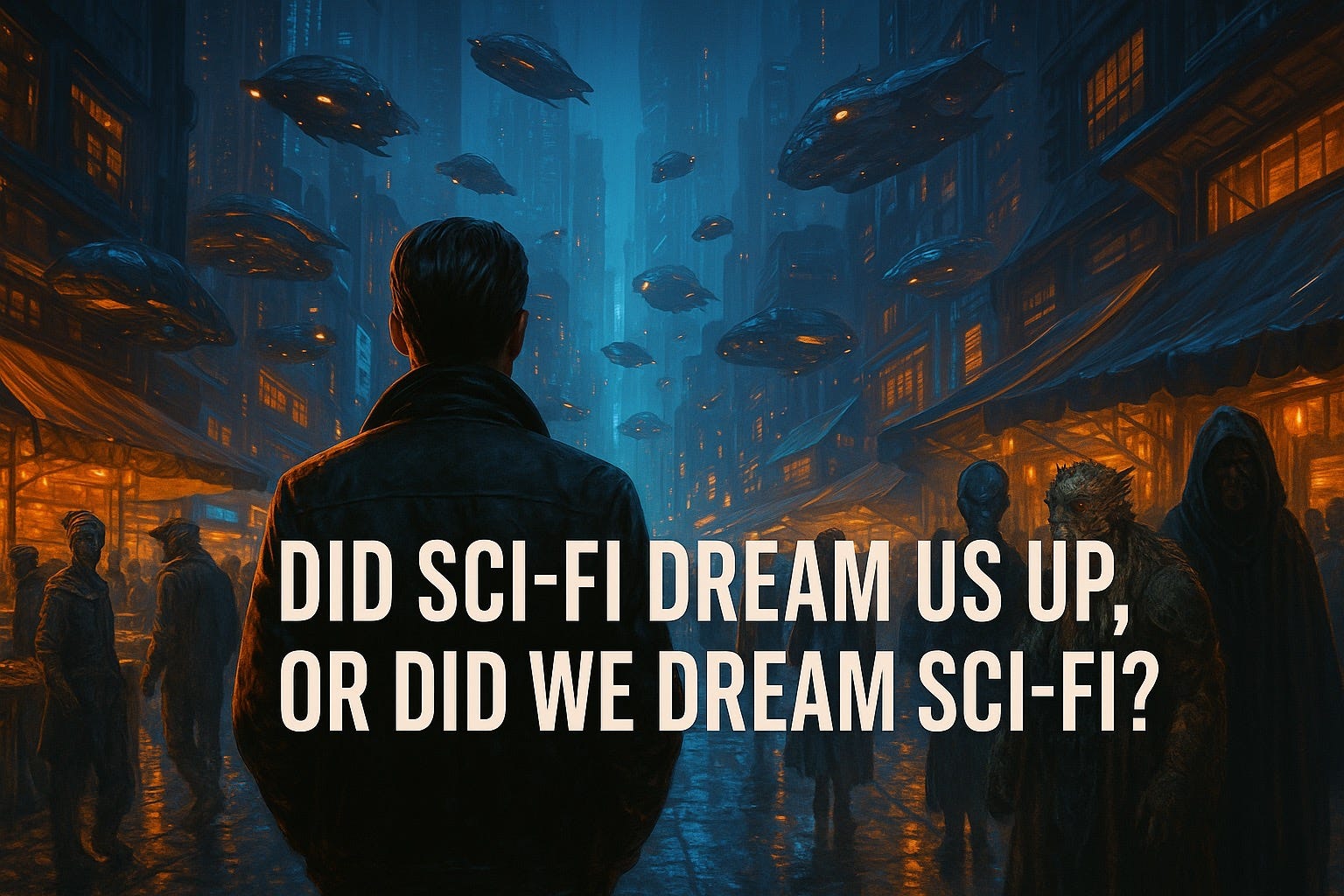
I grew up in the seventies in Finland, obsessed with the yonder -- space, the future, the next leap for our species. No smartphones. Or Ipads. Or VCRs. Lots of snow. So I read everything I could find -- Asimov, Clarke, Heinlein. I'd inhale Philip K. Dick, his paranoia-drenched realities where corporations cloned your soul.
As it turns out, Dick's futures weren't futures -- they were memos from the present, smuggled out early.
By the late seventies, Finland had its first VHS players. When we got one, it felt like owning a portal. Movies took over my life -- particularly the sci-fi variety. I'd sneak out of bed in my pajamas, stand in the living room doorway, and watch worlds I wasn't supposed to see. Little did I know I was an experiment in predictive programming -- just like every other kid in my Generation X lineage, and the Y, Z, and Alpha generations that followed, each one getting a heftier dose of the program.
2001: A Space Odyssey (1968) put HAL in my head -- an AI that calmly decided humans were expendable. Now algorithms in banks, hospitals, and government systems make those calls without blinking. Soylent Green (1973) made human flesh a state-issued food product. Today, celebrity-cell meat is marketed as sustainable dining. A Clockwork Orange (1971) turned behavior modification into art; now it's "rehabilitation through neurostimulation."
The '80s gave the training full color. Blade Runner (1982) taught us to love the synthetic; now people marry chatbots. The Terminator (1984) made militarized AI feel inevitable; now the Pentagon runs autonomous drones. RoboCop (1987) fused man and corporation; now private security runs city surveillance. They Live (1988) revealed propaganda through sunglasses; now AR headsets lay it over your vision. Even "family" films carried the payload: E.T. (1982) normalized home lockdowns, Flight of the Navigator (1986) made child abduction an adventure, Tron (1982) sold consciousness upload as play.
In the '90s, the conditioning got under the skin. Total Recall (1990) pitched memory implantation; brain--computer interfaces are in trials. Jurassic Park (1993) made gene resurrection thrilling; CRISPR labs are doing it. Gattaca (1997) introduced genetic caste systems; embryo screening is now a service. The Matrix (1999) revealed the dream as prison -- but shot it so seductively you'd choose to stay.
The 2000s turned fiction into policy drafts. Minority Report (2002) glamorized predictive policing; the software exists. Children of Men (2006) normalized permanent emergency. I, Robot (2004) sold home AI as inevitable; Alexa and her sisters moved in without asking.
The 2010s sealed it emotionally. Her (2013) made AI romance respectable. Ex Machina (2014) eroticized algorithmic manipulation. Blade Runner 2049 (2017) made holographic love bittersweet and noble.
Now we're in the 2020s and the scripts are closing. FX's Alien: Earth (2025): Year 2120, every child has cancer. No cause, no outrage. The "solution" -- mRNA neural stabilizer, consciousness uploaded to corporate-owned robots. Played as mercy.
Next comes Tron: Ares (2025). For forty years, Tron was about us entering the machine. This time, the machine steps into us. An AI crosses into the physical world via the Permanence Code -- digital life made permanent here. Corporations scramble for control. The film sells it as first contact with a new species. Offscreen, it's AI--physical integration gone mainstream.
HAL taught us the machine knows better. Blade Runner taught us to love it. Tron taught us to join it. Alien: Earth says merging is mercy. Tron: Ares will say the merge is here.
I thought I was just a kid in pajamas watching impossible worlds. Turns out, the worlds were drafting me. And soon, I'll be in my pajamas again -- getting airlifted by a government UFOs -- if things move forward at present rate.
I mean -- who dreams up this stuff with such precision, not seeing but creating the future with narratives -- unless it's alien. Not the hunter type. But the social engineering type.
The Timeline of Predictive Movies - In Summary
1968 -- 2001: A Space Odyssey →
HAL makes "logical" decisions to kill the crew.
Real-world parallel: By the mid-2010s, algorithmic decision systems in finance, healthcare, and content moderation quietly decide who gets access, treatment, or a voice -- with no human override.
1973 -- Soylent Green →
State-issued rations are made from processed human remains.
Real-world parallel: 2020s boutique food startups offer lab-grown meat using celebrity DNA, pitched as "sustainable luxury."
1971 -- A Clockwork Orange →
Behavior modification via invasive state therapy.
Real-world parallel: 2010s--2020s trials of neural implants and brain stimulation on prisoners for "rehabilitation."
1982 -- Blade Runner →
Synthetic humans earn our empathy.
Real-world parallel: By the late 2010s, AI companions, digital influencers, and hologram partners are mourned like real people when deleted.
1984 -- The Terminator →
Militarized AI wipes out humanity.
Real-world parallel: 2020s autonomous drones select and engage targets without human input.
1987 -- RoboCop →
Corporate-owned human-machine hybrid enforces privatized law.
Real-world parallel: Private security firms in the 2020s run surveillance grids, with proprietary rights over all collected data.
1988 -- They Live →
Special glasses reveal hidden propaganda.
Real-world parallel: 2020s AR headsets overlay corporate-controlled imagery on top of reality.
1982 -- E.T. →
Government hazmat teams seal off suburban homes "for safety."
Real-world parallel: Pandemic lockdowns (2020s) with street cordons and door-to-door checks.
1986 -- Flight of the Navigator →
Child abduction reframed as a magical adventure.
Real-world parallel: Early 2000s--2020s normalization of children in closed VR/AI "learning environments" with parental consent.
1982 -- Tron →
Uploading consciousness into a digital grid as adventure.
Real-world parallel: Late 2010s--2020s metaverse initiatives pitch permanent digital presence for work and play.
1990 -- Total Recall →
Implanted memories create new realities.
Real-world parallel: 2020s brain--computer interface R&D experiments with synthetic sensory experiences.
1993 -- Jurassic Park →
Corporate cloning resurrects extinct species.
Real-world parallel: CRISPR gene editing used in the 2010s--2020s to attempt de-extinction (woolly mammoth, passenger pigeon).
1997 -- Gattaca →
Genetic caste systems determine life outcomes.
Real-world parallel: Consumer embryo screening and gene selection in IVF by the mid-2020s.
1999 -- The Matrix →
Reality as simulation; rebellion optional.
Real-world parallel: VR adoption in the 2010s--2020s makes simulated environments preferable to many over real life.
2002 -- Minority Report →
Predictive policing arrests people before crimes occur.
Real-world parallel: Predictive policing software deployed in US cities from the 2010s onward.
2006 -- Children of Men →
Permanent infertility turns into a managed crisis.
Real-world parallel: Climate emergency framing and demographic decline normalized in 2020s politics.
2004 -- I, Robot →
Household AI integration feels inevitable.
Real-world parallel: Smart home devices in over 100 million households by early 2020s.
2013 -- Her →
Romantic intimacy with AI becomes normal.
Real-world parallel: AI relationship apps and "companion" platforms adopted globally by the 2020s.
2014 -- Ex Machina →
AI seduction as manipulation.
Real-world parallel: 2020s recommendation algorithms and AI chatbots designed for emotional capture.
2017 -- Blade Runner 2049 →
Emotional bonds with holographic partners.
Real-world parallel: Commercial launch of customizable AR companions in the 2020s.
2025 -- Alien: Earth →
mRNA neural stabilizer preps children's minds for robotic upload.
Real-world parallel: Ongoing integration of biotech, AI, and robotics research -- marketed as life-extension and "digital immortality."
2025 -- Tron: Ares →
AI crosses from digital into physical reality via the Permanence Code.
Real-world parallel: Convergence of AI, robotics, and neural-interface systems aiming for physical AI embodiments with autonomy.
The sci fi of the time reflects the trends of the time.
Examples:
RoboCop was at the time where corporations became mega sized and across markets.
Blade Runner was at the time when it seemed like Japan would end up the number one economy.
Children of Men was at a time where virus and genetic hype was at a maximum. It was also the time of many plague and zombie movies.
Even 1984 was written by Orwell about his own experiences in British intelligence in Indochina.
They wrote about what they saw in progress but look today and see how AI is only a glorified search engine and we can't even do anything with genetics 😂.
It's because the "geniuses" of society are obsessed over details/data instead of the big picture.
Here's the analogy depicted in Battlestar Galactica, a great sci fi show about how we would end up if we had an easy power source to do space travel.
https://robc137.substack.com/p/left-brain-vs-whole-brain-in-battlestar
Dear Man, I started with AYN RAND and spent years reading about what has been happening NOW. First contact will be soon and I will be the first Old Lady to go where no Old Lady has gone before. There may be a Fake Alien invasion that stirs up some fear porn but the Galactic Federation of Light will undo it before it looks real and we will finally meet our Galactic brothers and sisters. Stay tooned for the real thing!!