


A WORD FROM THE LEGAL DEPARTMENT (READ IT)
I am not a doctor, and the evidence below suggests I would make a menace of one. This is a field report from one body, mine, and an audience of one is an anecdote with delusions of grandeur, not a clinical trial. Nothing here is medical advice. Emergency medicine is a miracle. Heart attack, stroke, break, bleed, baby, or an infection that wants you dead by Thursday: run toward the people in scrubs. Never stop or cut a prescription on your own. Blood-pressure medication, antidepressants, steroids, insulin, seizure medication and blood thinners can hurt you worse coming off wrong than they ever did going on, so you taper only with the doctor who prescribed it, or not at all. Do not fast if you are diabetic, pregnant, underweight, under eighteen, on medication, or carry any history of disordered eating. Do not stare at the sun. Keep your doctor. This is a story, not a protocol. Proceed like an adult.
Before You Begin: This Is a Mirror
Most health writing hands you a verdict and a product. This does neither. What follows is a manual for a discipline almost nobody practises anymore, the honest self-audit. You measure your own life against the things that raise or drain your energy, you change one of them, and you watch what the change does. Every road is individual, and we stopped paying attention to what charges us and what flattens us, so that once you start paying attention again you can begin taking the wheel back from the pills, the protocols and the subscriptions that were only ever going to manage you.
The body keeps perfect books whether or not you read them, and the modern world is built to keep you from reading them, to mistake the cortisol high for energy, the prescription for a cure, the busy for the well. This piece runs on one Greek word, Ɛ (Energeia), which names life-force as a calm, steady current instead of a wired one. Naming it is what lets you put a number on it, and a number is what lets you tell whether last month’s change did anything at all. Self-evaluation is that habit, done on purpose, on a schedule, for the rest of your life.
The piece is built in two halves so you can use it that way. First the story and the reasoning, one man’s crash and the twenty levers that pulled him back. Then a Field Manual with the protocols laid out for reference, plus the red flags worth taping to your fridge. Read it straight through the first time and come back to the manual after.
Want to grade yourself first?
Before you read a word of the story, you can take your own reading. The Human Energeia Field assessment at energeia.now asks you about every lever in this manual, across body, field, mindset and spirit, and helps you work out which of them is leaking and which one is worth changing first. It takes a few minutes, costs nothing, and stores nothing. Take it now and read the rest with your own answers in hand, or read first and test after.
I. The Crash
Forty-something, bulletproof, double-espresso, the low-grade dread I had trained myself to read as ambition. Then my immune system stopped returning calls. There was no ambulance and no white light, only a slow, humiliating subtraction until I was sleeping nine hours and waking up pre-exhausted. The doctors drew blood, frowned, said the numbers were within range, offered an antidepressant (the opinion a hammer holds about every problem), and suggested I was getting older, in the tone of a man closing a folder. I had cleared every disease with a billing code, so I fell straight through the floor of their attention into the basement marked unexplained. Officially fine. I have never felt less fine in my life. The distance between those two sentences is the whole story.
It took me two decades of trial and error to get back to being a person who does not need to see doctors. Not a superman, but at least a wellmann. What follows are my plainest conclusions, so plain they can sound annoying, which in my experience is what useful advice sounds like. Your road will not be mine. What carries over is the habit. Watch yourself, measure yourself, change one thing, measure again, and keep going until the good days stop being accidents.
II. Energy Is the Wrong Word. The Greeks Had a Better One.
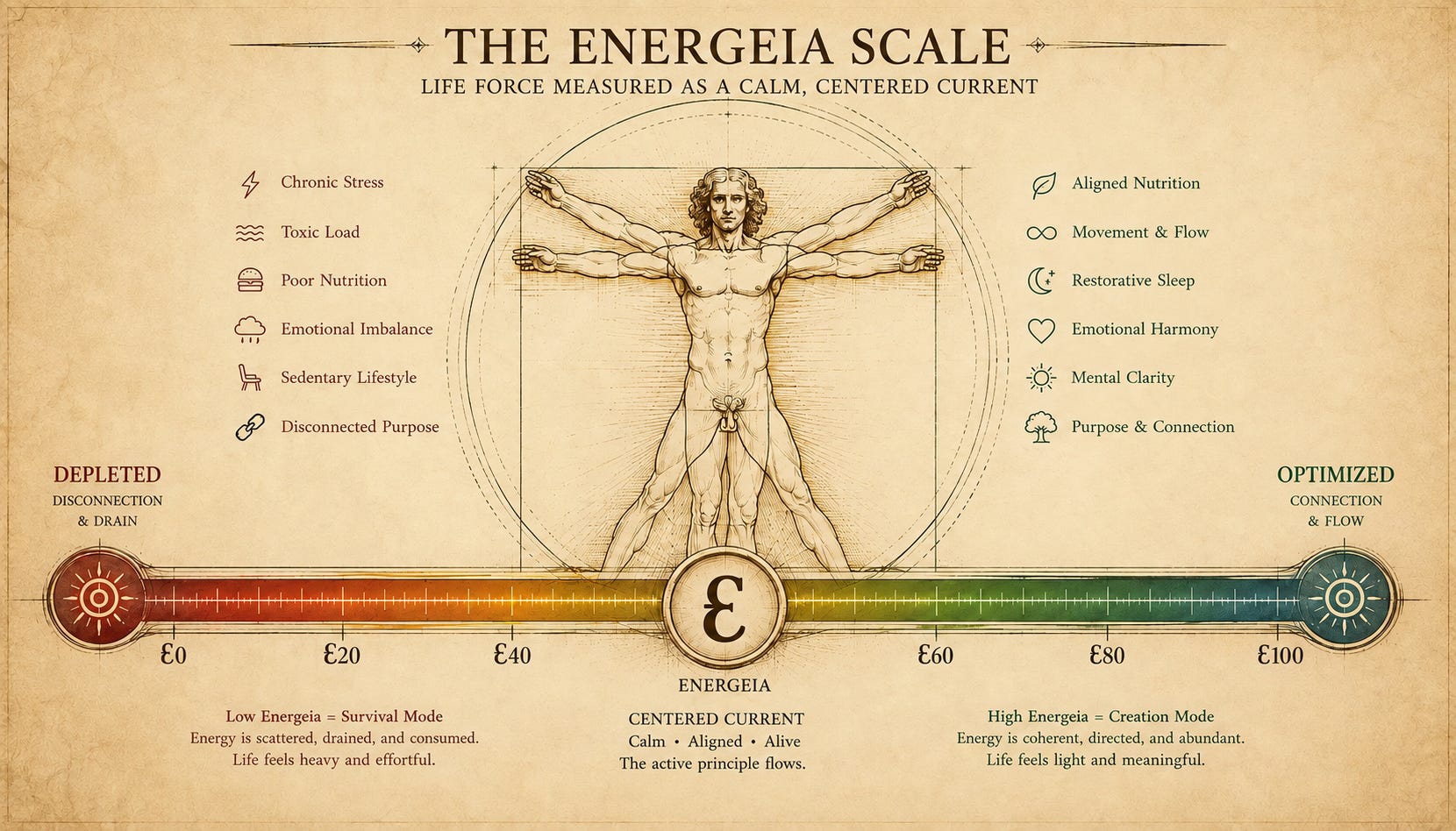
We talk about energy as though it were one thing, and we measure it by how wired we feel, which is exactly backwards. The Greeks had the better word. Energeia meant power, vigour, the active principle, the force that turns potential into motion. The Hindus called the same current prana, the Chinese chi, the Japanese ki, and an electrician would call it voltage. Different names for the charge a living system runs on. I write it as Ɛ, because once a thing has a name you can begin to measure it, and once you can measure it you can stop lying to yourself about how much of it you have.
The trap the whole culture falls into is mistaking the cortisol high for Ɛ. That wired, three-espresso, inbox-conquering buzz you have been calling energy is its opposite. It is adrenaline and stress hormones, the body borrowing tomorrow’s fuel at loan-shark interest, and the bill always comes due, usually around four in the afternoon or age forty-five. Real Ɛ is quiet. Focus without force, alertness without jitter, a steady amperage that neither spikes nor crashes, the current of somebody who sleeps without negotiating for it and wakes without bargaining. Power, the real kind, looks more like serenity than mania. Energy that feels like a held breath is borrowed, and the lender always collects.
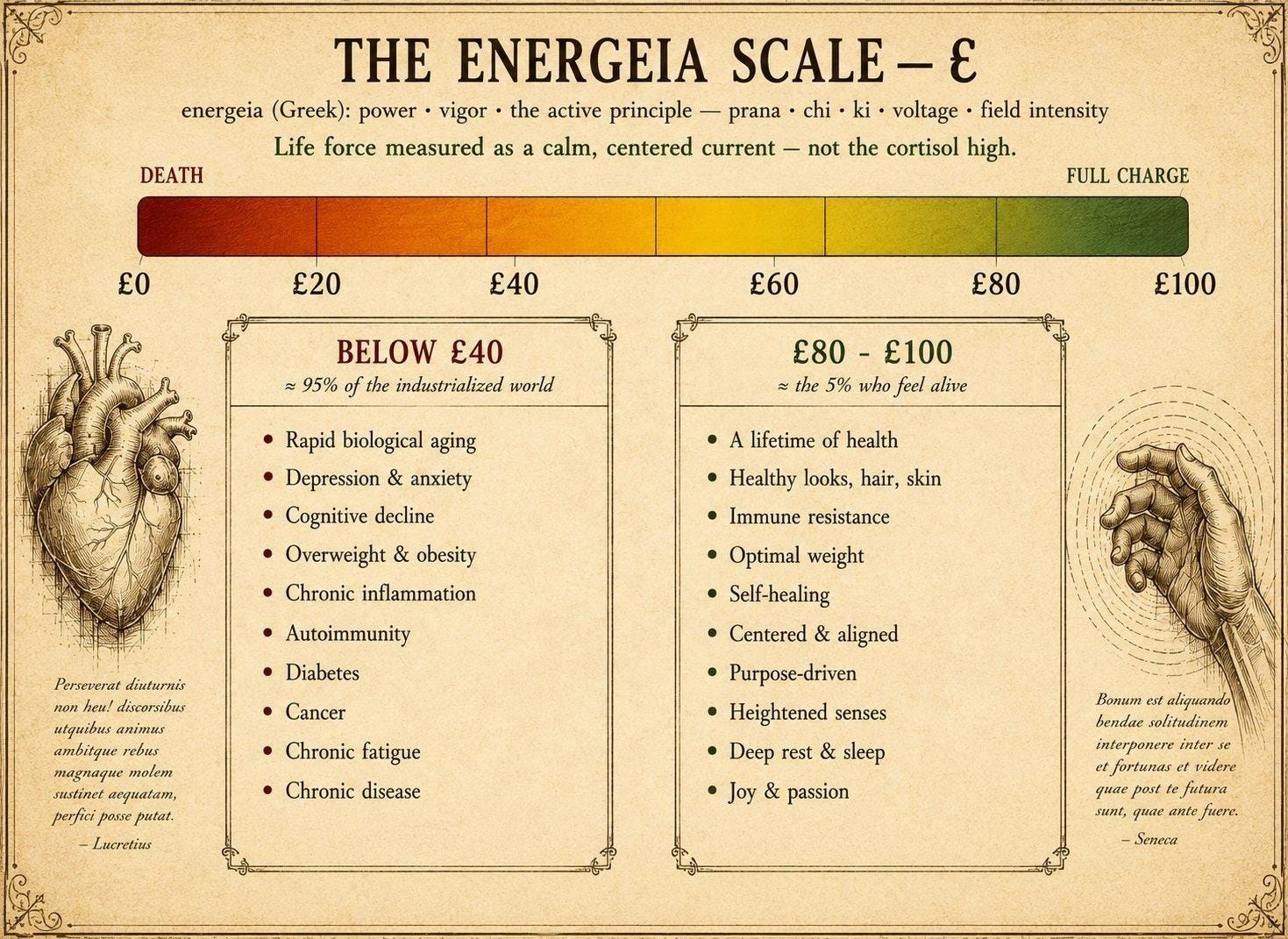
The Ɛ scale: from flat-line to full charge, and what each end feels like.
Picture a charge running from Ɛ0 to Ɛ100. Ɛ0 is death. Most of the industrialised world idles somewhere below Ɛ40, running on sugar and stress hormones, sliding through inflammation and fatigue toward the cluster of problems we have agreed to call chronic, and calling that baseline normal because everyone in the room reads the same low number. The far end, Ɛ80 to Ɛ100, belongs to a small minority. Steady immunity, easy weight, quick recovery, deep sleep, and a joy nobody is performing. Everything that follows is about walking the dial out of the red and into the green, and the first surprise is how little of it costs money.
III. The Gauge
I got lucky, and I will say so. Through a side door I will spare you, I had early access to a piece of over-engineered Swiss-German kit and to metabolomic panels I could not otherwise have afforded. Neither of them diagnosed anything, and neither was necessary. What they gave me was a set of readings I could take again a month later and lay beside the first set. Laying two readings side by side is the only honest way to find out whether a change did anything, instead of deciding by how you happened to feel on the morning you asked.
IV. The Field, and the Tuesday the Bill Comes Due
Once I could measure, the map drew itself, and it was bigger than diet. Four domains feed and drain your Ɛ at the same time. Body is what you eat, drink and breathe. Field is light, sun, EMF and the planet’s own charge. Mindset is stress, emotion and attitude. Spirit is meaning, creativity and alignment. Every one of them runs a current into the battery or a leak out of it, and the modern world has quietly tilted all four toward leak.
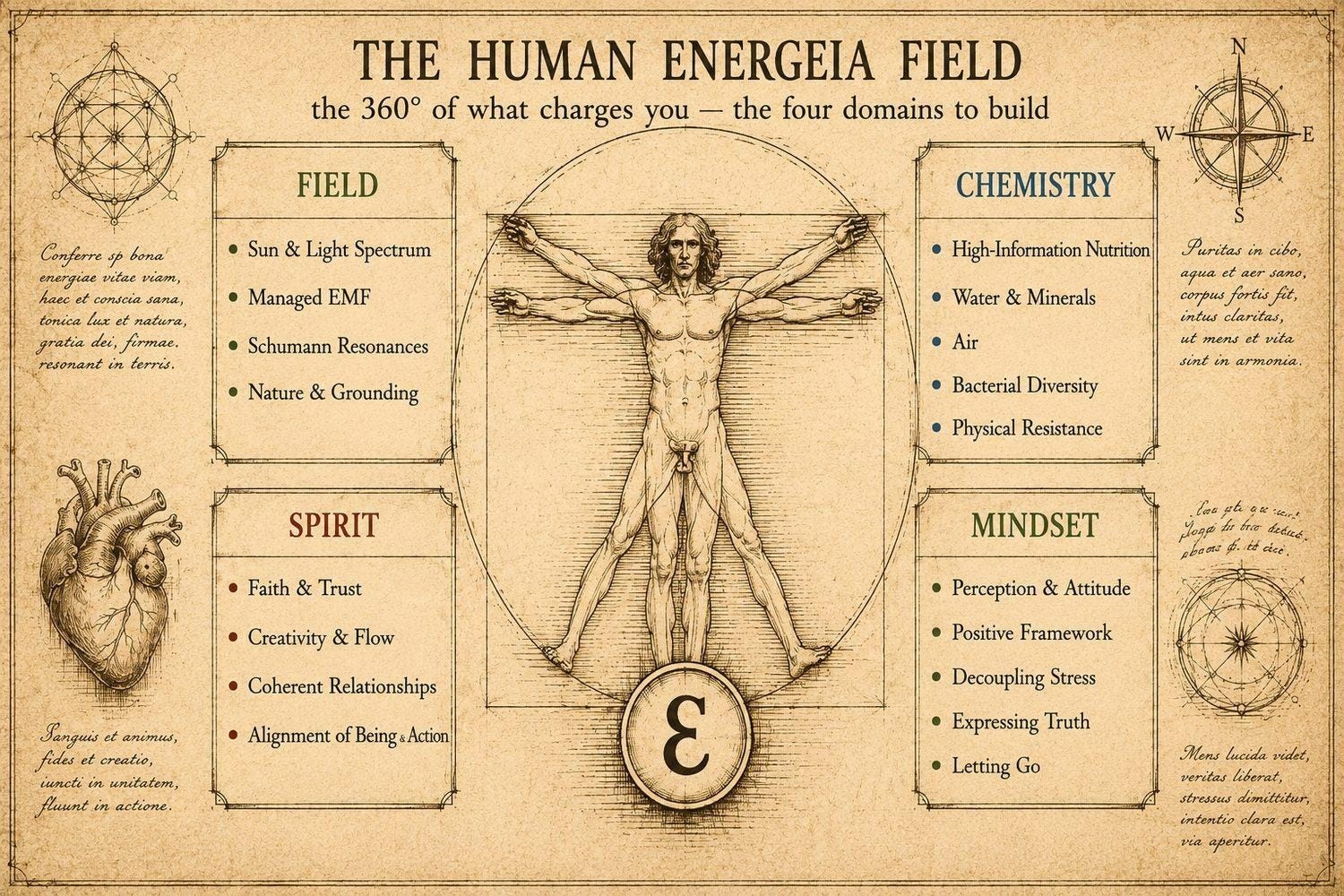
The four domains that charge you. Build all four. Diet is one quadrant of four.
None of it is dramatic, which is the con. One seed-oil dinner will not kill you, one phone on the pillow will not, one Sunday marinating in someone else’s anxiety will not. All harmless, the culture swears, because the culture only knows how to fear the dramatic. But the body keeps books the conscious mind cannot read, and the books compound. The collapse, when it comes, arrives the way a small business fails, fifteen years at a loss and then one ordinary Tuesday when it cannot make payroll. That Tuesday feels like ageing. That Tuesday is arithmetic, and arithmetic runs both directions. Close enough of the leaks and the charge climbs back. The rest of this is how I closed them, domain by domain.
FIELD — the energy around you
Sun and light spectrum. The sun is the master signal, not a carcinogen to be slathered against. Sunrise in unshielded eyes, then tolerance built like a barbell, with the full sun protocol below. Managed EMF. You cannot escape the signal soup, but you can build one low-EMF repair bay where you sleep, and the EMF protocol is below. Schumann resonances. The planet hums at its own low frequency and your biology evolved inside that hum, so the further you get from concrete and into open country, the more the static settles. Nature and grounding. The simplest lever of all and the most ignored, bare skin on actual earth, covered in its own section.
BODY — what you take in
High-information nutrition. Food that carries real signal instead of noise, which in practice means dense protein from clean, free-grazing, hormone-free sources and high-grade saturated fats your cells recognise as fuel. Water and minerals. Quality water carrying quality mineral salt, because hydration is salt rather than volume. Air. The input nobody audits. You breathe more of your environment in a day than you eat or drink, so clean air indoors counts as much as clean food. Bacterial diversity. Live and fermented foods plus real contact with soil and nature, and an end to the over-sterilised bubble that starves your microbiome. Physical resistance. Movement that meets a resistance point, walking uphill, lifting, core, play, stretching, always pushing a little past the edge, because a body never challenged quietly powers down.
SPIRIT — what you live for
Faith and trust. Pick a coherent belief system and abide by it, oriented toward a benevolent universe and a purpose worth the trouble, with the rational bet on syntropy covered later. Creativity and flow. Invest hours in the things that pay no salary and impress no one, because flow is where your mitochondria run cleanest. Coherent relationships. The people and groups you stand in are a field that shapes your own, covered next, so choose the ones that raise your charge. Alignment of being and action. Choose the work and the activity that put you in your highest-energy state, and the money, the sleep and the so-called discipline mostly solve themselves downstream.
MINDSET — how you meet it all
Perception and attitude. The same event can charge you or consume you depending on how you meet it, and that meeting is trainable. Positive framework. Blind positivism is useless. What works is the earned conviction that even the worst adversity carries a usable outcome, a lesson, a redirection, a door. Decoupling stress. You cannot delete the stressor, but you can choose not to let it land, using the heart-centred breathing below to cut the wire between signal and body. Expressing truth. Speaking your actual truth instead of swallowing it to fit in, because suppression is a slow, silent leak. Letting go. Releasing the negativity, disappointment and vengeance you have been hauling, with the Hawkins technique covered later.
Those four domains are the map. The sections that follow work through the levers one at a time, starting where the body starts, with what you put in your mouth.
V. Most Drugs Treat the Smoke Alarm by Removing the Battery
Modern medicine is the finest fire brigade ever built. Break in half, bleed out, go septic, and there has never been a better century or country to do it in. But chronic decline behaves like a flood in a basement nobody inspects, and a fire brigade has no boat, so it does the one thing it knows how to do and silences the alarm. Heartburn gets a pill that switches off the acid your stomach makes on purpose. Blood pressure creeping up gets a pill that forces the number down without once asking why it climbed. A flat mood gets a pill that fogs the part of you screaming for a reason. Every one of them a manager, never a mechanic, paid to keep the symptom quiet and never to find the leak.
A great many prescriptions written for chronic, lifestyle-driven conditions can be lowered once the lifestyle changes, and getting that wrong is how people end up in an ambulance. Do not freelance it in your kitchen on the strength of a Substack. You fix the inputs first, for months, while the doctor watches. Then you walk back in with your new numbers and ask them to lower the dose. The order is not negotiable. Lifestyle first, labs second, the prescriber holds the pen. Anyone who tells you to flush your pills today is selling you a funeral with good production values.
VI. You Do Not Quit Sugar. You Outflank It.
Every reformed sinner claims they beat sugar with willpower, and every one of them is either lying or about to relapse, because willpower is a muscle and sugar is a chemical that specialises in defeating muscles. I white-knuckled it first and lasted a long weekend, at the end of which I ate something from a cabinet I am not legally required to name. Cold turkey on carbs while your body still runs on sugar is a hostage situation in which you are both the hostage and the idiot with the gun, and calling it discipline does not change the ending.
The move that works goes sideways. You do not subtract the carbs, you add the fat first, and the sugar walks out on its own once the body has something better to burn. Flood the system with good fats, stable and slow-burning and hormonally calm, until the body quietly notices it is no longer desperate and the cravings lose their teeth. Eat them without apology. Avocado, extra-virgin olive oil, coconut oil, ghee and grass-fed butter, macadamias and almonds and walnuts, chia and flax and hemp, pastured egg yolks, fatty fish, MCT oil, tallow and duck fat. Within two weeks of leading with fat I forgot to be hungry. I did not suppress the hunger, I stopped noticing it, because the system was finally running on fuel that does not spike and crash you every ninety minutes like a toddler on frosting.
Then, and only then, you narrow the window. Fat-adapted and no longer panicking at the four-hour mark, you eat inside six hours and tighten toward four, which is not starvation but the overnight off-shift your repair systems were built around. Once you are adapted the carbs come back, real ones, fruit included, but in the first half of the day, riding your natural cortisol wave, never at night. Sweet potato at noon is fuel. Mango at ten in the evening is a small act of self-sabotage with excellent flavour. Eat the fruit, and eat it before evening.
VII. A Steak Is Not a Steak
A calorie is not a calorie and a cow is not a cow. The animal that spent its life knee-deep in feedlot misery, dosed with hormones and finished on corn it was never built to digest, is a different food than the one that walked on grass under open sky, and your cells can tell even when the label cannot. Animal protein is not the villain the seed-oil decade made it, but the densest repair material a body can get, and it carries the life it came from. From a sick source it ferries the sickness. From a healthy one, the health. Buy organic, free-grazing and hormone-free, and pay the difference without flinching, because the difference is the food.
The modern plate forgot the organs entirely. Your ancestors ate the liver first and threw the lean muscle to the dogs, because they were not idiots. Liver is the most nutrient-dense food on the planet, a multivitamin that mooed, stacked with the minerals and cofactors your ATP line is starving for. Heart is pure mitochondrial fuel, the one organ that never rests, handing you the exact machinery to build your own. Nose-to-tail is the oldest nutrition there is, and filing it under foodie affectation is a two-generation memory problem. Eat the organs. Your great-grandmother did. She never once set foot in a supplement aisle.
VIII. Hydration Is Salt, Not Volume: the White Powder in Your Cupboard
The wellness internet told you to drink a gallon a day, so a generation now walks around translucent, peeing out their minerals every forty minutes and calling it health. Water without minerals runs straight through you, taking minerals with it on the way out. You can drown your cells in distilled water and stay parched at the cellular level, because what drives water into a cell is salt. The fix is quality, not quantity. A glass of water with a real pinch of Celtic or sea salt first thing in the morning hydrates you better than a gallon of the naked stuff, because it carries the electrolytes that open the door. Never table salt, which has been stripped, bleached and dosed with anti-caking agents until it is a chemical wearing a mineral’s name.
The humblest miracle in your house is bicarbonate of soda. Baking soda. A box costs less than a coffee. It outperforms half your bathroom cabinet. A small dose in water in the evening helps buffer the acid load that modern food and modern stress pile on, because your body fights minute by minute to hold a narrow pH and most of us run acidic from sugar, seed oil and cortisol, which taxes the system every hour it is awake. Bicarbonate is a cheap, gentle hand on that scale. It does not stop at the glass either. It scours pans, scrubs sinks, deodorises, brushes teeth and washes laundry, retiring a cabinet of fragranced, hormone-scrambling branded chemicals in favour of one inert white powder that has been in human kitchens for centuries. Keep the dose modest, skip it if you are on a sodium-restricted diet or have kidney trouble, and otherwise let it quietly do the work of twelve products you have been overpaying to absorb.
While you are at it, look at what you smear on your skin, because whatever goes on it you eat through it, slower and no less completely. The drugstore lotion thick with parfum and preservative is a meal you did not know you ordered, served through your largest organ. Swap it for coconut oil. It moisturises better than the forty-dollar jar, it is one ingredient you can pronounce, and you can fry an egg in whatever is left.
IX. Supplements: Measure, Then Act, and Do Not Shotgun the Casino
The food supply is depleted now, with mineral-poor soil and fruit bred for sugar and shelf life, so even a clean diet can leave you short and a few targeted supplements earn their place. The supplement aisle is also a casino, and the people swallowing forty capsules on a podcast recommendation are flushing money and quietly stressing their livers. The move is the same as everything else here. Measure, find the holes that are actually yours, and fill those. Your five are not my five, and the only way to know yours is to test instead of guess, ideally with someone who reads the numbers for a living.
Five come up short most often in modern bodies and repay attention first. Magnesium, stripped from the soil and torched by stress. Vitamin D3 with K2, because we live indoors like veal. Marine omega-3, to undo years of seed-oil saturation in your cell membranes. Iodine and trace minerals, where real sea salt does much of the lifting. And the methylated B-vitamins that run the engine room of ATP. Call that a starting hypothesis rather than a prescription, checked against a measurement and a professional, never poured down the hatch by the handful because the internet was confident.
X. Fasting: Give the Body the Room to Repair
You were not built to graze from waking to sleep. Grazing is a modern accident of cheap calories and bright kitchens. Hand the body a window, eat inside six hours and tighten toward four once fat-adaptation has killed the cravings, and the overnight crew does its repair work uninterrupted instead of forever clearing the next snack. The nervous-system load on my instruments dropped every single night I stopped eating early. When the system is badly bogged down, dug into a hole it cannot climb out of, an occasional longer water fast switches on autophagy, the cellular recycling crew that eats your own junk for parts and clears the wreckage so repair can begin. I have used the three-day fast to reset after a crash, sparingly and on purpose, never as a stunt and never without the guardrails in the manual below.
XI. Sleep Is the Night Crew That Rebuilds the Engine
Everything else in this document is the day shift. Sleep is the crew that rebuilds the engine, and for most of my adult life I kept firing them and wondering why the car would not start. Quality beats hours. Always has. Nine ragged hours leave you more wrecked than six clean ones, and the whole protocol amounts to finding whatever sabotages the six and removing it, one item at a time, until the mornings stop being a negotiation. Sunrise in your eyes within an hour of waking to set the master clock. Last meal by six so you are not digesting when you should be repairing. Screens off and lights low before bed. Room cold, black and silent. Phone in another room, not the nightstand. Same schedule on weekends, because your biology cannot read a calendar and does not care that it is Saturday.
XII. The Sun Is Not Trying to Kill You. You Are Out of Practice.
We were sold one of the great inversions of the age, the idea that the star our entire biology evolved beneath is a carcinogen to be feared, slathered against and hidden from. Light came before food, before medicine, before us. It sets hormones, mood, the circadian clock and mitochondrial output, and a human who never sees it is a houseplant in a closet wondering why it feels grey. What changed my body was learning that you build tolerance to sun the way you build tolerance to a barbell, gradually and never to the point of injury. Skin is an organ that adapts to whatever you give it.
But first you clear the interference, the step nearly everyone skips. You cannot calibrate to light through a layer of static, and conventional sunscreen is a cocktail of endocrine-disrupting chemicals you rub into your largest organ and then bake. Get them off your skin before you change a thing. Then build in steps. Sunrise and early light into unshielded eyes, with no glass and no sunglasses. A couple of minutes of midday sun, retreat to shade, repeat. Add a few minutes every several days as melanin wakes and tolerance climbs. Manage overexposure with a hat, a shirt and shade. One law overrides all of it. Never burn. A burn is an injury, and injuries are not training. If you are pale, live under brutal high-altitude or tropical UV, or carry any history of skin cancer, the maths is different for you. Be far more conservative, and talk to a dermatologist who is not allergic to the word sunlight.
XIII. You Sleep Next to a Transmitter and Wonder Why Repair Never Finishes
You spend the night eighteen inches from a router screaming at full volume, a phone glowing on the pillow, earbuds parked in your skull, and then you wonder why the repair shift never quite finishes the job. We are electric beings running on a charge, and the fields we have filled our houses with push on that charge. Microwaves are the last thing you want around you while you are trying to regenerate. Kill the Wi-Fi at night. Keep the phone off your body, not in the pocket over your organs, not under the pillow. Ditch the Bluetooth earbuds you wear ten hours a day. Drop the phone into airplane mode while you sleep. Build one low-EMF room, the bedroom, and treat it like the repair bay it is.
XIV. Breathe Through Your Nose, You Animal
The most embarrassing thing that moved my numbers was discovering I had been breathing wrong for forty years. James Nestor spends a whole book on it, called Breath, and it is worth an evening. He documents how the modern human mouth-breathes its way into worse sleep, worse focus, worse jaws and a chronically half-panicked nervous system, and how much of it reverses the moment you close your mouth and route the air through the organ evolution built for it. The nose filters and humidifies, paces the breath slower, and generates nitric oxide, which opens your vessels so oxygen reaches the tissue instead of rattling around your chest. I taped my mouth shut at night, felt ridiculous, and woke up the next morning like someone had swapped my battery. I now breathe slow, low and nasal by default, awake and asleep, for the price of admitting I had been doing the most basic function of life wrong since birth.
XV. You Cannot Fire Your Family. You Can Mute the Signal.
The trap that nearly took me was waiting to fix my stress by fixing its sources. Win the argument, clear the inbox, resolve the crisis, then relax. The sources never run out. The work crisis is replaced by the next one, the family produces conflict the way a heart produces beats, and the inbox is a hydra. If your peace is contingent on the world running out of stressors, you signed a contract that can never be fulfilled.
The technique that breaks the loop is almost insultingly simple, which is why it works. You breathe slow, five seconds in and five out, and while you do it you drag your attention out of your spinning head and down into the area around your heart, as if you were breathing through your chest. Then you deliberately generate one renewing feeling, gratitude, appreciation, calm, the memory of a dog who has never once read your email, and you hold it for a few minutes. It raises heart-rate variability, drops cortisol, and swings the nervous system out of fight-or-flight into repair. The stressor is still there. Your boss is still your boss. But the line between the stressor and your body has gone slack, and practised daily it stops being a technique you reach for and becomes the default, so the email that used to spike you for an hour now lands, registers, and passes through like weather. The storm does not get conquered. You stop being made of paper.
XVI. Letting Go Is Metabolic Hygiene
The breathing handles the moment. But some weights are not moments. The decade-old resentment, the person who wronged you, the grudge you have marinated so long it became a flavour of your personality. For that load the most useful instrument I found was David Hawkins’ book Letting Go, and the mechanism is so plain it embarrasses the elaborate suffering we build around it. A feeling persists not despite your attention but because of your resistance to it, and the effort you spend justifying, suppressing or winning the argument is the rope keeping it tied to you. Letting go is the strange, counterintuitive act of allowing the feeling to be fully present without feeding it the story and without shoving it away, until it runs out of fuel and lifts on its own, the way a wave you stop fighting eventually sets you down.
I did not believe it, because it sounded like a fortune cookie in a lab coat, the sort of line you nod at in a waiting room and forget by the car park. Then I tried it on an ancient grudge I had been hauling around like furniture I had forgotten was not bolted down, let the hot ugly thing sit in my chest without commentary, and it dissolved in about the time it takes to read this page twice. It came back. I let it go again, smaller. Then smaller still. It works because the body keeps the score on every resentment you refuse to set down, and the stress you carry from people and events you cannot change taxes your mitochondria as surely as the seed oil and the sleepless night. Letting go is engine maintenance, not spiritual decoration.
XVII. You Are the Five People You Marinate In
I mean that physiologically, not as a motivational poster. Sit in a room with someone whose nervous system is on fire and yours starts to smoke. Their anxiety is contagious and so are their habits, and the slow stuff seeps across the gap like damp through a wall. The drinking, the doom-scrolling, the catastrophising, even the chronic conditions that ride along on shared behaviour. The friend group whose only ritual is getting hammered every Friday. The colleague who is a human cortisol dispenser. The group chat that is a slot machine for outrage. You audit your food. Audit your people the same way, because the field they put out is an input as real as anything you swallow. Turn it over and the same rule pays. Social time counts as a charge only when it is with people who raise your voltage, the ones you leave feeling bigger than you arrived. Obligatory small talk, the networking grind, the catch-up you dread for a week beforehand, all of them leaks wearing connection’s clothes, and cutting them frees more Ɛ than most diets. You do not have to fire everyone, but you get to choose what you stand next to, and standing next to the wrong field for twenty years is its own slow crash.
The input nobody counts is creative time. Building, playing, painting, writing, fixing an engine. Anything that drops you through the floor of the clock pays a dividend your spreadsheet cannot see. Flow is a physiological state, not a luxury. It lowers cortisol, it puts dopamine and endorphins where they do some good, and your mitochondria run cleaner inside it than in any grinding productive hour of dread. The thing you do for no reason, that earns nothing and impresses no one, may be doing more for your cells than your gym membership. Protect those hours the way you would protect a prescription.
XVIII. The Planet Has a Pulse. Stand On It Barefoot.
The Earth hums at a low frequency, the Schumann resonance, around 7.83 cycles a second. Your biology evolved bathed in that note, before we sealed ourselves in concrete and steel and started vibrating to the router instead. I will not oversell the physics, because the romantics in this space always do. But put your bare feet on actual ground, grass or soil or sand or stone, and the Earth’s charge bleeds the static off an over-revved nervous system. Ten or twenty minutes a day, skin on earth, costing nothing. The simplest lever in this piece, and the one people skip first.
The version that reset me stacks all of it at once. A walk, barefoot where I can manage it, slow nasal breathing, attention dropped out of the skull and into the body, and a deliberate letting-go of whatever I carried in as I move. Meditation that does not make you sit still. The breath steadies, the ground takes the charge, the grievance loosens its grip somewhere around the second mile, and I come back not fixed exactly but reset, the way a body resets when you finally hand it the conditions it was built for.
XIX. The Thing You Would Live For, and the Trust That Lets You Stop Forcing It
The input no lab measures and no supplement touches may be the biggest one on the board. A reason to be well. Call it purpose, call it the chase of something you believe in, the work you would do unpaid, the art nobody asked for, the people you would take a bullet for. The materialists wave it off as soft and the wellness crowd files it under spirituality, and both are wrong, because it is the most physical thing there is. A body kept alive with no reason to climb rarely climbs. Ask any nurse.
You have seen the pattern even if you never named it. The man who works forty years for the gold watch and drops dead six months into a retirement that left him nothing to get up for. The grandmother who refuses to die before the wedding and then, the week after, quietly does. The friend whose stubborn symptoms started lifting the month he finally walked away from the job that was strangling him, not because the job was toxic in the chemical sense, though it may have been, but because misalignment is its own slow poison, a daily low-grade signal to the body that this life is not worth defending. Purpose is voltage, not garnish on the plate of health.
This closes the loop back to Energeia. The old definition called it the force that aligns purpose, action and drive into one current, and that alignment is where the calm, high-amperage Ɛ comes from, the kind that needs no caffeine and never crashes. When what you believe, what you do and who you are all point the same direction, the body stops fighting itself and the charge climbs on its own. Do the work you love. Chase the thing you believe in even if it pays nothing and impresses no one. Your mitochondria are listening, and they can tell the difference between a life you are enduring and one you are living.
There is a deeper layer beneath purpose, and I resisted it for years because it sounded like church. Call it faith, though not the Sunday kind, and not its mirror image either, the scientism that holds nothing to be real until a current instrument can weigh it. Real faith is more rigorous than that. Faith of that kind is a rational bet placed on evidence, and the evidence is sitting inside your own recovering body.
The bet runs like this. Entropy is real, everything winds down and falls apart and returns to dust, and the physics teachers were right about all of it. But it is half the ledger. Look at what life does. Order assembling itself out of soup, a cut sealing without instruction, a forest swallowing a parking lot, a wrecked metabolism climbing back toward repair the moment you stop poisoning it. Somebody named that upward pull syntropy, and the universe runs both engines at once. Once you have watched your own charge climb out of the red, pretending the syntropic current is not there becomes the less scientific position.
Trusting that current is neither soft nor passive. A nervous system braced against an enemy universe grips and forces and white-knuckles its way toward safety and success and the checklist somebody else handed you. A nervous system at ease in a universe that is at least partly on its side does none of that. The braced state is pure cortisol, and strain burns the charge it is chasing. I was a champion strainer. I gripped harder. The battery drained faster. What finally worked was the opposite of effort. Get the charge up, stop forcing, and let a rested body make the decisions, because a rested body makes better ones than an anxious body chasing whatever goal was nearest.
Which is the whole of carpe diem, a phrase we have sanded down into a fridge magnet. Seizing the day was never about cramming it with conquest. You make the most of a day by being charged and present enough to meet it, awake in it, rather than grinding through it half-dead toward some someday that keeps backing away as you approach. The day is the unit. You do not win it, you inhabit it. A body running near Ɛ100 inhabits its days in a way the rest of us, white-knuckling toward a finish line that recedes, never quite manage.
XX. All of It, Together, or None of It at All
Two decades on, the instruments read like a different man, and the part I need you to hear is that no single item did it.
There is no hero input.
Fat-first did not save me, and neither did the sun, the salt, the sleep, the organs, the people I stopped standing next to, or the purpose I stopped pretending I did not need. They moved the dial together, the same way they had let it fall together, which is the secret nobody can bottle. All of it, slowly, for years. The collapse was a dozen small leaks at once. The climb was closing them one at a time until the red went green.
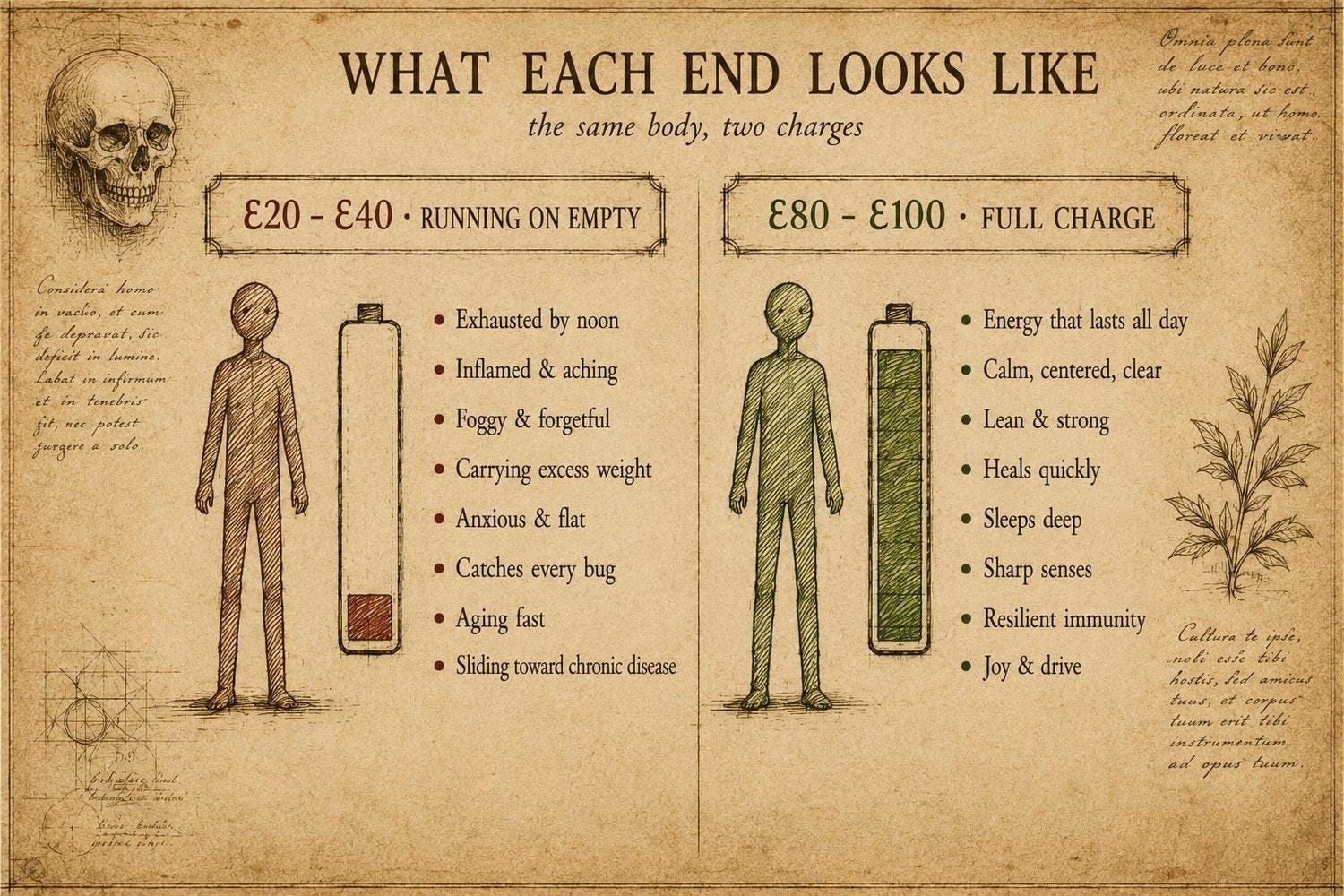
Same body, two charges. The whole project is walking from the left figure to the right.
And when the charge finally came back, it did not arrive as a buzz. It arrived as quiet — the steady, unhurried Ɛ of a body no longer at war with itself, awake before the alarm and glad about it. Keep your doctor. Run toward the ER. But the slow brown-out they file under ageing and you file under dread was always going to be an inside job, run by the only person holding the keys. Nobody is coming, and that is the whole liberation.
What Moves Your Charge
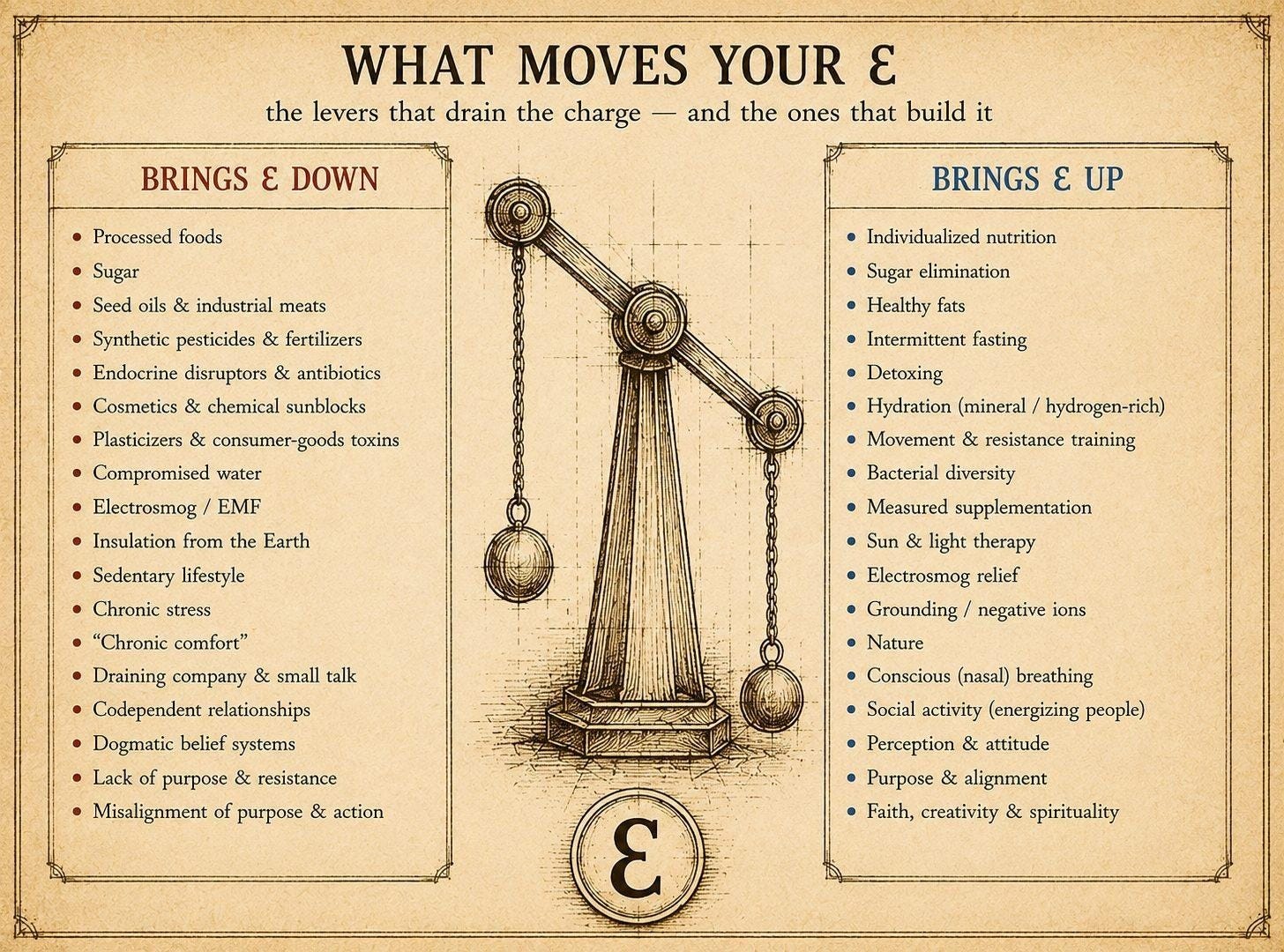
Every lever, sorted. What drains the charge, and what builds it.
Tape the red ones to the fridge. You cannot avoid everything, and the people who try develop a second disease called being insufferable. But these are the lopsided ones, small effort and large return, the bright lines worth holding.
RED FLAGS — FOOD
Seed and vegetable oils. Canola, soybean, corn, safflower, sunflower. They oxidise and embed in your cell membranes, and they are in nearly everything wrapped.
Anything ultra-processed. If your great-grandmother would not recognise it as food, your mitochondria do not either.
Liquid sugar. Soda, fruit juice, the smoothie that is a milkshake in athleisure.
Default carbs. Bread, pasta, cereal, pastries, crackers, three times a day on autopilot.
Factory animal protein. Feedlot, hormone-dosed, corn-finished. It carries the life it came from.
Table salt. Stripped, bleached, anti-caking agents. Use real mineral salt.
Sugar-free anything that swapped sugar for a paragraph of chemicals, and sweetened yogurt and granola bars cosplaying as health food.
RED FLAGS — CHEMICALS AND HOME
Plastic touching your food, especially heated. Microwaving in plastic feeds your endocrine system instructions it cannot read.
Fragrance. Parfum is a legal black box hiding dozens of hormone disruptors, in detergent, candles, air fresheners and most personal care.
Conventional sunscreen and skin products loaded with endocrine disruptors, absorbed straight through the skin.
Drugstore lotions and creams. Swap for coconut oil, one ingredient you can pronounce.
A cabinet of branded cleaners, most of what bicarbonate, vinegar and salt already do for pennies.
Nonstick pans past their prime, shedding coating into your eggs.
RED FLAGS — EMF AND LIGHT
The phone on the pillow, or anywhere in arm’s reach, all night.
Wi-Fi blazing in the bedroom while you try to repair.
Bluetooth earbuds parked in your skull ten hours a day.
Overhead LED and screen-blue light after dark, lying to your brain that it is still noon.
Zero natural light before noon. A body that never sees sunrise never sets its clock.
RED FLAGS — PEOPLE AND TIME
The friend circle whose entire ritual is getting hammered.
The colleague who is a human cortisol dispenser.
The group chat that is a slot machine for outrage and doom.
Obligatory small talk and draining socialising that costs more Ɛ than it returns.
Years standing next to a nervous system on fire. Anxiety and habit seep across like damp.
Zero creative or flow time, no hours spent doing the thing that earns nothing and feeds everything.
A life with no purpose you believe in, the quietest, deepest leak of all.
The Field Manual
Everything above was the story. Everything below is the manual, every protocol pulled from the Energeia Field Guide and the practices in this essay, boxed so you can find them without rereading the gonzo. The medical release at the top governs all of it, and the consult-a-professional notes inside these boxes are not decoration.
1 · General Lifestyle and Nutrition
Reduce processed sugar. Cut breads, pasta, pastries, cereals, fruit juices, sodas, candy, sweetened yogurt, granola bars, and everything ultra-processed. Sugar spikes insulin, destabilises energy, and inflames tissue.
Increase nourishing fats. Avocado, butter, ghee, coconut oil, olive oil, nuts, seeds, eggs, fatty fish.
Hydration and minerals. Real hydration depends on minerals and not on water alone. A pinch of Celtic salt in your morning water, a small dose of mineral salt to restore electrical balance, and increase natural salt slowly. Never table salt.
Daily foundations
Natural movement. Walk, swim, dance, stretch, cycle, lift lightly, outdoors when possible.
Whole foods. Organic vegetables, clean proteins, healthy fats, and cut additives and seed oils.
Raw and living foods. Sprouts, raw vegetables, seaweeds, raw nuts, lightly cooked greens.
Fermented foods. Kefir, kimchi, sauerkraut, fermented vegetables.
Time in nature, social coherence, and reduced EMF at night.
2 · Thyroid Health
Low thyroid is usually protective, the body slowing itself to survive stress. Restore safety instead of forcing the gland.
Signs. Fatigue, cold intolerance, dry skin, constipation, thinning hair, foggy thinking.
Triggers. Stress, low protein, high-PUFA oils, poor sleep, estrogen dominance.
Indicators. Low morning temperature, low resting pulse.
Support. Adequate protein, gentle carbs, fewer seed oils, daily cooked-carrot salad for estrogen detox, morning sunlight, minerals, stable sleep.
Consult a professional before adding thyroid-specific supplements.
3 · Anti-Inflammatory Nutrition
Inflammation signals overload. Remove triggers, add cellular calm.
Eat more. Vegetables, berries, citrus, greens, garlic, onions, fermented foods, clean proteins, turmeric, ginger, bone broth.
Avoid. Refined sugar, seed oils, fried foods, processed grains.
4 · Modified Ketogenic Diet
Switches the body from sugar-burning (unstable, inflammatory) to fat-burning (stable, anti-inflammatory).
Best fats, eaten liberally. Avocado · extra-virgin olive oil · coconut oil · coconut milk and cream · ghee · grass-fed butter · macadamias · almonds · hazelnuts · Brazil nuts · walnuts · pecans · chia · flax · hemp seeds · pastured egg yolks · salmon oil · sardine oil · MCT oil · duck fat · tallow · lamb fat · beef fat.
Proteins, moderate. Eggs · salmon, sardines, mackerel · chicken thighs · grass-fed beef · lamb · turkey · organ meats · bone broth · collagen.
Low-carb vegetables, daily. Spinach · kale · arugula · Swiss chard · broccoli · cauliflower · asparagus · Brussels sprouts · zucchini · mushrooms · green beans · mixed greens · cucumbers · celery · herbs · cabbage.
Avoid completely. Bread · pasta · rice · potatoes · tortillas · cereals · crackers · pastries · sweets · juices · soda · high-sugar fruit · all seed oils.
Electrolytes are essential. Celtic sea salt, magnesium, potassium-rich greens, sugar-free electrolyte mixes.
5 · Starch Alternatives
Rice swaps. Cauliflower rice, broccoli rice, shirataki rice, quinoa, barley, couscous.
Bread swaps. Lettuce wraps, almond tortillas, coconut wraps, cauliflower bread, occasional sourdough.
6 · Fermentation
Fermented foods repair the gut-brain axis and support microbial diversity. Add small amounts daily and increase slowly if you notice detox symptoms. If reactions persist, consult a professional.
7 · Reducing EMF Exposure
Cut nighttime exposure to protect sleep, hormones, mitochondria and repair.
Turn off Wi-Fi at night.
Keep devices away from your body.
Skip Bluetooth earbuds.
Airplane mode during sleep.
Build one low-EMF bedroom.
8 · Stress-Release Breathing (HeartMath Coherence)
Ten-minute daily practice
Breathe slowly, five seconds in and five seconds out.
Shift awareness to the area around your heart.
Imagine breathing through your chest.
Generate a renewing emotion. Appreciation, compassion, gratitude, calm.
Continue for ten minutes.
What it does. Raises HRV, lowers cortisol, improves vagal tone, balances sympathetic and parasympathetic, aids digestion and immunity, steadies emotion.
9 · Sleep Hygiene
Sleep is your deepest regenerative window, and quality beats hours.
No screens one hour before bed.
Room cool, dark and quiet.
Magnesium glycinate.
Morning sunlight, daily.
Last meal by 6 pm.
Consistent schedule, weekends included.
10 · Intermittent Fasting and Zero-Carb Transition
Eat between 12 pm and 6 pm, tightening toward a four-hour window once fat-adapted.
Zero-carb transition (two to four weeks). Remove all grains, sugars, starches, sweet fruits, juices and processed carbs. Use electrolytes. Drink mineralised water.
Consult a professional for depth and pacing. Skip fasting entirely if diabetic, pregnant, underweight, under 18, on medication, or with any history of disordered eating.
11 · Three-Day Water Fast Protocol
Can activate autophagy, immune recalibration, mitochondrial repair and metabolic reset, used when the body needs to regenerate.
Cycle. One three-day fast per month, up to three consecutive months.
Prepare. Reduce carbs, use electrolytes, hydrate deeply.
During. Water, electrolytes, herbal teas. Rest.
Breaking the fast. Broth, soft vegetables, eggs. No heavy meals for seven days.
Always consult a doctor before any multi-day fast. Do not attempt if diabetic, pregnant, underweight, on medication, or with any history of disordered eating.
12 · Sun Protocol
Light is the master signal for hormones, circadian rhythm, mood and mitochondria. Infrared raises ATP, and UVB drives melanin, vitamin D, nitric oxide, serotonin, immunity. Morning builds protection, midday strength, evening repair.
Protocol A. Sunrise and sunset eye calibration
Sunrise (1–10 min): outside as the sun rises, no glass, no sunglasses, facing the horizon. Clear sky 1–2 min, cloudy 5–10 min.
Early morning light (10–20 min): infrared and red repair mitochondria and prep skin for UV.
Sunset (1–10 min): watch the horizon as the sun drops, which signals melatonin and parasympathetic wind-down.
Protocol B. Sun resistance, or solar callusing
Stage 1. Morning priming before any UV.
Stage 2. UVB introduction, 2 min midday, rest in shade, repeat, adding about 5 min every few days.
Stage 3. Melanin cycling, tolerance and light-to-energy conversion rise.
Stage 4. Full resilience, 15–30 min midday by skin type and location.
Clear the interference first. Get endocrine-disrupting chemicals off the skin. Manage overexposure with clothing and shade.
Never burn. A burn is injury, not training. Be far more conservative with fair skin, high UV, or any history of skin cancer.
13 · Grounding and Earth Connection
The Earth’s negative charge calms inflammation and steadies the nervous system, and the Schumann resonance is the background note your biology evolved with.
Barefoot on grass, soil, sand or stone.
Sit on, or lie on, the ground.
Swim in lakes, rivers, oceans.
Mineral baths of Epsom salt and baking soda.
Walking meditation. Slow nasal breath, attention in the body, letting go as you move.
Aim for ten to twenty minutes a day.
14 · Hot and Cold Therapy
Heat expands the vascular system, releases heat-shock proteins, eases pain, aids detox. Cold activates brown fat, lifts dopamine, lowers inflammation, hardens mitochondria.
Sauna 10–20 min.
Cold shower 10–30 sec, building to 1–3 min.
Contrast therapy. Heat, cold, heat, cold.
Consult a professional if combining with fasting or other intense protocols.
Additions Beyond the Guide
15 · Salt, Water and Bicarbonate
Hydration, quality over volume. A glass of water with a real pinch of Celtic or sea salt each morning hydrates better than a gallon of plain water, which flushes minerals. Salt drives water into the cell. Never table salt.
Bicarbonate of soda, evening and household. A small dose in water in the evening buffers the chronic acid load from sugar, seed oil and stress. It also replaces a cabinet of chemicals, doing the scouring, the cleaning, the deodorising, the toothpaste and the laundry.
Keep the dose modest, and skip it if on a sodium-restricted diet or with kidney issues.
16 · Skin and Home: What You Wear, You Eat
Replace drugstore lotions and creams with coconut oil, one ingredient and a better moisturiser.
Drop fragranced products, because parfum hides endocrine disruptors.
Use bicarbonate, vinegar and salt for cleaning instead of branded chemicals.
Manage sun exposure with clothing and shade.
17 · Food Quality and Organ Meats
Source matters more than macros. Organic, free-grazing, hormone-free animal protein is essential repair material. From a sick source it carries the sickness, and from a healthy one the health.
Eat the organs. Liver is the most nutrient-dense food there is, a multivitamin in food form. Heart is pure mitochondrial fuel. Nose-to-tail is the oldest nutrition there is.
18 · Supplements: Measure, Then Act
Depleted soil and bred-for-sugar produce mean even a clean diet can leave you short. But individualise it with a professional and a measurement, and do not shotgun the aisle.
The five that most often come up short
Magnesium. Stripped from soil, burned by stress.
Vitamin D3 with K2. We live indoors like veal.
Marine omega-3. To undo seed-oil saturation.
Iodine and trace minerals. Real sea salt does much of the lifting.
Methylated B-complex. The engine room of ATP.
A starting hypothesis, not a prescription. Test, do not guess.
19 · Reducing Medications: The Order Is Not Negotiable
Most drugs for chronic, lifestyle-driven conditions manage symptoms and not causes. Many can be lowered, but only in this order.
Change the lifestyle first, and hold it for months.
Re-test, and bring your new numbers.
Ask the prescriber to taper. They hold the pen.
Never stop or cut a prescription on your own. Some drugs are dangerous to withdraw from incorrectly.
20 · Purpose, Faith and the Field: the Master Switch
Chase a purpose you believe in. Alignment of being and action is the deepest source of calm Ɛ.
Faith instead of scientism. Trust the syntropic current, because the universe builds order as well as breaking it. Striving in strain is futile. Get the charge up first, and the right choices get easier to see.
Carpe diem. Make the most of the day by being charged and present in it, instead of grinding through it toward a someday that recedes.
People are an input. Spend time with those who raise your energy, and cut draining company, obligation and small talk.
Protect creative and flow time. Hours in flow lower cortisol and run your mitochondria cleaner, even when they pay nothing.
Find Your Own Ɛ
Where does your charge sit, and which of the four areas is leaking the most?
Reading about Energeia is one thing and measuring your own is another. The Human Energeia Field assessment asks you about every lever in this manual, across body, field, mindset and spirit, and helps you work out which of the four is leaking, how badly, and which protocol in these pages is worth starting with. It takes a few minutes, it costs nothing, and it stores nothing, because the whole reading happens in your own browser.
Take the assessment at energeia.now. Then sign up for one tailored step a week, starting with your weakest area.
If this landed and you are not a subscriber, buy me a coffee. Or subscribe. Or share. Or comment. Good or bad. Every little nudge will increase my life juice.
I agree with most of this except for the ketogenic diet.
Moderation is better, which is avoiding bad carbs like in the Paleo diet.
Keto is extreme and more of a cycle to run here and there if needed.
My personal experience with keto was that I took it well but in my physical job I had less energy and occasional headaches.
I eat more carbs and sugar now and I've actually done better than before. Perhaps some body types do better but I'm athletic/naturally thin.
As for supplements I've recently found creatine which helps transport energy not just for the body but the brain too.
It's also very helpful for people with dementia, but they take higher than normal doses.
I take 5g in the morning in my coffee or tea and 5 in the evening.
Now , if I can just embody this ! Thank you so much. I’ve been in healthcare for over 40 years, and this is one of the most comprehensive and insightful handbooks for health and wellbeing. So appreciated!