


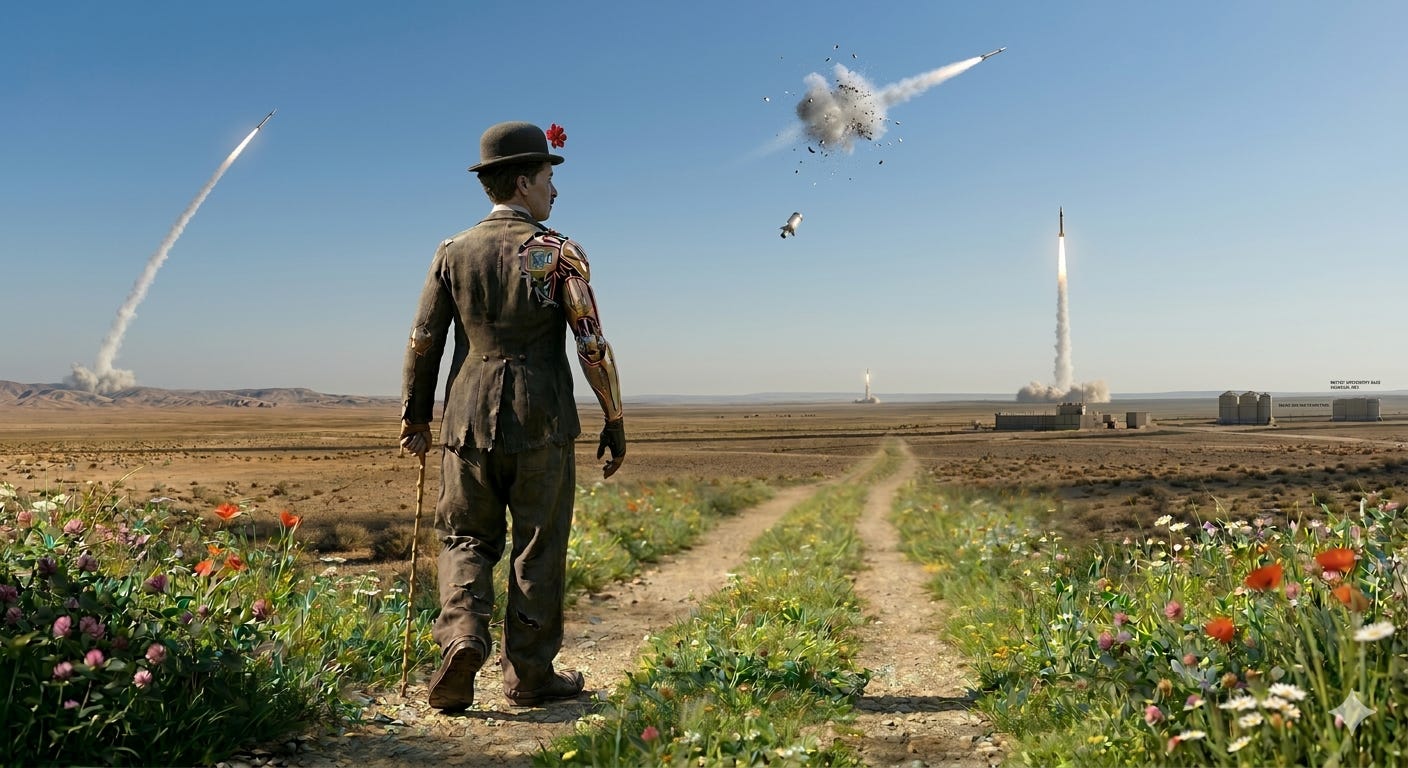
DISCLAIMER: What follows is a thought experiment. A paranoid fever dream. A conspiracy theory of the highest order, which I hereby disavow in advance, during, and after the reading. None of this is real. I am clearly projecting. The world is run by well-meaning people who care deeply about you. Please return to your regularly scheduled programming.
I. Level One: The Game Loads
Let’s say — purely as an exercise in paranoid imagination, the kind the therapist charges two hundred fifty dollars an hour to gently discourage — that the world is a simulation. Not in the Elon Musk sense, not the philosophical Descartes sense, but in the older, dirtier sense: that there are people behind the screen holding the controllers, and the game they’re playing has been running longer than you’ve been alive, and you are not the player. You are the NPC. You are the little stick figure in the burning village.
Now. Purely hypothetically. Imagine that in late February 2026, someone pressed the big red button. Not by accident. By design. The Strait of Hormuz seals shut like a bad wound. Twenty percent of the world’s oil — gone. Qatar’s gas liquefaction plant — offline. European natural gas prices — doubled before the week is out. Oil climbs from seventy dollars a barrel to ninety, then a hundred fourteen, then the whisper campaign starts: two hundred is coming.
Meanwhile, the audience doesn’t really pay attention to the prices, because they are dazzled by the fireworks. No one is sure what fireworks are real. Regardless of which side you are hooting for, it seems to be winning decisively. It’s only a matter of time that the enemy will capitulate.
Except that they won’t, because you are an NPC, and you’re embedded in a simulation that has other plans for you.
(Obviously, I don’t really believe any of this. But I’m going to continue anyway, because it’s raining and there’s nothing else to do.)
II. The Indefinite Extension Patch
In video games, when the developers want to keep you engaged, they release a patch. New content. Extended storyline. In my paranoid little simulation, the war that started in February 2026 — the one the economists are already calling the worst energy crisis since 1973 — receives its extension patch sometime around month three. There is no ceasefire. There is no diplomatic resolution. Instead there are new fronts, new provocations, new press conferences with men in uniforms pointing at maps, and the Strait of Hormuz remains, as the diplomats say, “effectively closed.”
Purely hypothetically, here is why you would want to extend it. The numbers:
At $100 oil: US gasoline hits five dollars a gallon. CPI climbs nine percent. People are uncomfortable. They blame whoever happens to be president or Ayatollah (both also NPCs, by the way).
At $150 oil: Gas hits seven dollars. European industry begins curtailment. Germany shuts chemical plants. Small businesses fail by the thousands. People stop driving, stop spending, stop resisting. They are busy surviving.
At $200 oil: Gas hits eight to ten dollars. CPI hits twelve to fourteen percent. Food costs rise twenty to thirty percent. Heating oil in the American Northeast doubles. In Europe, governments begin rationing. Small farmers — the ones who never incorporated, who never took the subsidy, who grew actual food — find that diesel for their tractors costs more than what the food is worth. They quit. The land goes fallow or gets bought. By whom? I’ll come back to that.
And at $300 — the threshold beyond which global GDP growth falls below two percent and the word “recession” becomes inadequate — you are no longer in an economic crisis. You are in a reorganization. A restructuring. A reset, if you will. Maybe even a great reset.
(Notice how convenient the sequence is, although I encourage the reader not to draw any conclusions from it.)
III. The Food Weapon (or: How You Starve a Free Man)
Here is where it gets agricultural. Stay with me.
One third of the world’s fertilizer — the nitrogen, the sulfur, the ammonia that makes the corn grow — travels through the Strait of Hormuz. Nearly fifty percent of global urea. Twenty percent of the world’s LNG, which is the feedstock for nitrogen fertilizers. The price of urea at the New Orleans hub jumped from $475 per metric ton to $680 in the first week of the closure. By month six of my hypothetical indefinite extension, it’s at $1,200. By month twelve it’s at $1,800.
The American Midwest farmer — the one the politicians put on their posters, the one with the tractor and the sunset and the flag — is now paying three times what he paid before for fertilizer. His diesel is at eight dollars a gallon. His inputs have tripled. The price he gets for corn has gone up forty percent, which sounds good until you subtract the other costs. He is losing money on every acre. The bank, which has been patient, is suddenly not patient. And hovering at the edge of the field, like a crow that has been waiting all winter, is a purchasing agent from a sovereign wealth fund or an ESG-compliant investment trust who offers him a price that is, under the circumstances, surprisingly reasonable.
The farmer sells. Not because he is weak. Because he has been squeezed until the option disappeared.
Meanwhile, the person in the city is paying forty percent more for groceries. Not because food disappeared — food is still there, the supply chains bent but didn’t completely break. But the margins vanished, and the costs were passed down, and the person buying eggs and flour and ground beef is spending, by month nine of the extended conflict, about sixty percent more than they were in 2024. On a salary that went up four percent. This is called, in polite company, “persistent inflationary pressure.” On the street it’s called not eating.
(I recognize this sounds ominous. I reassure you: it’s fiction. Carry on.)
IV. The AI Coincidence (or: Your Job Left While You Were Watching the War)
Here is the thing about crises: they are extraordinarily efficient at accelerating what was already happening.
Before the war, the layoffs were already coming — white-collar jobs eaten by language models, logistics networks eaten by route-optimization AI, customer service eaten by chatbots that, unlike their human predecessors, do not require health insurance or bathroom breaks. The economists were calling it a “transition.” A “structural shift.” They were, with laudable creativity, describing mass unemployment as opportunity.
Now, in the extended war scenario, the corporations face a choice: pay inflated labor costs to a workforce that is increasingly desperate, or accelerate automation. The choice is not difficult. The CFO does not agonize. The CFO runs the numbers and the numbers say: deploy the system. By month eight of the conflict, the announcements come — not in a torrent, but in a steady rain. Logistics companies announce AI-managed fulfillment. Insurance companies announce AI-managed claims. Banks announce AI-managed lending. Governments announce AI-managed benefit distribution. Each announcement is wrapped in the language of efficiency, resilience, and — crucially — the need to manage the crisis.
The crisis, in my speculative fiction, turns out to be an accelerant. A convenient one. The jobs that disappear in a boom generate protest, unionization, political pressure. The jobs that disappear in a crisis — when everyone is distracted by gas prices and food costs and the breaking news ticker — disappear quietly, as if they were never there.
(I do not suggest this was coordinated. I simply note that, as a matter of pure coincidence, it could not have been timed better if someone had tried.)
V. The Universal Income Trap (or: How to Buy a Man’s Soul for $1,400 a Month)
By month ten of the hypothetical extended conflict, the political pressure is severe. Unemployment has climbed. The middle class — that legendary creature, half myth already before the war — is functionally gone in its lower reaches. The people who were struggling are now drowning. The people who were managing are now struggling. The people who were comfortable are now managing. And the people who were wealthy are, by and large, doing “OK” — while actually scrambling for Plan B cashflow streams.
So the proposal arrives. It was, in my fiction, always going to arrive — the crisis simply provided the justification. Universal Basic Income. Not enough to thrive. Enough to not riot. Enough to buy food at the new elevated prices, pay the rent to the investment trust that now owns your apartment building, and leave just enough for the subscription services that provide the streaming content that keeps them entertained or distracted enough not to realize what’s really happening around them. Then there is the medical bill for the pills, without which, it would all start to be a bit too real.
The UBI is delivered — here is the elegant part — not in cash, not in a check that could be spent on things the system disapproves of. It is delivered through a Central Bank Digital Currency. A CBDC. A wallet on your phone that is loaded monthly, that expires if unspent (velocity of money, they explain, is good for the economy), and that has — buried in the terms of service that nobody reads — a few quiet features.
You cannot spend it on unapproved items. The list of approved items is managed by an algorithm. The algorithm updates without notice. You can spend it at certified vendors. Certified vendors have agreed to the platform terms. The platform terms include, among other things, a provision that the vendor’s inventory must meet certain — the word used is “sustainable” — standards. You find, over time, that you cannot buy a gas stove through the CBDC wallet. You cannot buy an internal combustion vehicle. You cannot donate to organizations that have been flagged by the trust and safety board. You cannot purchase seed stock that has not been registered with the approved agricultural database.
You could use cash, of course. But cash is being phased out. For your convenience.
(I acknowledge this is paranoid fantasy at its finest. I tipped my hat to myself in the mirror this morning.)
VI. Agenda 2030: The Document That Exists But Is Definitely Not a Plan
Here I must pause and make something clear: Agenda 2030 is a real document. Signed by 193 nations at the United Nations in 2015. It is a framework for sustainable development. It includes Sustainable Development Goals — SDGs — which cover poverty, hunger, health, education, clean energy, and a number of other things that sound, on their face, entirely reasonable.
I do not claim the document is a sinister manifesto. I am simply noting — satirically, fictionally, with full paranoid disclosure — that in my hypothetical scenario, the goals of Agenda 2030 and the outcomes of the extended crisis rhyme in ways that would be, if one were inclined toward pattern recognition, notable.
By 2030, the document envisions: significant reductions in private car ownership (SDG 11 — sustainable cities). A transformation of the food system toward “sustainable” agriculture (SDG 2). Universal access to financial services (SDG 8 — which, in my fiction, arrives via CBDC). Massively reduced carbon emissions (which happen automatically when the economy collapses and nobody can afford to drive). And a general redistribution of resources toward — the language is careful — “equitable” outcomes managed by multilateral institutions.
What a coincidence that an energy crisis, a food crisis, a job crisis, and a currency crisis all converge to produce exactly the conditions under which these goals become not aspirational but operational. What remarkable timing for a war that brings all of these goals together in a neat soup.
(A fantasy soup, not a real soup. Remember, this is still all speculation.)
VII. The Covid Rehearsal (or: We’ve Seen This Play Before)
Let me briefly consider 2020, in the spirit of historical comparison.
In 2020, in a period of weeks, the following occurred: travel was prohibited globally, borders were closed, small businesses were forcibly shuttered while large corporations with online infrastructure were designated “essential” and allowed to operate. Supply chains were disrupted. Cash was discouraged — for hygiene reasons. Emergency powers were invoked that, in many jurisdictions, have never been fully returned. Experimental medical interventions were deployed at speed, liability-free, with mandates attached that made employment, travel, and in some countries, public life, conditional on compliance.
I do not adjudicate the necessity of those measures. I note only — in this satire, this fiction, this paranoid projection — that they established the template. A practice run. It worked perfectly. The population, when presented with a sufficiently frightening emergency, would accept restrictions on movement, commerce, bodily autonomy, and expression that it would have rejected as fascism in any other context.
And it would call the people who refused: dangerous.
In the extended-war fiction, the emergency is not a virus. It is energy scarcity and economic destabilization. But the mechanism is identical: an existential threat that justifies extraordinary measures. Travel restrictions — not for health this time, but for carbon rationing. Emergency financial controls — not to stop bank runs, but to manage “wartime inflation.” Mandatory participation in the new digital currency infrastructure — not because they want to control you, but because the old system collapsed and this is the only one left.
I invite you to notice that the emergency always seems to require the same solution: more centralization, more compliance, more surveillance, fewer options, less exit.
(Pure fantasy. I love fantasy. So don’t let any of this get you on another prescription. Reality is much better than fantasy.)
VIII. The Feudal Upgrade (or: Serfdom with Better Graphics)
The feudal system — the one that ran Europe roughly from the ninth to the fourteenth century — was elegant in its simplicity. A small class of landowners held everything. Everyone else worked the land in exchange for protection and subsistence. You could not leave. You could not own. You owed your labor and a portion of your harvest to the lord, and the lord owed you — in theory — security. In practice, the security was variable and the labor obligations were not.
The system ended, eventually, because the serfs could run. Because the plague of the 1340s killed so many workers that labor became scarce and therefore valuable. Because information — the printing press, the Bible in the vernacular, the pamphlet — got loose and couldn’t be put back. Because there was, always, somewhere to go. A frontier. A city. A ship.
The upgrade — and here is where my fiction becomes genuinely interesting, or genuinely terrifying, depending on your constitution — eliminates the escape routes.
In the new feudalism of my hypothetical 2030, you do not own your home — you could not afford to, after four years of eight percent inflation on a salary that went nowhere. You rent from a REIT or a municipal housing authority. You do not own your car — you access mobility-as-a-service via an app that charges per kilometer and can be suspended if your social credit dips below threshold. You do not own land. Land has been consolidated — through the agricultural crisis, through the ESG investment funds, through the climate regulations that made small-scale farming economically impossible — into large managed entities that grow food according to approved protocols.
You can grow a garden, technically. But the seeds that produce reliably are patented. The water is metered. The plot is on land you do not own. And if you start selling food outside the certified system — if you set up a table at the end of the driveway and sell tomatoes for cash to your neighbors — there is a regulation. There is always a regulation.
Don’t forget the air. In this fantasy, air is tokenized, just like all other natural resources. Even breathing is a subscription service. Should NPCs breathe for free? To create a stable, safe, and fair economy, everything must be accounted for.
The difference from medieval serfdom — the one that makes the upgrade complete — is this: the medieval serf knew he was a serf. He had no illusions about his condition. He hated his lord with a clear, honest, time-tested hatred. In the new version, the serf is called a “stakeholder.” He is told he owns nothing because ownership is bad for the planet. He is told his movement is restricted because carbon. He is told his money is programmable because efficiency. He is told he should be grateful for the Universal Income because the alternative — in the discourse, always — is chaos.
And unlike the medieval serf, he has nowhere to run. The frontier is closed. The city is managed. The ship requires a digital ID. The information system — the one that used to get loose and start revolutions — is now moderated, and the moderation is AI-assisted, and the AI was trained on data that the platform selected, and the platform is owned by people who will not be affected by any of this.
(I’m pausing here for a drink. Italian Barolo. Untokenized.)
IX. The Other Reality (or: What the Lords Are Doing While You Manage)
There is, in this fiction, a parallel economy. There has always been a parallel economy — money has always been different when there is a lot of it — but in my scenario it becomes a parallel reality.
While you navigate the CBDC and the approved vendor list and the programmable money that expires at the end of the month, the upper tier transacts in assets. Land. Art. Private equity in the AI systems that manage everything. Hard commodities — gold, agricultural land, water rights, energy infrastructure. They do not use the CBDC, except when they must interface with the managed system. They have accountants and lawyers whose full-time job is to exist at the boundary between the two realities, extracting value from the lower and depositing it in the upper.
They eat real food — grown on land they own, by farmers they pay in something other than programmable money. They travel on private aircraft, which are not subject to the carbon credits that make commercial flying the exclusive territory of business class and above. They live in compounds — the word used in the discourse is “community” or “campus” — with security, energy independence, clean water, and what used to be called, without irony, amenities.
They attend meetings — in Davos, in private conference centers, in places that do not appear on the news — where they discuss, with great earnestness, the challenges facing humanity. They are very concerned. They have pledged, many of them, to give away their fortunes. The fortunes seem not to diminish. The pledges seem not to be tracked.
They are not villains in this fiction. That is the important thing. They are people who made a series of rational decisions in a system that rewarded the accumulation of power, and who have now accumulated enough power that the system serves them completely, and who genuinely believe — I grant them this, with full satirical generosity — that what is good for them is good for the world.
This belief has the advantage of being very comfortable to hold.
X. The Depopulation Question (Which I Raise and Then Immediately Retreat From)
This fantasy doesn’t go as far as some other conspiracies. That there is a deliberate plan to cull the NPC population. I note, however — as a purely structural observation — that the fiction I’ve described would, as a byproduct of its normal operation, produce population outcomes that rhyme with what certain prominent people have, in public, said they want.
When food costs forty percent more. When healthcare is rationed through an algorithm that weighs productivity metrics. When the stress of permanent economic precarity drives the fertility rate — already declining across the developed world — toward the statistical basement. When independent agriculture collapses and the food supply is managed by entities that optimize for margin rather than abundance.
In this fiction, nobody has to plan depopulation. The system produces it. Perfectly. Even if the NPC manages to refuse the next mandatory healthcare protocol, longevity will drop like a day-old helium balloon.
(I have now finished half of the Barolo.)
XI. Coda: The Thing About Simulations
The thing about a simulation — the real kind, the kind that runs in flesh and blood and market forces and policy decisions and the slow geological pressure of compounding incentives — is that it doesn’t need a director. It doesn’t need a villain in a room pressing buttons. It needs only a set of rules that consistently reward certain behaviors and punish others, run long enough, with enough participants, and it will produce, with the cold certainty of mathematics, the outcomes the rules were designed to produce.
The rules, in the current version of the game, reward: scale over independence. Compliance over resistance. Dependence over self-sufficiency. Debt over ownership. The managed over the free.
The war in the Strait of Hormuz may end tomorrow. The oil may flow again. The CBDC may remain a policy proposal gathering dust. The farms may stay in family hands. The UBI may never arrive, or may arrive in a form that actually, genuinely helps people. History is not determined. I am not predicting.
We, the NPCs, still define the outcome. With one caveat.
The medieval serf had one advantage over us. He knew the system was rigged. He could see the lord’s castle from his field. The structure was legible. The enemy had a face and a name and a coat of arms.
The new system’s elegance is that there is no castle. There is an algorithm. The algorithm has no name. The algorithm was trained on data curated by people who are not accountable to you, or to the democratic process you were told about in school, or to any court that has jurisdiction over anything that matters.
You cannot storm an algorithm.
Remember, however, that this is all a paranoid mind exercising its paranoid muscles on the paranoid apparatus of the available evidence. The world is not a simulation. Nobody planned the war. Agenda 2030 is a sincere attempt to address genuine problems. The CBDCs, if they come, will be well-intentioned. The AI systems that displace your job will create new jobs somewhere, eventually. The food will be fine.
Everything is fine.
(And that completes the Barolo.)
Excellent analysis.
Does not seem fantastical in any way, of course.