


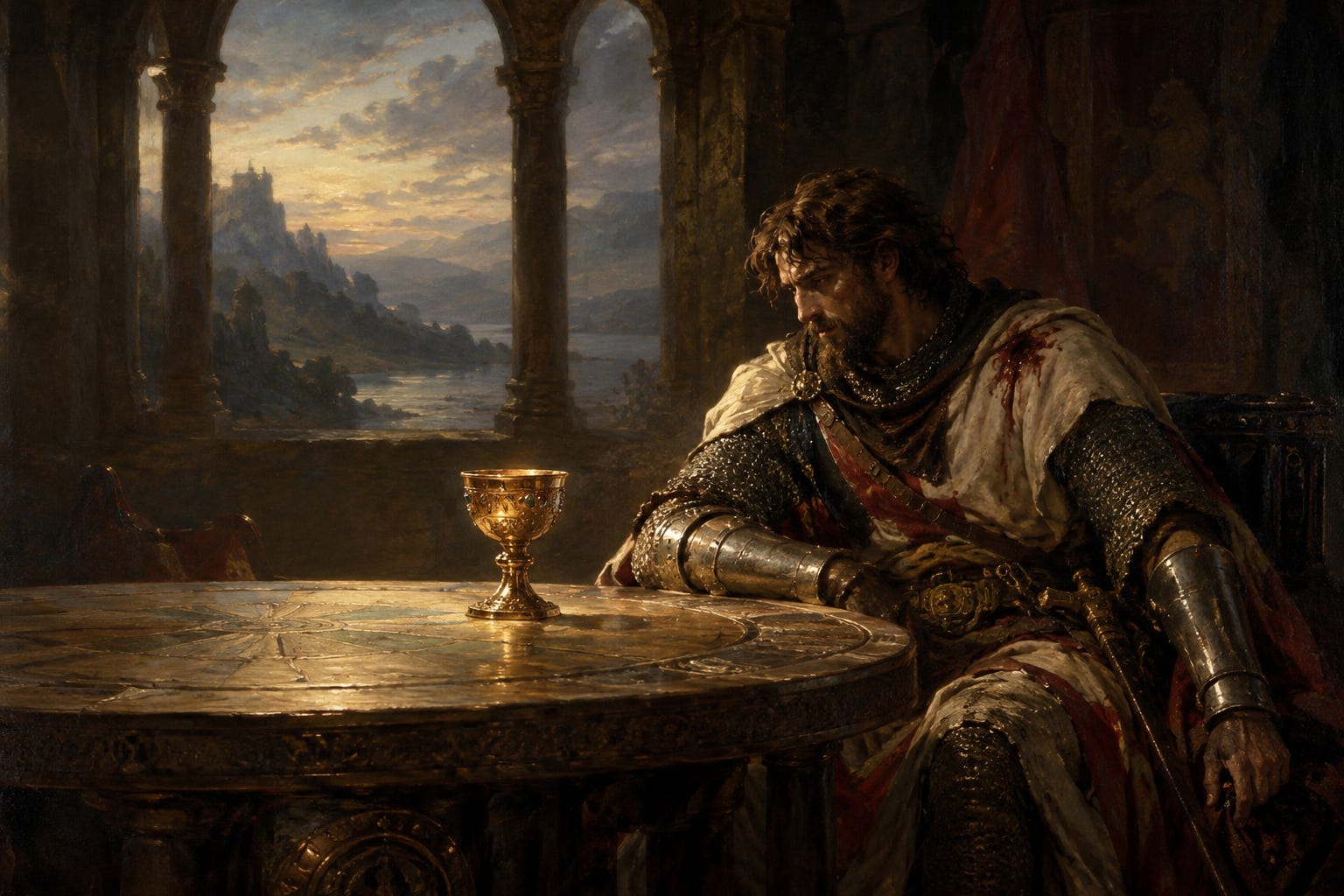
You know the urge. Somebody says or does something stupid, and the sheer scale of the stupidity demands a response. Your chest goes tight with voltage. Your jaw clenches. Open your mouth, spit out the truth, and the world will be right again. Or so you believe.
Two forces bear down on you at once. One wants to fix the wrong, and that takes courage. The other counts the cost, and that takes foresight.
Underneath both sits a quieter question, the one that turns lead into gold, or gold into lead.
The green streak
After the mandates ended, I spent a long stretch trying to talk strangers out of their masks. On the street, in shops, wherever I saw one. I had the Danish trial and the Cochrane review on my phone, and I could quote them from memory. One of the strangers was a young woman with a green streak in her hair. I remember the streak better than anything I said to her.
At first about one in five took the mask off, or at least listened. A year later it was one in ten. Then I stopped, even though the pile of studies had only grown.
What was I doing out there? I told myself I was helping strangers free themselves from absurdity. Then why did I keep count? One in five is a score. What did I need a score for?
And why did the numbers fall? Was the long tail more clueless? Or had I changed? The longer I kept at it, the less I looked at the face in front of me, and the more the whole exchange ran on rails, my opening line, their flinch, my study, their excuse, my second study, until the conversation was over before I had reached them.
When somebody took the mask off, I felt a small hot pleasure at being right, and almost none of it was for them. When somebody refused, I felt right anyway, about my theory that humans can be programmed, irreversibly, to do stupid shit. Heads I was right, tails I was right. Helping anyone never came into it.
There are two ways to walk up to a stranger with the truth. One is about them. You notice the person, you wonder what the mask (or whatever other stupid shit) is doing for them, whether it is fear, habit or a sick mother at home, and you ask. The other is about you being right.
Always keeping quiet is not an option. Today the world is so full of stupid shit that you could argue, for the sake of the planet, that speaking out has become a matter of survival. And political correctness, being nice and avoiding the “negative” have become the atomic bombs of modern societal breakdown.
So here is the thesis. Knowing which side of the thin line you are on, between speaking to help and speaking to be right, decides the fate of the kingdom. Not just yours, but the rest of the grand simulation as well.
The red pen
I was one man on a few street corners. The silence itself is an ocean that runs through hospitals, medical journals, legislatures, universities, publishers, pharmacies, and police stations in every country that likes to think of itself as free. And it is very funny, as long as you believe you don’t live in it. But you do, in fact, live in it.
A hospital trust in Brighton told its midwives to say chestfeeding and birthing parent. The Lancet put “bodies with vaginas” on its cover, where it used to say women. Stanford University published a list of harmful words that included American. Puffin went through Roald Dahl with a red pen, and Augustus Gloop is no longer fat, only enormous. HarperCollins did the same to Agatha Christie. In Germany, Ravensburger pulled two Winnetou children’s books because they might hurt someone’s feelings. Mr Potato Head lost his Mister.
Scotland, land of Braveheart, now protects “transgender identity” under a hate crime law. Stir up hatred against it, by anything “a reasonable person would consider to be threatening or abusive”, and you can go to prison, even if you said it in your own living room.
Germany has agreed to host American missiles that can reach Moscow, and half a dozen of its neighbours are designing their own, all for the sake of peace. In June, Finland voted to allow nuclear weapons on its soil, next door to St Petersburg, so that everyone can feel safer.
And in January 2025 the British House of Commons voted 364 to 111 against a national inquiry into the gangs that raped thousands of teenage girls in town after town for decades.
The list goes on for about another eleven thousand and one pages.
So do you speak out, announce you’re a crank, or just shut up for the sake of political correctness? Behold the abysmal downside of voicing your concern. The prospect of never quite getting the promotion. The friends who unfriend you on Facebook. The actual friend who quietly stops calling. All because of your negativity.
Negativity is the last sin left in a culture that has given up on the other seven. A doctor who looked at your X-ray and refused to say anything negative would be struck off. A dinner guest who does the same gets a second invitation. The most powerful determinant of human behavior, litmus-tested on MK Ultra, is fear of social exclusion. Which makes it an easy trick to get people to stop being negative, or politically incorrect.
The phrase “politically correct” first turns up in 1793, in one of the earliest cases before the United States Supreme Court. Justice James Wilson complained that people at dinners raised their glasses to “the United States” when they should have toasted “the People of the United States”, because in his view the people came first and the state second. The toast, he wrote, was “not politically correct”. Two hundred years later the phrase means pretty much the opposite, a rule about what you are allowed to say, whether or not it is true.
The disease is older. Hans Christian Andersen took The Emperor’s New Clothes from a Spanish collection finished in 1335, where the cloth is invisible to any man who is not his father’s true son, so the whole court praises a naked king rather than admit to being bastards.
Every village that ever existed has had a table where one subject could not be raised, and a crank who raised it anyway for his own reasons. Nobody teaches you where the line runs. Not school, not parents, not friends, not the colleagues before the bonus round. Nobody teaches you the weight of one question, or how to tell the question that heals from the one that only wins.
That is where the old stories come in. Joseph Campbell found a common strand in myths. They were told by people who had watched kingdoms rot, and they had no interest in being nice about it.
I recently borrowed Jean Houston’s The Search for the Beloved from the Internet Archive, reread Campbell on the Grail and pulled three Grail romances off Project Gutenberg, looking to understand the thin line. What I found is that political correctness is a young name for an ancient disease, and the best description of it was written eight hundred years ago. It is the story of a young knight who sits at a king’s dinner table, sees the king is gravely wounded, and says nothing, because he was taught that a good knight does not ask questions. The cure the story offers turns on the same small difference I found on the pavement.
In the most famous version, Wolfram von Eschenbach’s Parzival, written in German around 1210, the hero wanders for four and a half years and three days before he gets it right.
The castle
For anybody who skipped the Middle Ages, a short tour. King Arthur rules Britain from Camelot, and his best knights sit at the Round Table, built round so that no knight sits higher than another. The Grail is the holy object they spend their lives looking for. Nobody agrees on what it is, a serving dish, the cup of the Last Supper, a glowing stone, a bloodline, an alchemical medicine. Everybody agrees that it feeds people, it heals, and it is kept in a hidden castle by a wounded king.
That king is the Fisher King. He has a wound that will not close, a spear through the thigh, which is the medieval way of saying he can no longer make anything grow. He cannot ride, rule or father children, so he sits in a boat with a line in the water, waiting for the day to pass. Because the king is sick, the land is sick. Crops fail, rivers dry up, women stop bearing children.
A young man rides in. Parzival was raised in a forest by a mother who hid the world from him, and an old knight named Gurnemanz taught him to fight, to show mercy and to sit properly at a lord’s table. One rule stuck harder than the rest. A good knight does not ask too many questions.
At dinner in the castle he watches a procession pass the table. A lance that drips blood. The Grail, feeding everyone in the hall. The king on a couch, unable to sit or stand. Everybody in the room is weeping. The young man, who does not yet know the king is his own uncle, remembers his manners and says nothing.
The next morning the castle is empty.
One question would have healed the king and the land. In Wolfram it is a handful of words. What ails thee, mine uncle? Preferably delivered with genuine concern, not as small talk.
He failed because he was polite.
Campbell put it in three lines. Parzival’s nature prompted him many times to ask the question, but he thought of his knightly honour, his reputation instead of his true nature. The social ideal interfered with his nature, and the result is desolation.
Wolfram adds a detail the other versions miss. In his castle nobody goes hungry. The Grail gives everyone a full plate every night. What is gone is joy, strength and any sense of a future. In the Waste Land, Campbell wrote, life is a fake. People are living according to a system of rules.
Put a rich country of 2026 next to that castle and you need few changes. The shelves are full. The pharmacies are full. The calendars are full. And the father who has been drinking since the redundancy, the colleague who has stopped laughing, the teenager who has not left her room since spring, sit at the table like the Fisher King on his couch, while the rest of us pass the chow and talk about the weather.
The mechanism repeats at every size. Everyone can see the lance. A rule makes asking rude, risky or disloyal. Everyone obeys, so everyone is complicit, and the wound turns into furniture. Then the land stops bearing. Joy, trust, children, truth. The silence does more damage than the wound ever did.
The lance
The bill gets paid in lives, in every field.
Between 2005 and 2008 at Stafford Hospital in England, patients were left unwashed and unfed while managers chased financial targets. The public inquiry found a culture in which raising concerns was neither safe nor welcome. Estimates of avoidable deaths ran from four hundred to twelve hundred.
About fourteen hundred children were sexually exploited in Rotherham between 1997 and 2013. Professor Alexis Jay’s report found council staff nervous about naming the ethnic origins of the men involved, for fear of being thought racist. For sixteen years, being thought racist was the risk people weighed. The children were the cost.
In June 2024 the President of the United States walked onto a debate stage in front of about fifty million viewers and could not finish his sentences. Many around him had seen the decline for a long time. They kept quiet, because saying it would help the other side.
On a cold January night in 1986, engineers at Morton Thiokol warned NASA that the O-rings on the Space Shuttle Challenger might fail in the frost. Their own managers overruled them, and seventy-three seconds after lift-off the shuttle broke apart.
A country is a few million dinner tables. A culture that cannot ask is a few million people who each sat at one, saw something wrong, and decided, one dinner at a time, that this one was not worth the trouble. And a culture that can only argue is a few million people like me on a pavement, each walking over with the answer already loaded.
The knights
The later romances send the whole Round Table after the Grail, each knight alone into the forest where it is darkest and there is no path. Each fails or succeeds for his own reason, and every one of those reasons has a seat at our table.
What does it mean to be a knight? The word comes from the Old English cniht, a boy or a servant. The German Ritter and the French chevalier both mean rider. Literally, a knight was the most expensive thing in a medieval army, a man on a warhorse in armour worth more than a farming family earned in years, who usually trained from about seven as a page and from fourteen as a squire before anyone touched his shoulder with a sword. Symbolically he was a man who had sworn to stand between the weak and whatever came for them. Malory’s knights renew that oath every Pentecost. They promise never to commit outrage or murder, to give mercy to anyone who asks for it, and never to fight in a wrongful quarrel for love or for money.
The ordinary man owed his lord rent and labour. The knight owed his life, and he owed his word.
Galahad is the perfect one. One chair at the Round Table stood empty for years, because anyone unworthy who sat in it would die on the spot. Galahad walks in, sits down, and nothing happens. He finds the Grail and asks God to let him die, because there is nothing left for him to learn. Today he has moved beyond politics. He posts sunrises and leaves before the conversation gets uncomfortable. He is right about everything and useful to no one, because he never sits at a table where he might be wrong.
Lancelot is the best knight in the world and fails because of the one thing he will not give up, his affair with Arthur’s queen. Today he is the man who cannot ask anyone else what is wrong, because the honest answer would start with himself. The minister who writes the rule he breaks. He knows exactly where the wound is and has arranged his whole life around not touching it.
Gawain is the charming one, first to swear the quest and last to change. Hermits tell him to repent, and he tells them he has no time. Today he has the right opinion on every cause by lunchtime, four thousand contacts and nobody to call at three in the morning. He turned the quest into a personal brand.
Bors is the ordinary man. He sees his brother dragged away and, at the same moment, a young woman about to be assaulted, and he can save only one. He saves the stranger, and he is the only knight who comes home to tell the others what he saw. Today he is the nurse or the teacher who says the one thing nobody at the table wants said, then helps with the dishes, and pays for it in the family group chat.
Cundrie carries messages for the Grail castle. She is no knight and has no seat at the Round Table. Wolfram gives her a nose like a dog’s and tusks like a boar’s. She rides into Arthur’s court in the middle of a celebration and tells Parzival, in front of everyone, that he sat at the wounded king’s table and said nothing, and that he has shamed himself. She is negativity on horseback. Today she is the woman in the meeting who says the project is dead and is called difficult for the rest of her career.
Wolfram gives her the last word, though. Four and a half years later, after Parzival has wandered, broken down and changed, it is Cundrie who rides out to find him. She kneels and asks his forgiveness for her harsh words, then tells him the Grail has called him and leads him back to the castle to ask his question. She never stopped telling him the truth. He had only learned to hear it.
The modern quest
A modern quest is usually sold as a flight to Peru or a retreat in Bali. Go, if you like. Parzival rode for four and a half years, won every fight and married a queen, and none of it moved the king one inch. The kingdom is healed in the same room where it was lost, at the same table, by the same person, with one sentence.
So the quest is to walk back into the room you left. The kitchen where your father sits. The office where the project is dying. The marriage where the two of you stopped asking what was wrong about five years ago. In the oldest romances the healer is never the old king. It is the outsider who failed once, wandered, broke, and came back.
Coming back is half of it. Once he is back in the room, he still has to open his mouth, and what he says, and why he says it, decides whether anything heals. That’s what the poem is about.
Wolfram emphasizes two points. The first is that the question has to be about the other person’s pain. The key to the Grail is compassion.
The second is that nobody can tell him to ask. Warned in advance, the question loses its power. It has to come from him, out of what Wolfram calls triuwe, an old German word somewhere between loyalty and love.
Back to the street corner. By the end, quoting my studies to strangers had nothing to do with their pain. It was about mine, the itch of being right and not being heard. And I always knew how the conversation would end before I opened my mouth. That breaks both of Wolfram’s rules. Parzival failed by keeping quiet out of good manners. I failed the other way, by speaking out of pride. Neither one heals anybody.
The psychiatrist David Hawkins drew a map of human states in Power vs. Force, from shame at the bottom up to courage, love and peace. He scored it with muscle testing, which is why his theories never breached the mainstream, but they contain the gist. Below courage, he wrote, people run on force, which always provokes a counterforce. Above it they run on power, which needs nobody’s permission. Political correctness lives below that line. It is pride dressed as kindness and fear dressed as manners. My campaign ended up below it too, pride dressed as public health, and a true sentence delivered from down there still arrives as force and gets force back. The honest question is the first step above the line.
You cannot outsource this, not to a campaign, a government programme or a podcast on active listening. One person, in one room, turns to the one in pain and asks what is wrong, because they want to know.
When Parzival finally does it, he kneels, prays three times and turns to the king. What ails thee here, mine uncle? The king rises healed on the spot, younger than before, and steps down. The one who asked becomes the king.
The catch? Whoever names the wound inherits the castle. Ask your father what is wrong and you will be the one sitting up with him at three in the morning. Tell the boss the project is dead and you will be the one asked to fix it. The question is free. The answer is not.
The second question
Wolfram ends the poem when the question has been asked. Real life keeps going. The next morning somebody has to run the castle with the same people who sat silent at the table for years. Keeping the room open takes a second question, and the best version I know comes from a management book with an unpromising title.
The Three Laws of Performance, by Steve Zaffron and Dave Logan, came out in 2009. Stripped of the consulting language, the laws say three things. People act according to how a situation looks to them. How it looks is made of language, of what gets said and, even more, of what never gets said. And a new way of talking about the future changes how the present looks.
The authors call the wound at a company table a racket, a complaint you keep repeating, with a payoff and a cost. The payoff is almost always the pleasure of being right. The cost is everything else.
Their best story comes from Lonmin’s platinum mines in South Africa. When Brad Mills became chief executive in 2004, workers were dying underground, miners said management treated them like equipment, and management said the unions only knew how to strike. Mills brought about a hundred leaders of the company, the unions and the community together for two days in a nightclub in the workers’ settlement. A worker dared him to sleep a night in a hostel with twelve miners, and he wrote the promise on a flip chart.
Then came the second question. The first had been what is wrong. The second was what have you been doing to stay right about the other side, and what would you give up to fix it?
Each side made a list. Management wrote down its own tricks: take-it-or-leave-it offers at the bargaining table, crying poverty, and showing the union only the figures that made the company look good. The union wrote down its own: wildcat strikes, damaged property, and never saying in the room what it really thought.
Every item on those lists was a way of winning the argument, and every one of them was costing both sides money, safety and trust. Both sides agreed to stop.
According to the book, the process spread over four years to around fifteen thousand people, and the mines produced more than a million ounces of platinum for the first time in their history.
That would be the perfect place to end the story, but it kept going. Mills left in 2008. In August 2012, at Lonmin’s Marikana mine, police shot dead thirty-four striking miners, the worst police massacre in South Africa since apartheid. Nobody can say for certain what changed after he left. What is certain is that the peace made in that nightclub did not keep itself.
Which is the last lesson of the story. The two questions, what is wrong here, and what am I doing to stay right about it, have to be asked again every day, by somebody, the way a dressing has to be changed on a wound, or the land goes back to what it was.
The Practice
Of all the knights in Camelot, the Grail chose the least prepared, a boy in fool’s clothes with bad manners who failed first and kept going anyway. That is the whole qualification. You are not too small for this.
The Philosopher’s Stone? You cannot ask anybody what ails them until you know what ails you. Otherwise every question comes out as a verdict.
Jean Houston spent her working life turning myths like this one into practices, things people do rather than read about. Her chapter on the wound carries a warning. The woundings will continue, she writes, sometimes relentlessly, apparently meaninglessly, until you agree to wake up.
Her remedy is a process for two people, stripped here to the bones. Sit facing a partner. One asks and the other answers, five minutes per question, then swap.
1. What happened? How were you wounded?
2. What did you feel when you were wounded?
3. What were the full consequences, for good and ill?
4. Tell it again as a myth.
Tell the myth in the third person, starting with once upon a time, and carry it past the wound to the place where it turns, even if your own life has not got there yet.
One rule for the person asking. Do not comfort, interpret or fix. If your partner weeps, sit still, repeat the question and listen. Houston calls this being a high witness. Wolfram would call it the Grail question with the manners stripped out.
Look around. The castle is still there. The table is still set. The king is still on his couch, and the whole room is still pretending not to see.
The question, rightly asked, is the Grail.
If you’re not a subscriber but enjoyed this piece, feel free to chip in!