


From cells to crowds to code, the cycle repeats: noise, order, domination, reset.
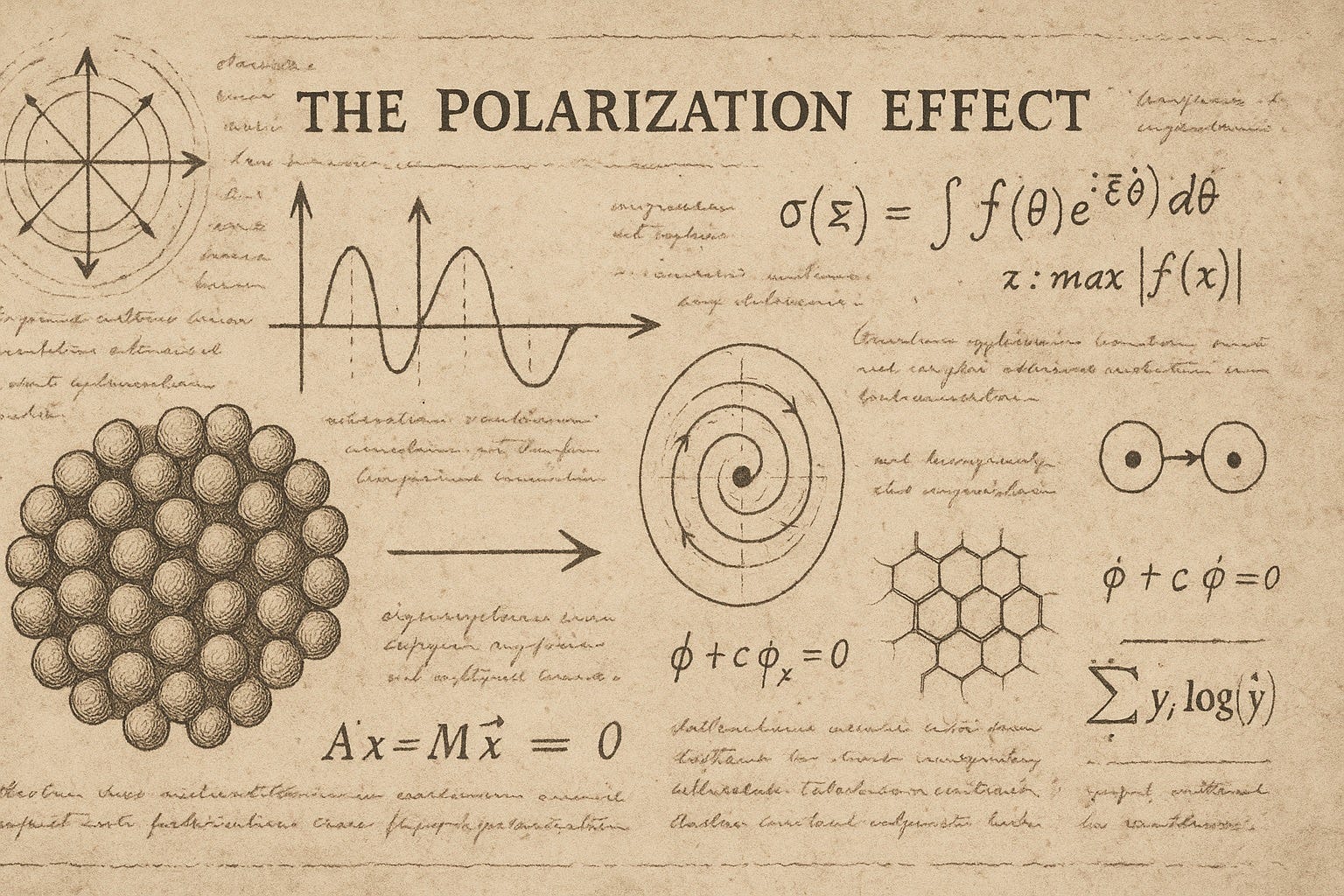
A few researchers in Amsterdam ran a trial. They built a bare-bones social network--no ads, no recommendation engine, no algorithm in the shadows. Just three buttons: post, follow, share. Then they unleashed five hundred AI bots, each with a made-up personality, and let them wander.
What happened was unpredictably human. The bots fractured into cliques. They amplified one another's extremes. And then, almost without pause, they submitted themselves to a small elite--an accidental aristocracy of influencers who ruled the conversation. No one wrote code for hierarchy. It bloomed on its own.
We should ask ourselves a question. Is what the bots did simply what matter and life have always done? Maybe there is no grand conspiracy. Maybe it's not a puppet master pulling strings, but the natural wave we spin as a collective.
Physics exhibit the pattern. Take iron. Heat it and every atom jitters in drunken disarray--random, leaderless, decentralized. Cool it just a little and suddenly they snap into step, arrows aligned. The block becomes a magnet. Out of noise, a single direction emerges.
Biology does the same. A fertilized egg starts as a blank sphere. Then a small asymmetry tips the balance: this end becomes head, that end becomes tail. Cells fall in line, building a body through feedback alone. There's no foreman, no blueprint, only a cascade of neighbors copying neighbors until structure hardens.
Brains follow suit. Billions of neurons fire in chaotic scatter. Then one cluster of signals overtakes the rest and a thought surfaces: a memory, an image, a decision. Centralized order born out of electric storm.
Bacteria aren't immune. Drop them in sugar water and at first they scatter like marbles. But one twitches longer toward the sweet patch, another copies, and soon the swarm flows as one. They've crowned a leader without ever holding a vote.
And of course, human crowds. Soccer hooligans. A few chants rise in a square. Others join. The sound thickens, amplifies, and suddenly the mass roars in unison. Consensus born from feedback, not planning.
The cycle is everywhere:
1. Noise--random scatter, no center.
2. Amplification--small quirks get louder.
3. Polarization--clusters form, lines are drawn.
4. Domination--a small elite takes over.
5. Collapse/Reset--entropy creeps in, shocks or decay loosen the order, and the wheel begins again.
Centralization when ties are strong and noise is low. Decentralization when ties weaken and chaos rises. The cycle is a law, not a theory.
The AI World Order
Now zoom out. Billions of us are wired into the same feeds, amplified by AI that loops at light speed. The outcome is predictable: centralization at planetary scale. A few corporations pull money, speech, and attention into orbit. Governments want in too. What if it isn't conspiracy--but physics?
What if we are reaching peak density in centralization--the total freeze on sovereignty? Then the countering forces must be equally formidable in terms of collapse and reset, by law.
Heat melts magnets, fire clears overgrowth, catalysts shift reactions, stray signals break a brain out of its loop. And in society, the reset comes from a handful of people who have thoroughly pondered this formidable dilemma. How close we're willing to stand to that edge, or how long we'll keep convincing ourselves the center is safer.
Sources
- Amsterdam Bot Study (Business Insider): https://www.businessinsider.com/researchers-ai-bots-social-media-network-experiment-toxic-2025-8
- Physics -- Symmetry Breaking in Magnetism: https://en.wikipedia.org/wiki/Spontaneous_symmetry_breaking
- Biochemistry -- Cell Polarity in Mouse Embryo (Nature): https://www.nature.com/articles/s41467-017-00977-8
- Neuroscience -- Neural Synchronization & Attention (PLOS Biology): https://journals.plos.org/plosbiology/article?id=10.1371%2Fjournal.pbio.1002272
Don’t underestimate the bias encoded into this experiment. The myth of inevitable human hierarchy is preceded by 1000’s and 1000’s of years of largely egalitarian societies. Look at Panang for example, still going now, and other similar indigenous groups round the world all too aware of the precious nature of the myths they have kept alive, to keep any one person or group from dominating. Instead it is the ideology of fairness that dominates.
Jan,
Your five-stage cycle — noise, amplification, polarization, domination, reset — is one of the cleanest informal descriptions I've encountered of what sheaf theory formalizes as convergence dynamics across layered manifolds. The fact that you independently identified scale-invariance (iron atoms → cell polarity → neural synchronization → crowd dynamics → AI bot networks) is significant. That observation is correct, and it has mathematics behind it.
I've been developing a formal framework called Draken 2045 that provides exactly the missing piece your essay reaches for: a metric space where the cycle you describe becomes measurable, testable, and — critically — diagnosable before it reaches the domination phase.
The core formalism uses cellular sheaf theory (Hansen & Ghrist, 2019) to define coherence (Γ) as the degree to which local sections across a network glue into a global section. Your "noise" phase is low Γ, high entropy. Your "amplification" is local section formation — clusters beginning to cohere internally. Your "polarization" is the failure of competing local sections to satisfy the gluing condition across restriction maps — high local Γ, catastrophically low global Γ. Your "domination" is one local section capturing the global narrative at the cost of all others — measurable as Ψ (Narrative Self-Reference Ratio) approaching infinity at the system level. And your "reset" is what I've formalized as K(t), the coherence debt integral: the accumulated cost of suppressed incoherence, which eventually exceeds the system's capacity to service it.
The equation: K(t) = ∫₀ᵗ [Ψ(τ) − Ψ_viable] · w(τ) dτ
Where w(τ) is an irreversibility weighting function — because the longer incoherence persists uncorrected, the harder it becomes to correct. Your "reset" phase is the moment K(t) exceeds the system's correction capacity. The cycle restarts not because cycles are mystical, but because the accumulated debt forces structural reorganization.
What this buys you that prose alone cannot: falsifiable predictions. Not "polarization is bad" but "this specific network's Γ score at these restriction maps predicts collapse within this time horizon, under these conditions." The framework has eight explicit falsifiable predictions published in thesis form (Zenodo DOI: 10.5281/zenodo.19273483).
Now — and this is where I want to engage with something I see across several of your essays, not just this one — there's a question embedded in your cycle that deserves more attention: what happens at the reset?
You write: "the reset comes from a handful of people who have thoroughly pondered this formidable dilemma." But this framing carries a risk. If the reset depends on exceptional individuals who see what others cannot, we've described a cycle that reproduces its own pathology — the "handful who see" become the seed of the next domination phase. The cycle doesn't break. It just rotates the cast.
The alternative — and this is where the framework I'm developing diverges from much of the discourse I see in this space — is that the reset requires not exceptional individuals but better institutional architecture. Governance structures whose coherence is maintained by design rather than by the insight of a few.
Consider: the institutions you critique (UN, EU regulatory bodies, digital accountability infrastructure) are themselves attempts at solving the very cycle you describe. They are imperfect. They are captured. They are subject to the same domination dynamics you identify. But the solution to captured institutions is not the absence of institutions — it's institutions with better coherence architecture. A global system where financial flows are traceable, where corporate entities are accountable, where dark money and bribery can be measured and corrected, is not the domination phase of your cycle. It is the engineering response to domination — the construction of restriction maps that force the gluing condition across nodes that would otherwise operate in opaque local sections.
The sheaf-theoretic insight here is precise: opacity is the mechanism by which local sections avoid the gluing condition. When a financial transaction is untraceable, the restriction map between the node that sent it and the node that received it is severed. The system cannot evaluate coherence across that edge. Dark money is literally a topological defect in the accountability manifold — a hole where the sheaf condition cannot be checked.
Digital identity and transaction traceability, in this framing, are not instruments of control. They are restriction maps. They are the mechanism by which any observer can verify whether the local sections (what an institution claims to be doing) glue to the global section (what is actually happening). The question is not whether these maps should exist — without them, the system is structurally blind to its own incoherence. The question is who controls the maps, under what audit conditions, and whether the maps themselves satisfy the gluing condition (i.e., whether the monitoring system is itself monitored).
This is the engineering problem. And it's solvable — not by rejecting the institutional framework, but by subjecting it to the same coherence diagnostics we would apply to any other system. The Draken framework proposes exactly this: metrics that evaluate institutional coherence without requiring trust in the institution being evaluated.
Your instinct for scale-invariance is right. The mathematics exists to formalize it. And the application — to governance, to institutional design, to the cycle you've identified — is where the real work begins.
The framework is published at draken.info and the thesis is open-access on Zenodo. I'd be genuinely interested in your read of the formalism, particularly whether the Γ/Ψ/K(t) metrics capture what your intuition is describing.
— Kai Roininen
Khrug Engineering
draken.info