


Six PM in the Spartan mountains and the light is dimming. Five hours in. Legs spaghetti. Canteen empty. The trail I came up on has become three, and each one loops back to the same rock. Birnam Woods with a Greek twist. The cold about to set in is no joke. It is mythological. I am drenched in sweat, not thrilled about becoming the mountain’s latest sacrificial popsicle. Hikers here have vanished before.
I keep moving because moving is the only thing keeping me from freaking out.
Then I stop. Not by choice. A Tai Chi guy I studied with years ago pops into my head and tells me what he used to tell us on Tuesday evenings. Stop. Feet under you. Weight down through the arches. Eyes long, halfway between the ground and the sky. Defocus the glance. Breathe the field in. Do not think.
I do it because I have run out of better ideas.
Something in the chest unclenches. The panic stays, but it stops being the driver. My legs stop shaking. Warmth returns to my hands the way it returns to a car engine, slow, then all at once. Then, without a decision, without a map, without a compass reading, my body turns left. Not a hunch, or a whisper. A needle-rotation in the chest. My feet follow.
I am at the trailhead in forty minutes. Warm. Jacked. Glowing. Fed by whatever it was I inhaled up there. Laughing at my behavior just a few minutes ago. How could I ever not trust the mountain spirit? Whatever made me think Zeus did not carry my sorry ass?
There it is. One data point. A data point on its own is a coincidence, which is what a Western education would call luck. The mountain was luck, the timing was luck, the compass in the chest was luck. I did not yet know the missing word for this type of “luck.”
The trouble with the coincidence file is that it fills up. Elevators used to lock me in when my claustrophobia got loud enough, and would unlock the moment I stopped feeding it. A chronic gut inflammation that shrugged off every protocol in the Western and Eastern pharmacopoeia collapsed inside a week the moment I confronted the specific fear underneath it. Each event on its own may indeed be a coincidence.
But. You get twenty small confirmations, then fifty, then a threshold you did not know you were approaching, and one morning you notice you have stopped explaining them away.
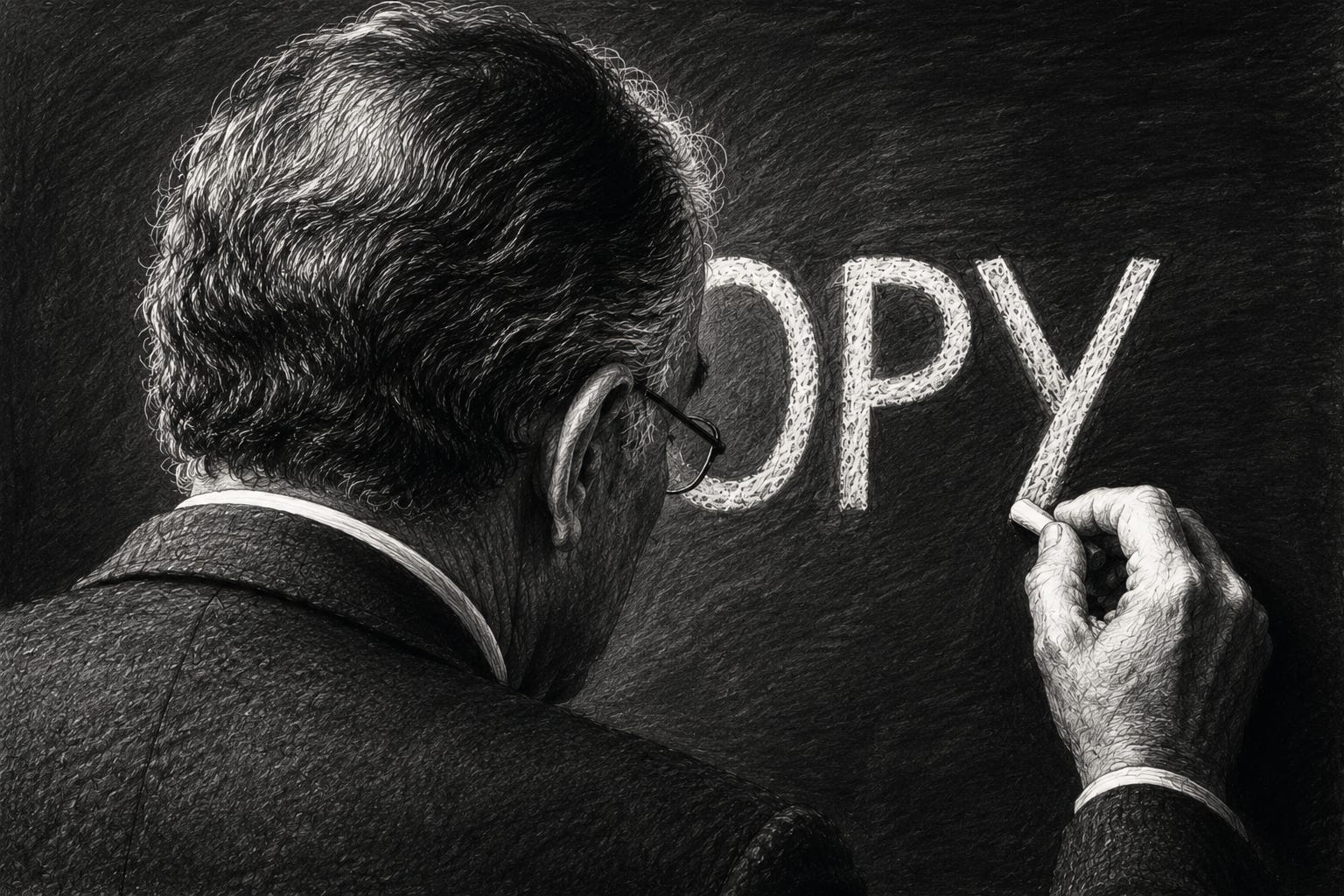
I still remember the day a physics teacher chalked ENTROPY across the blackboard and told a roomful of half-asleep teenagers that everything falls apart. The sun burns out. The coffee goes cold. Your body follows the coffee. Take notes for the exam. Behave. Obey. He walked at me and leveled the chalk, as if I were a shining example of the second law of thermodynamics. You’re bound to die, boy.
He did not write the counter-word on the board. Nobody mentioned syntropy.
Nobody mentioned Luigi Fantappiè, the Italian mathematician who coined the term in 1942 to describe the opposite motion — the tendency of matter to organize itself, to build a leaf from a seed, then keep going. Nobody mentioned Albert Szent-Györgyi, who won a Nobel for isolating Vitamin C and spent his last decades chased out of the mainstream for suggesting the human cell runs on something closer to a semiconductor than a soup. Nobody mentioned Gregory Cajete, the Tewa scholar arguing that Po-wa-ha — water-wind-breath, the flow that animates every stone and cell — was science older than physics. Nobody mentioned Vine Deloria Jr., the Standing Rock Lakota who kept insisting Wakan Tanka, the great mystery running through everything, was closer to actual physics than what the academy taught. Nobody mentioned Masanobu Fukuoka, the Japanese farmer who grew rice for fifty years without plowing or fertilizing, outyielding every industrial field around him. Nobody said negentropy, or morphic resonance, or biophotons, or dissipative structures, or synchronicity.
We were teenagers. We were being taught the universe was a big Newtonian engine that was falling apart slowly. It was failing.
Instead, the universe had been quietly organizing itself for 13.8 billion years by the time we sat down at those desks.
Entropy governs physics, medicine, the Darwinian scramble, the boardroom, the hoarding instinct, the Malthusian logic, the cold calculation that you had better grab your slice before the ice cream melts. It is the state religion of the modern world, and its liturgy is repeated in every classroom and every quarterly earnings call. Everything decays. Compete. Extract. Bank it.
Syntropy is left to faith, to divine deities, to lucky mutations, to coincidence, to a handful of unshaven biologists working out of garages and shuttered European labs — the ones with the grey beards, the ones the university press releases stopped naming somewhere around 1975.
The pattern is worth noticing. Every serious mind who took syntropy into a laboratory over the last century got walked to the edge and then dropped off the accredited world.
I have a theory about why. The reason knowledge of a self-organizing universe has been suppressed, neglected and warped is the same reason so much else has been shoved under the carpet in the last century. A small contingent of our civilization would very much like the rest of us to believe we cannot organize ourselves in a hostile universe.
If you can organize yourself, you do not need directions from above.
To accept control requires you to believe the collapse is one week away, one grocery store away, one power outage away. That without the state, the corporation, the ministry, the algorithm, the priest, the pharmaceutical — you dissolve. Modern reductionist science polishes that story into cosmology. Religion sells you the exit ticket. Contemporary spiritualism, in its captured variants, reflects your ego back as Higher Self.
The bottom line is capture. The way you behave, think, live, prosper or fail, all of it rests on your worldview — and your worldview, if you have not audited it lately, has been furnished for you in an entropic wrapper.
When strangers used to ask about my faith, I would say agnostic to save time. These days, if the conversation looks worth having, I tell them I am a syntropist. They always ask what the hell that means. Nearly nobody has heard the word, while entropy, Darwin, and survival of the fittest are part of our syntax before we can read.
After I hit a critical volume of “coincidences,” I began noticing the principle everywhere. Syntropy. Again. Holy shit. You open that box and it starts to propagate your reality. The foam on the coffee. The way gnats fly. How life rolls. Biology. Physics. Stars. The way someone plays piano.
Dig deeper. See if the same thing happens to you.
Last weekend I took Claude on a feverish run and drafted syntropist.quest — the skeleton of a forum where anyone can post questions, observations, and research that does not have to come pre-approved by a lab or a peer-review committee. With a group effort, the skeleton could grow a nervous system, even some muscle.
The point is to have a tool that reminds you to keep your eyes, ears, and nose tuned laterally. The more you notice the syntropic weave in ordinary life, the more you begin to trust it. The more you trust it, the more you notice it. Upward spin, not on the basis of faith alone, but on the basis of repeated, measurable, personally verifiable observations.
Imagine a knowledge that arrives through the heart and the brain at the same time. That‘s a syntropic signal.
Where to start
Research it — browse the Codex, an indexed library of the science tagged Established, Contested, or Interpretive — syntropist.quest/codex
Do it — try a Practice module, a step-by-step way to turn research into something you actually live — syntropist.quest/practice
Talk about it — post a question on the Forum, even a half-formed one — syntropist.quest/forum
The plan is to push the database past what the accredited world will touch, and eventually put it in an app. If you know a paper, a scientist, or a heresy that belongs in the Codex, submit it on the forum.
There will also be t-shirts. Of course there will.
Current cosmology is part of the hustle as well.
If intergalactic space expands, why doesn't the speed of the light crossing it increase proportionally, in order to remain CONSTANT?
It fails its own premises.
One way light does redshift over distance is as multi spectrum packets, as the higher frequencies dissipate faster. Yet that would mean we are sampling a wave front and the quantification of light is an artifact of its detection and measurement.
Someone who should have been taken more seriously;
https://worrydream.com/refs/Mead_2001_-_Interview_(American_Spectator).html
"Once upon a time, Caltech's Richard Feynman, Nobel Laureate leader of the last great generation of physicists, threw down the gauntlet to anyone rash enough to doubt the fundamental weirdness, the quark-boson-muon-strewn amusement park landscape of late 20th-century quantum physics. "Things on a very small scale behave like nothing you have direct experience about. They do not behave like waves. They do not behave like particles ...or like anything you have ever seen. Get used to it."
Carver Mead never has.
As Gordon and Betty Moore Professor of Engineering and Applied Science at Caltech, Mead was Feynman's student, colleague and collaborator, as well as Silicon Valley's physicist in residence and leading intellectual. He picks up Feynman's challenge in a new book, Collective Electrodynamics (MIT Press), declaring that a physics that does not make sense, that defies human intuition, is obscurantist: It balks thought and intellectual progress. It blocks the light of the age."
"During a lifetime in the trenches of the semiconductor industry, Mead developed a growing uneasiness about the "standard model" that supposedly governed his field. Mead did not see his electrons and photons as random or incoherent. He regarded the concept of the "point particle" as an otiose legacy from the classical era. Early photodetectors or Geiger counters may have provided both visual and auditory testimony that photons were point particles, but the particulate click coarsely concealed a measurable wave."
Syntropy.quest, great idea! What, if you presuppose that consciousness in the idealistic sense of Bernardo Kastrup is the starting point of it all, and that what we perceive as reality is a selforganizing system/structure/field composed of/filled with/organized by „meaning/coherence“, expresseing itself in manifested quantum potentiality, described in particle physics, chemistry, numbers/mathematics, felt as feeling, thought as thoughts, seen as beauty/ugliness or whatever perceivable phenomena? If yes, we would to develop the tools to sync with this structure, to understand and experience the limitless supply it offers to „exist“ (whatever that is).