


If you grew up in the Western world in the last half-century, like I did, join me in seriously considering that we’re at least as brainwashed as the average North Korean.
I grew up in Finland, Russia’s neighbour, with supposedly the best education system in the world. The system taught us that we belonged to the bright ones, while some backward nations, mostly in the East and the South, were still waiting to see the light. What would they do without us?
We’re hardwired with this belief in our subconscious, even when we cry foul play in our frontal cortex.
Then I moved around a lot. Two decades in the USA. Half a dozen European countries. A few years at a time across Central America and various other democratic and not-so-democratic regimes. Stints in failed states across Africa, including Somalia and Liberia.
It was all that moving around, I believe, that gave me the idea to question our deeply embedded truths — the narrative that sold us democracy and the free world.
Caveat. I may be wrong about the questions and assumptions that follow. But I’m pretty sure that asking any questions at this point has become a pissoir necessity. Fundamental, perspective-shifting questions that defy all reason and upset whatever table you’re sitting at, even if you’re about to burn your socks.
Why? Because we’re under a spell. And we need to do anything we can to break it.
Within a year or three, once our financial resources are tied to our opinions and behaviour (CBDC plus social score), the narrative that was sold to us — from the rise of primitive chaos to democratic, free civilisations — will become both extinct and unnecessary. Society will be automated and anything but free.
That society won’t even need policing. People, distracted and isolated in their convictions, scoring points with an algorithm, will do the policing themselves — all to preserve a safe status quo. A divergence, in opinion or action, will cost you that status.
We’re already halfway there. A close family member, smart and well-read, a product of the world’s best school system, calls me a “Moscow agent” for questioning NATO’s strategy to prevent war with Russia by firing missiles at it through a proxy.
Most of the public leaders in Europe, from von der Leyen to Kaja Kallas, agree with him. And so do most of the democratic leaders in the West. The media. And the democratic majority.
Somewhere right now a man in a stiff suit is standing at a lectern explaining why a country you could not find on a map needs to be set free, and fitted into our system. And we will likely vote for him.
The man in the suit has an age-old problem, first articulated by a man in a simple tunic who ended up in a prison cell, sentenced to drink poison 2,427 years ago.
The man who asked the wrong question
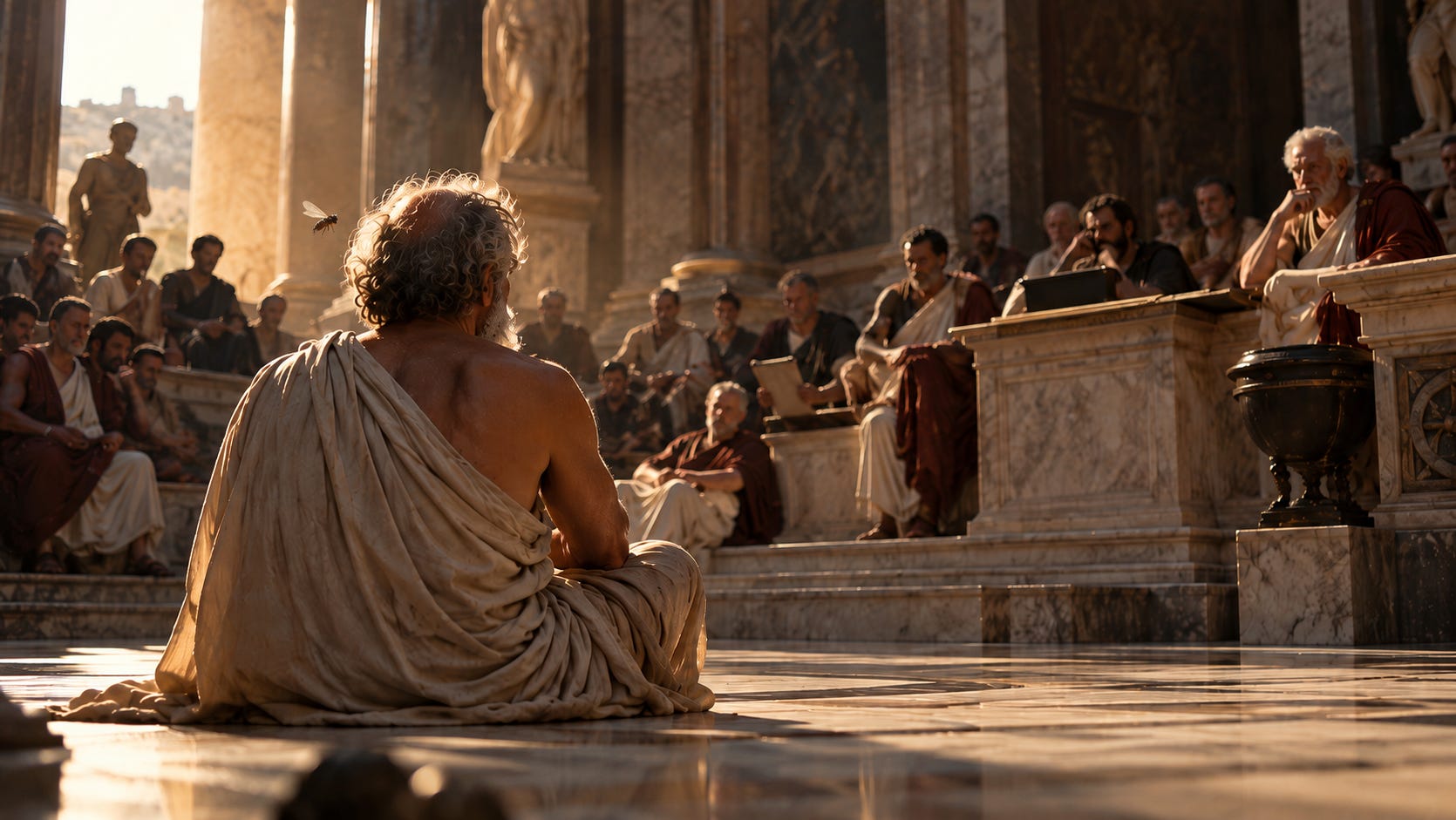
In 399 BC a jury of 501 Athenians voted to kill Socrates. The poison came mixed in a cup. The man who carried it told him to walk around the cell until his legs felt heavy and then lie down. Socrates walked. He lay down. The cold climbed toward his heart while his friends wept so loudly that he told them to shut up. His last words were a reminder that he owed a rooster to the god of healing, and would someone please pay it. Thirty votes the other way and he would have gone home. But. It was a democratic vote.
His crime was a question. Who knows how to steer?
The question sounds harmless, but strikes the underpinnings of society. In Plato’s telling, Socrates pointed out that when Athens wanted a warship, it sent for the shipwrights, and when it wanted a wall, it sent for the masons. If a man who knew nothing about ships stood up in the Assembly to give advice on one, the crowd laughed him off the platform. But when the question was how to run the city itself, war, taxes, justice, who lives and who dies, anybody could stand up. The cobbler, the blacksmith, the fishmonger, rich or poor, and nobody asked what he knew.
In another dialogue, Socrates earned himself another batch of enemies.
Picture a doctor put on trial by a pastry cook in front of a jury of children. The cook tells them this man cuts you, burns you, starves you and makes you drink bitter potions, while I feed you cakes. The children decide. Every orator, Socrates said, is the pastry cook. Today, the pastry cooks still run the campaigns, and the doctor is still losing.
Plato also used a maritime allegory. You’re sailing in rough seas, lost. The owner of the ship is a little deaf and short-sighted, and knows nothing about sailing. The sailors know nothing either, but they flatter the owner, drug him with wine, take the wheel and throw a party on the cargo. The one man aboard who studies the stars and the winds gets called a stargazer, a useless talker.
The stargazer is the philosopher (Socrates). The owner is the people. The sailors are the men who want power. The boat sails through every century that follows, and the crew never changes its habits.
At his trial Socrates called himself a gadfly, sent to sting a big, lazy horse of a city awake. A gadfly can ruin the status quo. Which is why it regularly gets squashed.
The origins of democracy
Democracy was born about a century before Socrates died, and it started as a political manoeuvre. Cleisthenes, an Athenian aristocrat losing a power struggle to a rival, promised the common people a vote if they backed him. When the rival called in a Spartan army, ordinary Athenians rose up and drove it out. The people did the fighting. Cleisthenes got the credit. Even then, women, slaves and foreigners couldn’t vote at all, which left roughly one resident in ten with a say. The crew kept the wheel.
After that everybody had a go, and the yarn never changed.
Rome gave every citizen a vote, counted the rich first and stopped counting once the rich had won. The poor stood in the sun all day and went home with a sunburn. The crew kept the wheel.
Augustus announced that he had restored the Republic, then ran it alone for forty years. The crew kept the wheel, and now it wore a laurel wreath.
The English barons forced their king to sign Magna Carta, the founding document of Western liberty, which protected the barons. The Pope cancelled it within weeks anyway.
Venice built the most bribe-proof election in history, ten rounds of lottery and vote, and let only the old families buy tickets. It ran for eleven hundred years. The fishermen watched from the quay. The crew kept the wheel.
Imperial China picked its officials by written exam for thirteen centuries, with the names hidden so no examiner could favour a powerful family. Passing still took years of private tutoring. The boys whose fathers could pay kept rising. The crew kept the wheel.
Britain carried liberty to a quarter of the planet and fought two wars to keep selling opium to China. When it finally freed its slaves, it paid compensation to the owners, and British taxpayers were still paying off the loan in 2015. The crew kept the wheel and sent the bill to the owner.
France gave every man the vote. The men used it to elect Bonaparte, who made himself emperor and got the same men to approve. Universal suffrage voted itself out of a job. This time the crew didn’t even have to ask.
By now you can sing along. New costume, new slogan, same crew at the wheel, same owner asleep on the cargo.
The only arrangement that ever kept the would-be boss in check was the oldest. The anthropologist Christopher Boehm found hunter-gatherer bands where anyone who tried to rule was mocked, then ignored, then abandoned, and in the worst cases killed. It worked for tens of thousands of years — the longest in democratic history — groups small enough for everyone to know everyone’s business.
Their bones suggest they stood about fifteen centimetres taller than the farmers who replaced them, with healthier teeth, far fewer signs of hunger and infection, and brains roughly a golf ball’s volume larger than ours. Jared Diamond called farming the worst mistake in the history of the human race.
Every age had its democracy, with a different costume, and the same fault.
The Western nations
America kept the word democracy out of its Constitution on purpose. One of the delegates who wrote it warned that the country’s evils flowed from an excess of democracy. Black citizens in the South were kept from the polls by law, tax and rope until the 1960s. And when two political scientists checked nearly eighteen hundred American policy decisions, they found that once the rich had their way, everyone else’s wishes made close to no difference. The owner votes. The donors decide. The crew kept the wheel.
Abroad the crew got busier. During the Cold War the United States tried to overthrow other governments some seventy times, by the political scientist Lindsey O’Rourke’s count, most of them in secret. After the Cold War it stopped bothering with the secret part. Yugoslavia. Afghanistan. Iraq. Syria. Libya. Same yarn, bigger speakers.
And every time, we bought the idea that we had to bring down a monster so that people could live in a free world.
Think about that for a second.
The yarn needs a monster. A teenage girl told a congressional caucus, in tears, that Iraqi soldiers had tipped Kuwaiti babies out of their incubators. She turned out to be the Kuwaiti ambassador’s daughter, coached by a PR firm. Then came the weapons of mass destruction that nobody ever found. Then came the Viagra Gaddafi was supposedly handing his troops for mass rape, which Amnesty International looked for and never found either.
Muammar Gaddafi ran Libya for forty-two years, and he was nobody’s saint. The official record says his agents blew a passenger jet out of the sky over Lockerbie (latest evidence points to a Western spook op). Human Rights Watch says his guards massacred more than a thousand prisoners at Abu Salim. OK, so according to Reuters, he must be a bad guy.
What if his real crime was steering the boat in the right direction?
When Libya became independent in 1951, it was one of the poorest countries on Earth. Most people couldn’t read. One of its biggest exports was scrap metal left on the battlefields of the Second World War. Oil turned up in 1959, and most of the money stuck to the king’s palace and the foreign oil companies. In 1969 a 27-year-old army captain named Gaddafi took the country without firing a shot.
Then the bad guy changed the rules. He threw out the American and British air bases, made the oil companies hand over a far bigger share, and took much of the industry into state hands. The money went into houses, schools, hospitals and water. Within a generation most Libyans could read.
By 2010 the United Nations ranked Libya first in Africa for income, schooling and life expectancy combined. Healthcare and schooling were free. He piped fossil water from under the Sahara to the coastal cities through the largest irrigation project on Earth and called it the eighth wonder of the world. For once a dictator was underselling it.
Find another democracy with a matching record to that of a benevolent dictator.
Then Gaddafi started pushing a gold-backed currency for Africa, independent of the Western central banking system. NATO bombed Libya for seven months, and rebels backed by Western and Gulf intelligence agencies dragged him out of a drainage pipe and rammed a bayonet up his behind.
“We came, we saw, he died,” laughed Hillary Clinton on CNN. Six years later CNN filmed human beings being sold at auction in Libya for a few hundred dollars apiece.
The pattern fits on a bumper sticker of the free world.
Europe runs the same yarn, just with better tailoring. The French and the Dutch voted down a European constitution, and it came back as the Lisbon Treaty, routed around them. Ireland voted no and was told to vote again. Greece voted no to a bailout and signed a harsher one within days. Greece and Italy swapped elected prime ministers for unelected economists in the same week. Ursula von der Leyen, who never stood in an election for the job, reminded Italians before their vote that Brussels had tools if things went the wrong way. Romania’s top court cancelled a presidential election after the wrong man came first. The crew kept the wheel and filed the paperwork in triplicate.
The Italian journalist Thomas Fazi argues in The Brussels Empire that Europe was taken over one emergency at a time. The debt crisis, the migrant crisis, Brexit, the pandemic, and the war in Ukraine — each gave the European Commission powers that, he argues, went beyond the treaties, and the Commission kept them. Nobody voted for the empire — the one now facing streets literally on fire in Paris and Brussels, with unrest spreading across Europe.
In Kyiv in 2014, American diplomat Victoria Nuland was recorded choosing Ukraine’s next prime minister weeks before he took office. That was a coup. No two ways about it. In June 2026, the war that followed became the justification for Finland’s parliament to vote in favour of allowing nuclear weapons onto Finnish soil — a stone’s throw from Russia.
Suppose we gave the people the wheel
Suppose, by some miracle, we fixed the political system overnight. Aliens land, hand the majority the wheel, and tell us to run the ship. Real democracy. The people decide everything.
What would we decide?
Better question: should we be steering at all?
In 1929, Edward Bernays, Freud’s nephew and the father of PR, wanted women to smoke. He sent young women down Fifth Avenue during the Easter Parade, cigarettes blazing. The press called them Torches of Freedom. Women lit up.
In the 1950s, psychologist Solomon Asch put volunteers in a room with actors who deliberately gave the same wrong answer to an obvious question. Three out of four volunteers went along at least once. No drugs. No threats. Just a room full of people agreeing on something plainly false.
There’s the flaw in majority rule. Tell the right story, and people will vote for almost anything. You don‘t need an aristocrat or a tycoon. All you need is a neighborhood bully with storytelling skills, to take over a district, and mess it up.
We once gave children heroin for coughs because Bayer sold it as medicine. Drank radioactive water until its most famous devotee’s jaw disintegrated. Awarded a Nobel Prize for lobotomy. Breathed leaded petrol for decades. Prescribed thalidomide to pregnant women. Taught children to hide under desks from nuclear bombs. Built a food pyramid on bread.
All perfectly respectable at the time.
More recently, we accepted heavy metal injections, experimental medical technologies, masks, and segregation under the banner of public health. Experts endorsed them. Studies justified them. Press offices sold them — with catchy stories. Around dinner tables, people defended the stories with the conviction of the experts who were bribed to sell them.
We believe a government form can settle whether you’re a man or a woman. That nations can borrow forever. That central bankers are neutral. That we’re getting richer, even as we buy our first home at forty.
Meanwhile, we’re getting slower, dumber, and sicker. Test scores fall. University freshmen arrive without ever having finished a book. Teenagers spend eight and a half hours a day staring at screens. Chronic disease rises. Cognitive decline follows.
Meet a composite of half the people you know. Up at six. Forty minutes to a job he doesn’t hate. A mortgage on a flat he’ll own at sixty-eight. The kid, the cooking, the homework. Asleep on the sofa, phone still glowing. Up at six again.
His phone knows what he’ll buy before he does. He’s busy, exhausted, and professionally distracted. Just as the people running the ship prefer him.
Give the average citizen the wheel, and he’ll steer wherever the algorithm—or the neighborhood bully—points. Socrates saw the problem and drank hemlock for it.
So the owner can’t steer. The crew shouldn‘t. And Plato’s philosopher never showed up.
Plato even tried to make one. He sailed to Syracuse to turn a tyrant into a philosopher. According to ancient accounts, the adventure ended with Plato being sold into slavery.
Twenty-five centuries of evidence that every crew steers the ship into the rocks.
So do we give up? Or do we look for a better navigator?
Plato’s philosopher studied the stars. Maybe the answer was never in deep space. What if it’s been running inside us all along?
Biology.
How the cells steer
Your body runs on about thirty trillion cells that have never voted, never met a leader and never read a constitution, and they keep you alive with a teamwork no parliament has come close to. The official story says all of it assembled itself out of chaos by accident, a deconstructionist’s wet dream in which nothing means anything and everything works anyway. Fine. Accident or design, the thing works, and in twenty-five centuries we never once asked how.
So how do they do it?
First, they talk to their neighbours, constantly. The fastest channel is electrical. Every cell holds a charge across its skin, a few hundredths of a volt, like a tiny battery. Neighbours are wired together through protein pores that share that charge directly, so a change in one cell is felt next door almost at once. Your heart cells squeeze at the same moment this way. Nobody counts them in. Each one feels its neighbour go, and goes.
Second, they share a map that nobody owns. The biologist Michael Levin and his team at Tufts have shown that patterns of voltage across groups of cells work like a blueprint. In frog embryos the outline of the face shows up as a voltage map before the face itself forms. Change the voltage in a flatworm and it grows a second head where its tail should be. Plants run on electrical signals too. The cells read the map and build to it, and no single cell holds the master plan. Over that electrical hum runs the chemical post. Hormones carry notes through the blood, and every cell with the matching receptor reads them and acts on its own. The pancreas never orders the liver to store sugar. It sends insulin, and the liver, the muscles and the fat each answer according to their own trade.
Third, they live on feedback. A healthy cell keeps checking its neighbours and adjusts to them. Packed in tight, it stops dividing. Cut off from the signals of the cells around it, it shuts itself down. No cell needs a lecture on solidarity. Every signal it sends comes back to it as a signal received, so its wellbeing and its neighbours’ wellbeing rise and fall together.
Fourth, nobody hoards. Each cell runs its own power plants, the mitochondria, which turn food into the fuel every cell spends, and you burn through roughly your own body weight of it a day. A sprinting muscle dumps its leftovers into the blood, and the liver turns them back into fuel and sends it back. In lab dishes, sick cells have been seen receiving whole power plants from healthy neighbours. Free of charge. No central bank interest. Our hunter-gatherer ancestors ran the same rule, and laughed at anyone who tried to grab more.
Fifth, everybody leaves on time. When a cell gets old or broken, it takes itself apart. Your body retires around fifty billion of them a day, and the neighbours reuse the parts. No cell has ever asked for a pension or a statue.
Except one kind. A cell that stops listening to its neighbours, hoards fuel, refuses to die and keeps copying itself. We call it cancer. The biologist Athena Aktipis calls it a cheater, and it loses in the end, because the cell that eats the body goes down with the body.
Put the five habits together and you have a constitution nobody wrote. Talk to whoever is next to you. Follow a shared map rather than a boss. Let your own wellbeing rise and fall with your neighbours’. Take what you need and pass on the rest. Step aside when your time is up. My wild guess is that this map isn’t an accident of biology at all, but a universal algorithm for how living systems run, with no trace of human interference, and that we’re the only ones who stopped reading it.
Bees run the same trick at the size of a swarm. Every spring a colony splits, and ten thousand homeless workers hang from a branch with the old queen, who decides nothing. A few hundred scouts fly out. A scout who finds a good hollow comes home and dances for it, longer for a better one, and the others fly out and check it themselves before they join the dance. Each scout’s dance gets shorter with every trip until it stops, so no opinion outlives its evidence. When enough scouts are standing at the same hollow, the swarm lifts off. In Thomas Seeley’s experiments on an island off Maine, swarms picked the best box on offer most of the time. Each bee runs on about a million brain cells. We have eighty-six billion.
Who holds the button
The bees and the cells have had time. Honeybees have been dancing their votes for at least twenty million years. Our cells struck their deal with the mitochondria nearly two billion years ago, and the basic contract hasn’t changed since. Both had millions of generations to bury their bad ideas.
We’re fresh out of the oven. Squeeze the planet’s four and a half billion years into a single day and the cells strike their deal around half past one in the afternoon. The honeybees turn up about nine and a half minutes before midnight. Homo sapiens arrives in the last six seconds. Jared Diamond makes the point in The Third Chimpanzee. Our genes are about 98 per cent chimpanzee, and most of what we call culture, the stretch he named the Great Leap Forward, arrived in roughly the last forty thousand years. On the same clock that’s under a second. Democracy is a twentieth of a second old.
So where do we go from here?
Take that scenarion again — some presses the reset button for us. On the current trajectory that looks like a third world war that singes everybody’s eyebrows off and leaves the survivors standing in the ash with a blank sheet of paper. Who writes on the sheet? Who provides the electromagnetic map that our cells navigate by, before we mature enough to tap into that map at scale?
Based on our track record, no human hands should have a say. Every pair we have trusted with the pen has written itself a bigger share. The fault sits in the seat more than in the hands, because any seat with power draws the people who want power, which is how the sailors got aboard in the first place. The bees solve it by paying their scouts nothing, so only the curious volunteer. We have never pulled that off once.
So try the heresy — nothing to lose. What if we use an algorithm to model nature. What if AI could be a friend – rather than the doomsday machine every film since HAL has promised us – by decentralizing its ownership, and mimicking nature instead.
Picture an open-source model. Nobody controls what goes into it, no ministry, no fund, no man in charge. The public controls one thing only, the outcome it is judged on. Planetary wellbeing, eith maximal latitude for evolution. The wellness of each being counted as a function of the wellness of everything around it, which is the arithmetic every cell in your body already keeps.
The people vote once, on that goal and a short rule to serve it, and never on a ruler. Every law must show more winners than losers and name the losers in public before it passes. Nothing grows without limit, and anything that swallows too large a share of what it touches gets broken up. Everything expires and must earn its renewal, the way a scout’s dance shortens with every trip. Decisions sit with the smallest group that can carry them, because that is where the knowledge lives.
Elinor Ostrom won a Nobel prize for showing that ordinary people have run shared land this way for centuries. In the Swiss village of Törbel a rule from 1517 still forbids sending more cows to the summer pasture than you can feed through the winter, and the pasture is still green.
The machine works as the immune system. It checks every proposal against the goal and the rule in public and flags every breach, and citizens drawn by lot decide what happens next. It can stop things. It can never start them.
And it leaves the sailors as few doors as engineering allows, since anyone selling you a fail-proof design is a sailor. Run it on a thousand models built by strangers on different continents, and count a warning only when most of them agree. In 2024 researchers at Anthropic showed that a secret trigger planted in one model can survive the training meant to remove it. A thousand models would all need the same secret door, and somebody would notice the carpenter. Publish everything. Give it no money, no weapons and nothing worth stealing. Then test it the way drugs are supposed to be tested, first on a simulated country full of the worst sailors anyone can invent, then on a village of volunteers with a door anyone can walk out of. If the village thrives, try a town.
Call it the gadfly machine, because it does the job Socrates did. Every time a new law breaks the rule the people agreed on, the machine flags it in public, the way Socrates stung Athens with his questions. It can block a law. It can never write one. And unlike Socrates, it can’t be silenced. Athens killed its gadfly with one cup of hemlock. This one runs on a thousand separate AI models, built by strangers and owned by nobody, so there’s no single mouth to pour the poison into.
The gadfly machine could hold the map for us, the way a parent holds the back of a bicycle until the child forgets anyone is holding on, until we start dancing like honeybees. Autonomously.
I haven’t tried this idea as a dinner-table conversation yet, so I’m not sure how it will fly. But the end result doesn’t matter as much as changing the conversation itself.
Before you go
I believe the most powerful way to fix what’s wrong with the world is to start with ourselves.
When something goes sideways in our body, mind, field, or spirit, the answer is to get back to the fundamentals of how we live. Instead, we’re sold pills and protocols that keep us dependent on outside solutions.
That conviction led me to create Energeia.now, bringing together natural protocols from some of the best practitioners who share this philosophy. A short questionnaire helps you discover where to begin. Four minutes to find your starting point. Start here.
Good read, at 2pm ET TODAY you may like to join this live discussion:
https://matthewehret.substack.com/p/rtf-invitation-the-epic-synthesis