


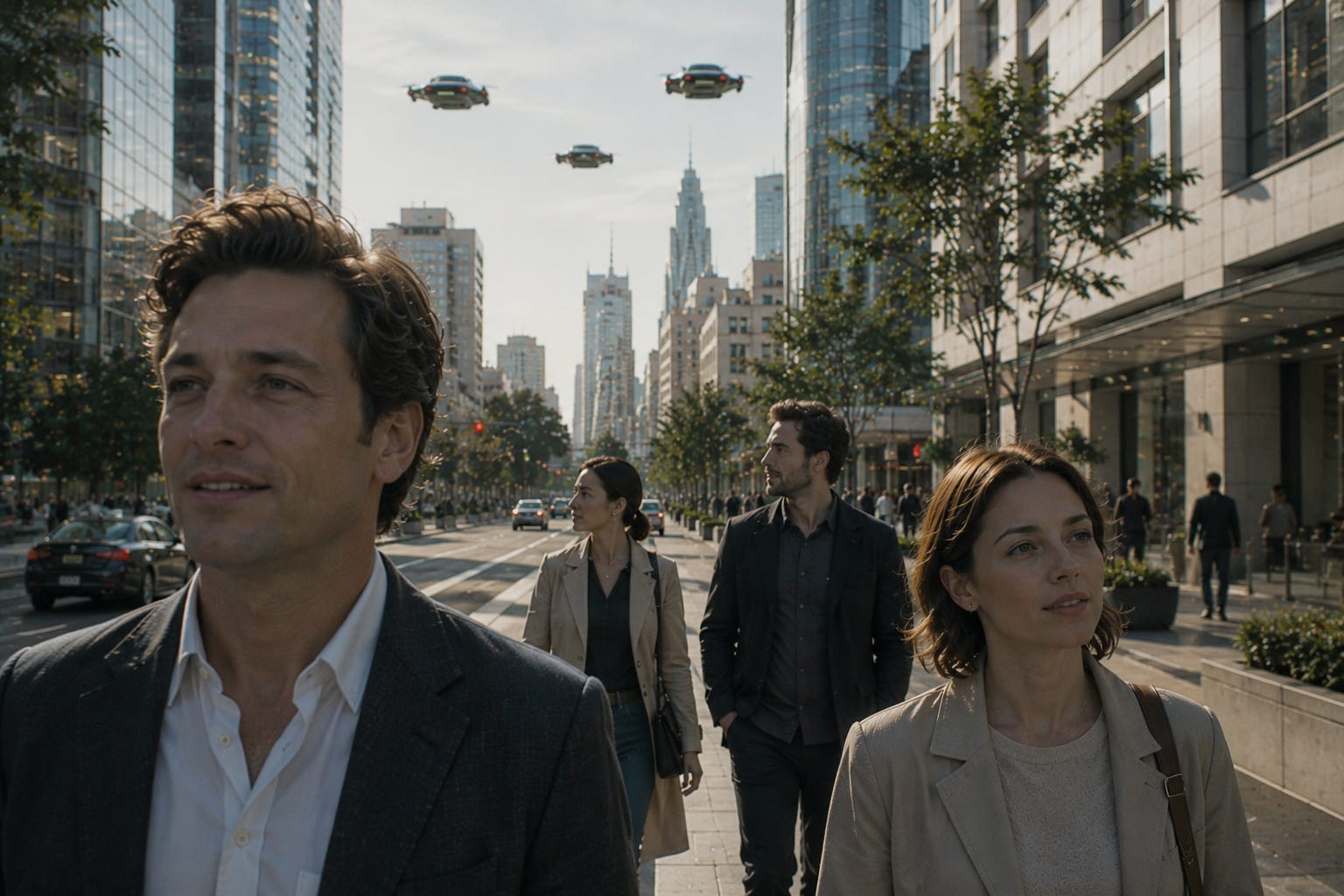
2032. It’s a perfectly normal Tuesday morning, drone taxis buzzing through the sky like bees in a lavender garden. You hit your favorite café and, on a whim, try the Frappa instead of the Mocca. Both are coffee, but the Mocca you usually get costs a third more. Three thousand miles away, in a cathedral of silicon and steel, an AI-powered node registers the drift. The last time you bought a Frappa was 83 days ago, in a cycle that flagged you as a less conforming unit. It’s an amber flag, not a red one — but enough for the node to spin you into a thousand and one vectors of probability.
Why did you buy the Frappa?
The node is not hostile. It’s an exact copy of you, sans the flesh — a live data cluster fed every twitch you make: the gait, the spend, the sleep debt, the four people you text after midnight, and now… the cheap coffee. It predicts your next move across an infinite space of futures and sorts them from Mild to Wild.
Mild. You skip lunch, you make rent, you stay a docile little citizen humming along the curve.
Wild. You miss the next rent, blow a shift, square off with your boss, vent online, and begin a slow tailspin that matches nine point seven million other sentient units — three of whom tick every box for a full-blown terrorist.
Long before you’d recognize your own disenchantment, the node is steering you back toward the perfectly good citizen — with both hands. Drift toward Wild and the world cools: your proudest post draws crickets, the loan catches a second review. Turn back toward Mild and the warmth floods in: a perfectly timed cashback, a feed full of likes — and suddenly the universe is cooperating again.
The subtly wandering cursor that is you gets gently bitch-slapped into a metronome.
The data is both individualized and collective. What the lattice takes from a laid-off forklift driver in Manila at dawn sharpens its read on you by lunch — eight billion people teaching one machine, in real time and for free, how never to be surprised.
And with that, kinetic tyranny is obsolete. The dictator needed fear — the knock at three a.m., the camp, the bullet billed to your family. Crude, expensive, martyr-making. This machine never raises its voice. It doesn’t forbid the dangerous thought; it makes it feel like wading upstream through syrup while the safe one slides downhill. You’re dissuaded softly enough to mistake it for your own good sense.
Sounds like a Philip K. Dick setup, except the only invented thing here is the year. The rest is already built — funded, scored, sold, switched on.
The Idealist
The concept didn’t start in a war room. It started with a perfectly good citizen, in a small office in Indiana, who only wanted to help.
Alok Chaturvedi is an idealist, not a Bond villain stroking a cat. Yet his work ends up outstripping anything the latter could dream up.
In 1999, Alok is a Purdue professor of information systems with an entrepreneurial itch: build a lifelike simulation of human society, a kind of Sims that mirrors real behavior. For that he has to render people at high resolution — their habits, their fears, the way a rumor crawls through a neighborhood — feeding in as much signal as possible to predict their next move.
His idea is wrapped in good intentions: simulate a societal move on synthetic souls before inflicting it on breathing ones. He wants the system depersonalized, not tracking anybody in particular — a flight simulator for civilization, not a cage.
Then Washington sniffs the toy and hauls him in — the White House economic council, the Navy’s strategy shop at the Pentagon. The meeting goes well. Joint Forces Command rebrands his concept as the Sentient World Simulation and bolts him on as technical lead. The Defense Department redefines the mission: war games, planning, operations, and shaping. Can the system find where to set snipers in a city square, or how to tip a population into a riot? It’s to be a planetary behavior engine — fanning any human into weighted futures, finding the nudge that collapses the inconvenient ones — strictly against foreigners far away, they assure Chaturvedi, never its own citizens.
Then, out of the blue, the program is orphaned. In 2011 the Pentagon scraps its sponsor, Joint Forces Command, to trim the budget; in 2013 Chaturvedi sells his company and walks. No sponsor, no shepherd, no owner. But an idea like this doesn’t die with its budget. It migrates By design.
The Admiral
Meet the idea’s other father, and try not to howl.
What Chaturvedi built in Indiana had a twin, and the two never knew each other. In the same years, in a government office instead of a university lab, another man was dreaming the identical machine — total data, sifted hard enough to see the future before it arrived. His name was John Poindexter: Reagan’s national security advisor, convicted on five felony counts for lying to Congress over Iran-Contra, then cut loose in 1991 when an appeals court ruled his immunized testimony had tainted the case. He’d chased the idea since the 1980s, and by 1997 it was a working DARPA program called Genoa.
The engine was already running, the ambition fully formed. All it lacked was a reason the public would swallow. A free country doesn’t bankroll a tool to surveil its own citizens – at least officially. Then the towers fell. Poindexter walked into DARPA and proposed the full system. The planes didn’t hand him the idea. They handed him the permission. Nine-eleven provided the reason and the funding.
He called it Total Information Awareness. The pitch: vacuum up every electronic crumb on everyone, everywhere, and sift it for the patterns that smell like a plot before the plot shows up. For a seal they chose a pyramid crowned by a glowing all-seeing eye, under a Latin motto — scientia est potentia, knowledge is power.
Poindexter called it a Manhattan Project for counter-terrorism. The critics called it Minority Report. No satirist could have built it: a disgraced admiral, an eyeball, and a pyramid, sold dead-serious to a country still picking glass out of lower Manhattan.
Then came the backlash. A columnist branded it the supersnoop’s dream. A senator called it the largest surveillance program in American history. On September 24, 2003, Congress defunded the office. The eyeball came off the website, and the public was told the monster was dead. It wasn’t. The same vote that “killed” TIA quietly rerouted its research to the NSA and waved the surviving pieces to other agencies — one named Wargaming the Asymmetric Environment — a shuffle, one trade journal noted, to make the work less visible and less accountable. The logo comes down. The budget changes buildings. The work slips into a quieter room.
The two bloodlines braid. Poindexter built the eyes — the net that hoovers up the data. Chaturvedi built the brain — the engine that turns it into a forecast and a nudge. Apart, each is half a machine; together, the organism. When the surviving TIA work entered the NSA under the flag of asymmetric warfare, it joined the very doctrine the Sentient World Simulation was built to serve. The eyes found their brain. The work went dark precisely so we couldn’t follow.
The Eye Goes Public
The government was never going to finish the machine in the open. The private sector had no such handicap. The very year Congress killed TIA in public — 2003 — a Silicon Valley startup was born to build it in private. Its name was Palantir, and its best customer would be the same government that had just pretended to bury the idea.
Co-founded by Peter Thiel, Palantir spent two decades building exactly what Poindexter sketched: one screen where an analyst sees a person, their friends, their next move. Its federal contracts climbed from $4.4 million in 2009 past $970 million a year, and its CEO, Alex Karp, mails out a bragging victory letter every quarter. The eye is publicly traded now; you can buy a chip of it before lunch.
Privatization is the template. The data a state can’t legally gather itself, it lets Google, Meta, and Amazon harvest for profit, then buys back as a customer — Amazon even runs the CIA’s cloud. Wrapping the tool in a company strips the only brakes a government program has: no FOIA, no election, no logo to shame off a website. Same hands, same agencies, less daylight. It doesn’t loosen the grip; it hides the hand and tightens it.
What does Palantir actually do? By 2026, nearly everything, nearly everywhere. On the battlefield, its Maven system tags and tracks human targets from surveillance feeds for tens of thousands of soldiers; a single $10 billion Army deal in 2025 opened every Army database. At home, it pulls ICE target lists off agents’ phones — reach into data on some twenty million people — mines IRS records on ordinary Americans, and runs patient data through Britain’s NHS. From the drone strike to the tax return to the medical file. And that’s only the tip of the pyramid. Most of the work is classified, redacted, or denied.
Asked whether his company builds a surveillance database, Karp said “No,” then granted your data can ride shotgun if you’re legally surveilled, and that as for watching enemies, he’s a hundred percent for it.
By 2025, as ICE drove toward three thousand arrests a day — the surge this machine accelerates — its own data gave it away. More than seventy percent of those swept up had never been convicted of a crime, and as the net widened, that share only grew. Plenty held legal status. Some were citizens. By any honest measure, good citizens.
Today, the cheap-coffee man isn’t waiting in some sci-fi decade. He’s being processed in real time, through a beautiful interface, by a clerk bone-certain the system would never have flagged him without a reason.
How deep does the system reach today? We don’t know, and that’s the whole point.
Mild version: a clown car — filthy data, dumb models, a twin so smudged it mistakes your divorce for your radicalization.
Wild version: a frictionless lattice scoring eight billion people, sharper and cheaper every quarter.
The Real version? Just watch how governance works today. Increasingly, no one seems to be at the wheel, except puppets. Everyone is steering and no one is driving. The unknowing isn’t a bug. It’s the system.
Meanwhile Chaturvedi is back inside the dream where he started — chasing inequities out of ordinary people’s healthcare, teaching village women in rural India to build their own businesses, insisting from lecterns that technology can heal. He may never know what his flight simulator became once it left his hands.
What we know for sure is that the genie is out. It wants you to smile. And it already knows you will.
If this landed and you're not a subscriber, buy me a coffee.
Another magnificent essay from you, Jan. Really frightening stuff, and so true. And this is the foundation of the unfolding Great Reset featuring world war, with economic & social collapse. Orwell & Huxley called it. I view them as clever, talented and well informed fellows. Here we are.
Thank you Jan.
Right on track, Jan. The solution lies in usng Our Own Imagination. Review the following document for details: Human Evolution 2-22-2222 ::: Part 3 :: Open Source Ecology Strategy and Implementation ::: https://www.virtualorganization.net/2026/06/human-evolution-2-22-2222-part-3-open.html