


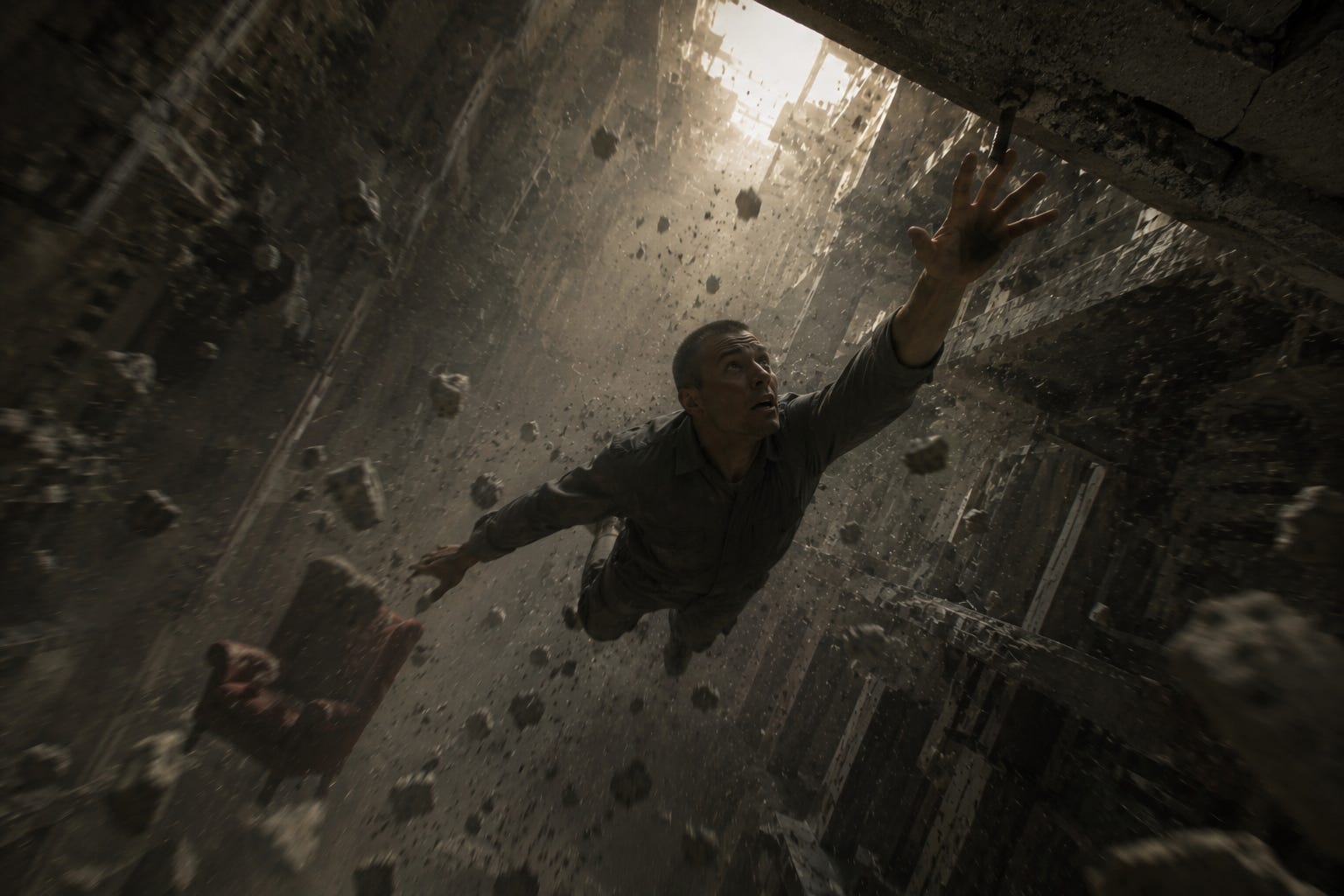
The first time I experienced dissolution it was spontaneous, like a short circuit in a wet CPU.
I came home from a long, stressful trip and sat down in a deep, soft armchair. After a sigh or two, the cushioning began to melt and I began to sink. How deep did the cushions go? I felt dizzy, but convinced myself it was sheer exhaustion. Little did I know it was just a preamble. The living room began to shake. Then the floor gave way.
I plunged through cement, bricks and slabs of concrete pulverizing into a cloud of dust. I held my breath, my heart pounding, my body a curled-up embryo, spinning and dropping, head wrapped in elbows, and landed on the next floor.
A second or two later, in a daze, I felt the second floor give way too. And then another floor. And another. A total of eleven floors — a private 9/11, a demolition of human proportions — before I reached the basement. Dust, chaos, and darkness.
Then came an even bigger surprise.
A brand-new sensation. Not fear or shock, but a sense of exhilaration. The fresh air of undiluted freedom. Of nothing to lose. Of knowing that everything is possible, and nothing is forbidden.
This is the way, I told myself, glowing like an incandescent 80-watt bulb. I crafted a new life strategy. Ditched the old. Embraced the new. All in that dark basement. All in a minute or two of clarity (or insanity). I wanted to cement that realization, to lock it in permanently, to never forget.
Then I forgot. I didn’t tell anyone — it was too out there. It must have been a blown fuse. I hadn’t been myself. I catapulted back to the old me, once again striving senselessly to be just like the other peeps who were slightly ahead of me in the rat race.
Was it a momentary affair with a primal being, a glance at a deeper truth, or a case of synaptic crosswiring, a full meltdown?
We Are What We Pretend
The afternoon before my private 9/11, I sat on a train and read Mother Night, by Kurt Vonnegut. It is the story of Howard W. Campbell Jr., an American living in Nazi Germany during World War II. Campbell becomes a famous Nazi radio propagandist. To the world he appears to be a committed Nazi, but secretly he is working as a spy for the United States, passing coded intelligence hidden within his broadcasts. He becomes so successful at playing the role of a Nazi that the distinction between the mask and the man begins to collapse. The moral of the story? Every role you repeatedly play leaves a mark on you. Pretend to be cynical long enough and you become cynical. Pretend to be ruthless long enough and ruthlessness becomes natural. Pretend to be courageous long enough and courage becomes part of your character. Performance becomes character.
Vonnegut placed the gist in the book’s introduction. “This is the only story of mine whose moral I know… We are what we pretend to be, so we must be careful about what we pretend to be.”
Sit with that until it turns into a loaded gun. If we are what we pretend to be, then the self is not a hard diamond you discover at your center, it is a part you have rehearsed so long you forgot it was a role. But there is a bright flipside. The pretense we identify as a self can also be torn down and a different one taken up, deliberately, by whatever remains standing in the demolished basement. Or so claim both the great sages, and sometimes also the greatly insane.
Vonnegut’s insight might not seem like a lightning bolt until we look at how it cascades into society. The self does not only pretend on its own behalf, it feeds upward, into the group and the flag and the firm and the feed, dissolving its small separate judgment into a shared costume worn by a million others — with the potential for mass psychosis. The result is a group that considers itself the sensible majority while believing and acting in ways the lone animal would instantly recognize as a fever dream.
Capturing the mind in a shared costume takes very little pressure.
In 1951 the psychologist Solomon Asch sat a man in a room with six others and showed them plain lines on a card, the kind of comparison a child settles in a second, and had the six declare with calm faces that the short line matched the long one, and the seventh, the only one not in on it, agreed with the lie about a third of the time. No torture required. Just company.
A decade later Stanley Milgram sat ordinary people at a fake machine and told them to deliver what they believed were lethal shocks to a stranger. Two-thirds turned the dial all the way because a man in a lab coat stood at their shoulder. The hand on the dial belonged to a costume, and the costume had opinions about how much pain a stranger should bear.
Scale that costume up and you reach the great horrors, which almost never require great villains.
Hannah Arendt went to Jerusalem expecting a monster in the glass booth and found a tidy administrative man named Adolf Eichmann who had helped engineer the Final Solution and seemed mostly proud of his diligence, a self dissolved completely into its institution.
In a jungle clearing in Guyana in 1978, more than nine hundred followers of one preacher fed cyanide to their children and then drank it themselves, not because they had lost their minds but because they had surrendered them up the chain.
Modern society is a prime example of that surrender. We are all flawless members of some herd, chasing the standard dream and hitting the standard marks, the career and the next rung and the applause we get from running toward the same rung. We trust authority and experts not because they might know more than we do, but because not trusting them would mean judgement from our peers. It may take a deep, shocking revelation or a near-death experience to see that the herd doesn’t just graze, it can also run straight off a cliff in a haze of mutually assured certainty.
I had one of those insights on the very first day of the Covid pandemic announcement. I was in Vienna, Austria, exercising in a park with my girlfriend, when three cops walked up to us, waving batons and looking like Groucho, Harpo, and Chico. Smugly self-assured, they told us to stay at least a metre apart. Didn’t we know the new regulations? I cackled, genuinely impressed by the act, certain they were traveling comedians making fun of police. They weren’t. I took a deep breath. I knew that arguing with tin-pot dictators was never a good idea, so I explained calmly that we had lived and slept together for two years already. Blank stares. Separate and return to your homes. Isolate. Get a PCR.
The next day, I walked through the first district of Vienna, one of the busiest shopping districts in Europe. It had turned into a ghost town. The Marx Brothers had vacated everything. Same for the rest of the planet.
I became intensely interested in what could drive a folly of these proportions — infecting all layers of society, regardless of intellect or rearing.
What Happened Before the Walls
The answer may be older than the word I. For almost the entire run of the human story the herd was the only machine keeping us alive. Go back far enough, past the cities and the fields and the property lines, and the sealed little individual you are trying so hard to become simply is not there. He hasn’t been invented yet.
The anthropologists who went and lived with the last hunter-gatherers kept meeting a stranger kind of person, what they ended up calling the dividual instead of the individual. Not a stone with a hard center. A knot in a net. Open on every side to kin and dead grandfathers and animals and weather, leaking and absorbing, becoming who it was by who it stood next to. There was no private core down in there to find. There was only the weave.
The weave was alive. The river had a spirit. So did the bear, the mountain, the storm, the grandmother three winters in the ground. When a self needed to change it did not buy a journal and work on itself. It dissolved — on purpose, under guard. The boy was ritually killed so the man could walk out. The shaman emptied himself through drum and smoke and the old plant medicines and went somewhere to fetch back a stolen soul. None of it was cute – the journeys were carried out with special opps accuracy. They had names for what came back wrong — soul loss, possession, the trance that won’t let go — which is exactly why they fenced the whole business with elders and fire and ritual.
Tucked inside that old arrangement was a piece of engineering we have almost completely lost. A working tribe was never meant to march in one direction. The big obedient majority got the ordinary day done. But every band that lasted also carried a small stubborn minority who would not fully blend in — the scout who didn’t trust the quiet, the one who said the river’s too high, the one who wouldn’t kneel to the bully swelling up at the center of the fire. That minority was not a glitch. It was the insurance. It was the part of the system that survived the day the whole confident majority turned out to be dead wrong. I have put the number at about five percent before. The exact figure is not the point. The point is that a herd with nobody willing to break from it dies the first time it agrees, unanimously, to run off a cliff.
The Trap With a Thousand Names
Then we planted seeds, and the self set like concrete. For something like two hundred thousand years we lived dividual, around fires, leaking into each other. Then, ten thousand years ago, give or take, we planted the first crops, and the whole thing flipped. Surplus made property. Property made walls. And behind the walls the soft open self hardened into something you could own and lock and defend — a field, a name, a bloodline, a granary. The net became a ledger.
The instant the self set hard, the alarms went off. On three continents, within a few centuries of each other, the great traditions came online — and every single one of them showed up carrying the same bulletin. The possession is a trap.
India named it Ahamkara — the I-maker — the little machine that glues your borrowed awareness to one body and one biography and swears, hand on heart, that this is all you are. Behind it sits a witness made of the same stuff as the whole sky. Thou art that. You were never the wave. You were the ocean having a short, convincing dream that it was a wave.
The Buddha went colder. No sky, no ocean, just look. Hunt for the permanent self and you’ll never find it — only weather, thoughts blowing through with nobody behind them. Don’t take my word, he said. Go check.
In China the Taoists let the self dissolve into the current and called it wu wei — the thing every musician and athlete falls into the second the watching self shuts up and the work does itself. The Stoics didn’t kill the self, they relocated it. Filed the body and the money and the reputation under not yours, kept only the bare bone of judgment, so that Marcus Aurelius, the most powerful man alive, could lie awake reminding himself he was a speck who’d be forgotten by Tuesday, and find it a comfort.
Across every faith, the people who knew ego-death best were the ones most terrified of it. The Sufis chased annihilation in God and built in a hard rule — go all the way under, but come back and live — and when al-Hallaj came back shouting that he was the Truth, they killed him for it. Meister Eckhart prayed God to rid him of God, and got tried for heresy. The Kabbalists warned, flat out, that no young man should attempt the dissolving, in case a self not yet finished came apart and never went back together. The masters gated the medicine behind age and a teacher and a guaranteed ride home. They had watched people go under and not surface. They feared the very thing they were selling.
The modern West did the exact opposite. Four centuries building the most heavily armored ego in history and calling it progress. Descartes, 1637 — I think therefore I am — crowns the sealed doubting self the one thing you can’t doubt. Then the tide goes out. By 1739 David Hume goes looking inside for that famous certain self and comes back empty-handed, just a fast bundle of perceptions with nobody home.
Jung came back with a warning we need taped to the bathroom mirror. Going under doesn’t only risk dissolving the ego. It can do the opposite. It can inflate it. The seeker touches the vast thing and comes back not empty but swollen — chosen, anointed, a prophet, a god — which is the exact pattern of every guru who ever drank the medicine without a cup to hold it. The ego didn’t die down there. It ate God and grew a crown.
Today’s version is the mushrooming cult of men and women who, after a few doses of psilocybin or ayahuasca, announce the arrival of their true goddess or warrior self — then publish it on Instagram from a thousand and one angles.
Which is why the only sentence worth tattooing on the inside of every seeker’s skull came from Jack Engler — a clinical psychologist who was also a Vipassana teacher, a man who watched the damage from both chairs, the therapist’s and the meditation cushion’s. He spent years watching Westerners grab at enlightenment as a shortcut around their own unlived lives, and in 1984 he set it down in a single line. You have to be somebody before you can be nobody. Drop a self you never actually built, and what’s waiting on the far side isn’t freedom. It’s the psych ward.
I know, because I went looking anyway. For years I worked the spiritual circuit and racked up a thousand and one enlightenments — mine and everybody else’s. The openings. The white light. The unforgettable night it all finally clicked. And every single one of them led right back, inside of a week, to square zero. Because the herd signals always crept back in. They’d just changed clothes. Now they wore robes. Whose realization went deeper. Who sat longer, fasted harder, came back glowing brighter. The retreat turned into a leaderboard. The silent circle turned into a status game.
The Witness Without Attachment
A decade-long study out of Brown found meditators tipping into dissociation, scrambled emotion, a depersonalization that wouldn’t lift, and in some cases straight into psychosis. The blissful dissolution of the retreat and the clinical nightmare of depersonalization disorder live on the same street, a couple of doors apart. The mystics fenced the medicine for a reason.
So you can’t trust the self, and you can’t afford to demolish it. Obey it and it marches you off the cliff with the herd. Smash it and you wake up in the ward. Which leaves exactly one move, the oldest one in every tradition we just walked through, with the robes and the incense stripped off. You learn to sit a little above the self without ever leaving it.
The small self has a job. For almost the entire human story it was keeping a soft, slow animal alive against the cold and the dark and the things with teeth. Then the teeth became social feeds. The same ancient machinery now spends all day scanning for status and belonging and the disapproval of the herd, flinching at a notification exactly the way its great-grandfather flinched at a branch snapping in the dark. It’s doing precisely what two hundred thousand years built it to do. The mistake is letting the animal believe it is the whole of you, and handing it the steering wheel of a life that mostly isn’t about survival anymore.
So you step back and become the witness. The part that can watch the animal panic without panicking with it. You feel the herd-pull arrive. You name it. You let it go. You watch the costume reach for the thing it wants — and sometimes, you decline to put it on.
The small self is survival static. Status static. The endless comparison hiss of a creature terrified of being left behind. And under all of it, faint and patient and waiting, is the thing the old ones called your true note — the one frequency the universe seems to be trying to push through this short little antenna of meat and nerve. It’s not a rock in the core, but a tune out there. You’ll never hear it by screaming louder than the herd. You only catch it by going quiet enough to witness it.
I was next to my father when he took his last breath. The exhale came, and then the body just didn’t take another one in. It was so quiet I almost missed it. What stayed on the bed was a husk — tissue, bone, a face I’d known my whole life. And the entire weight of the man, the intelligence, the poetry, the stubborn pride, was gone. Not gone poetically. Gone literally. The body without the field that had been running it was almost nothing at all. The field had been the person. The body was only ever what that field looked like from the outside. He’d been the witness the whole time.
The animal needs the witness or it stampedes. The witness needs the animal or it evaporates. Health is the two of them in harness — the running legs and the steady hand.
The Last Chance For Resistance
1962. A Soviet submarine sits blind under the Caribbean while American depth charges hammer the hull. The air’s running out. The captain is sure the war has already started. Firing the nuclear torpedo takes three officers agreeing. Two say fire. And one man — flotilla commander Vasili Arkhipov — says no. Alone. Against the room and against every screaming nerve in his body. And holds. And there is no war. Most of the people breathing right now are doing it because one man would not merge with the others inside a steel tube on the floor of the sea.
1983. Stanislav Petrov watches a Soviet screen light up — five American missiles inbound. His role, rank, and costume tell him to report it up the chain. But reporting it up the chain ends the world. And he decides, on nothing but a gut, that it’s a glitch. It was. Planet saved.
My Lai, 1968. A helicopter pilot named Hugh Thompson puts his aircraft down between American soldiers and the villagers they’re murdering, and orders his own crew to open fire on their own countrymen if the killing doesn’t stop. His own tribe called him a traitor for thirty years before it agreed to call him what he was.
Each of them performed the same impossible amputation — cutting off the part of themselves that belonged to the group — to keep faith with something past it. And each paid in the only currency that purchase ever takes.
The self.
The fractional minority — call them the five percent, or the zero point five percent nowadays — who are willing to let go of the self for the common good have never been more endangered, because the strangest herd of all is forming now. A herd of one.
Welcome to the age of AI. The last phase in the assimilation of independent thought.
Feed a person to an algorithm tuned to nothing but their own preferences and the crowd shrinks to a population of one — a mirror that agrees with everything, because agreement is what keeps you looking. The old herd at least had other people in it, and other people, push back. A mirror never does. A self with no one left to argue with it can no longer produce an Arkhipov, a Petrov, a Thompson. The friction that makes the five percent possible is the first thing the machine is built to remove.
Which is why the oldest quest just became the most urgent. To sit a little above the self, to keep the witness awake, to stay porous to the people who still tell you the truth to your face — this was always the work. Now it is also the resistance.
If you found value in this article and would like to support future work, consider buying me a coffee.
It's inspiring that you have been here for 7 years quitely contributing in the tide of becoming. Thankyou Coherent Reality. This year is so exciting...all the happiness to you. Thanks for being here.
When you are running with the herd, you can't just stop and scratch your ear.
Though for the little critters in the forest, it is all about situational awareness.
I would agree the larger the crowds, the lower the common denominators and we are dealing with some very large crowds these days, but don't totally discount the situational awareness. A lot of people know it is seriously screwed up and are trying to figure out why.
They are the white blood cells in a world being run by the cancer cells.
"What doesn't kill us, just makes us stronger."
The lessons to be learned from this bout of insanity are significant.