


Some say history repeats itself. But maybe it's more satiric than that — maybe it's a faulty simulation stuck in a loop, playing the same four bars of imperial overreach like a vinyl needle that can't find its groove. Take the Battle of Carrhae, 53 BC, and the events leading up to it, as narrated by the formidable Dr. Roy Casagranda. Try not to spot the parallels to what's unfolding across the Middle East today.
It’s the Battle of Carrhae. Southern end of Turkey, a little bit to the east, just north of Syria.
The reason that battle took place is because of what a guy named Gaius Julius Caesar did. You guys incorrectly call him Julius Caesar. Caesar? I’m going to do it too, because it’s fun. Who doesn’t like to mispronounce things on purpose.
Caesar decided his family was going bankrupt, and that the best way to solve the bankruptcy was to start an illegal war with the Celts living in Gaul, conquer them, plunder their resources, and enslave them. And so that’s what he does, and he becomes fabulously wealthy, and he saves his family from bankruptcy.
He was part of a secret, illegal arrangement with two other men.
The three men were in the Senate. Two patricians and a plebeian. The Senate always wanted a plebeian on board. And the plebeian, of course, was Pompey Magnus — the most famous plebeian to be in the Senate. Then Caesar, who was a patrician. And another guy named Crassus. Nobody ever remembers Crassus. Crassus and Pompey hated each other’s guts, and there was a real fear that a civil war would break out. So to prevent that, Crassus, Pompey, and Caesar got together and created this secret little power arrangement so that they could control the Senate — the three of them would rule Rome, and everybody would pretend somebody else was doing it. Pretty cool.
Crassus sees what Caesar does, sees how wealthy Caesar becomes, and goes: I want this. Crassus was the governor of Syria, so he thought — what’s the nearest rich place I can go conquer? And he went: Persia. Let me attack it. And so he took 40,000 Romans and marched them from Syria into the Persian Empire. And they met at Carrhae.
40,000 Romans.
32,000 infantry. Heavy infantry. Think of Roman legionaries with the interlocking shields and the spears called pilum. And they had a gladius — a short sword — and they would march in tight ranks, heavily armored. They were basically a giant human wall, a pointing human wall, because they had the spear sticking out. And then about 4,000 light cavalry and about 4,000 medium cavalry.
And they meet the Persians at Carrhae.
They meet 8,000 Persians on horseback. 8,000 cavalry. And the Persians that they met were light cavalry with bows and arrows. So the Romans were like: we got this. 40,000 versus 8,000 — what are they going to do, shoot arrows at us?
So the Persians ride up, and they fire arrows from horseback. And the Romans go: testudo. Testudo is where you take the shields and interlock them — you connect them together. They locked them together on the sides, and then the row behind held the shields up overhead, and the row behind them did the same, so they interlock to make a roof and a wall.
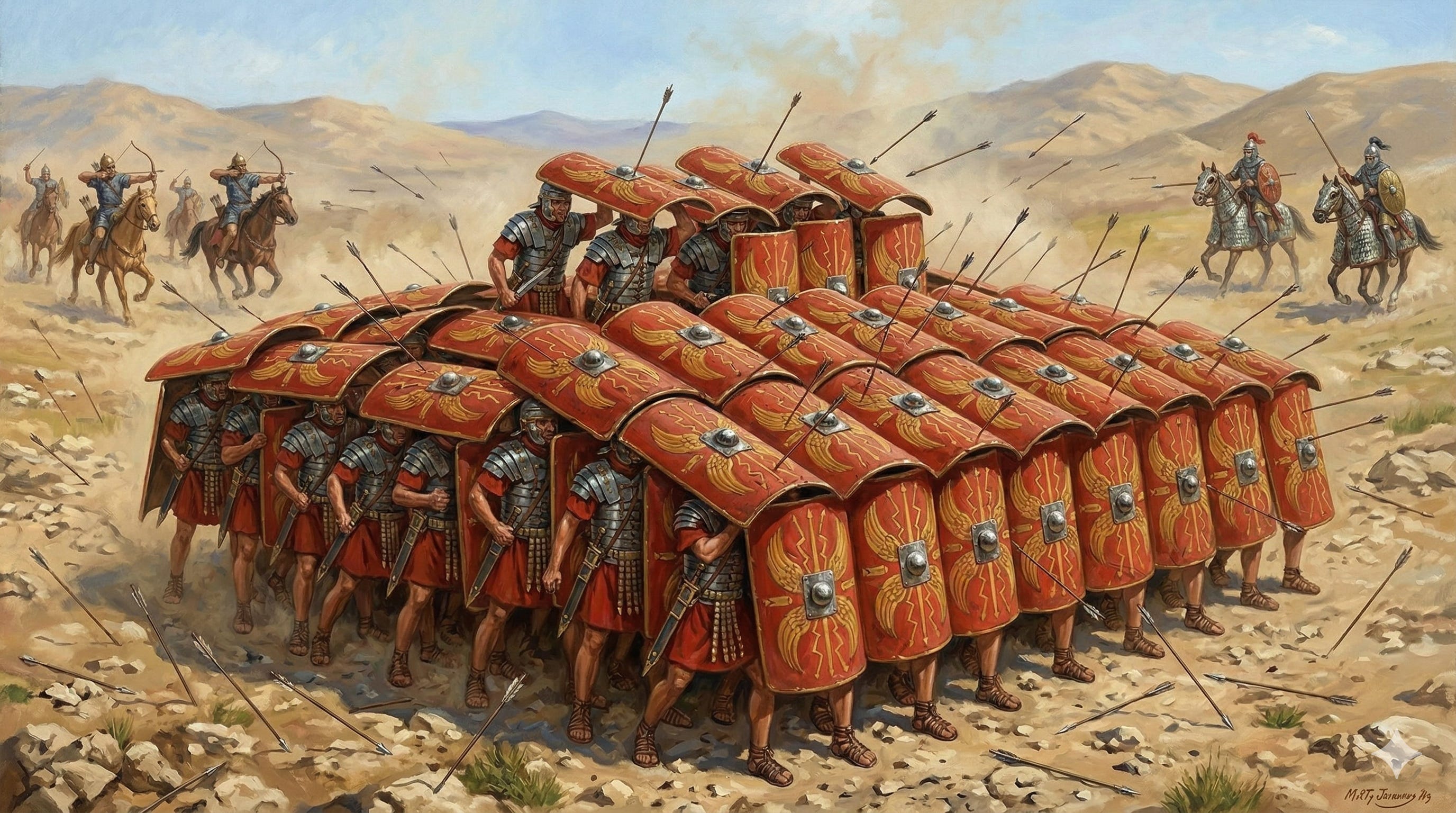
And the Persian arrows bounce harmlessly off the top. It probably sounded loud, but otherwise nobody’s injured. And so at this point the Romans are chuckling. They’re like: what are you gonna do? Just keep doing that — you’ll run out of arrows eventually. And so the Romans march forward slowly, and the Persians turn around and fire another round, and then they ride off.
So now the Romans think: let’s chase them. They go out of testudo — because you can’t run like that, you can’t run holding a fortified position, you need to lower your shields. So they lower their shields and take off on foot, running.
They’re chasing 8,000 Persian horse archers. And the Persian horse archers turn around in their saddles and fire backwards. Nobody had ever done that in battle. The Romans are shocked. They’re so surprised they don’t have time to pull up testudo, and hundreds of Romans go down.
This rattles the Romans. They’re like: whoa. We can’t just chase these guys. We need to be more cautious. And the Persians start running up a hill. So now the Romans are slowly following, and the Persians turn around and shoot again. The Romans slow down enough to get back into testudo and not many are injured — but not quite fast enough, so some do get hit.
They’re getting nervous. But then the Persians go over the top of the hill. So the Romans think: well, we might as well run — they can’t shoot through the hill. So they start running up, and just as they’re cresting the hill, to their shock and dismay, the Romans see 1,000 cataphracts.
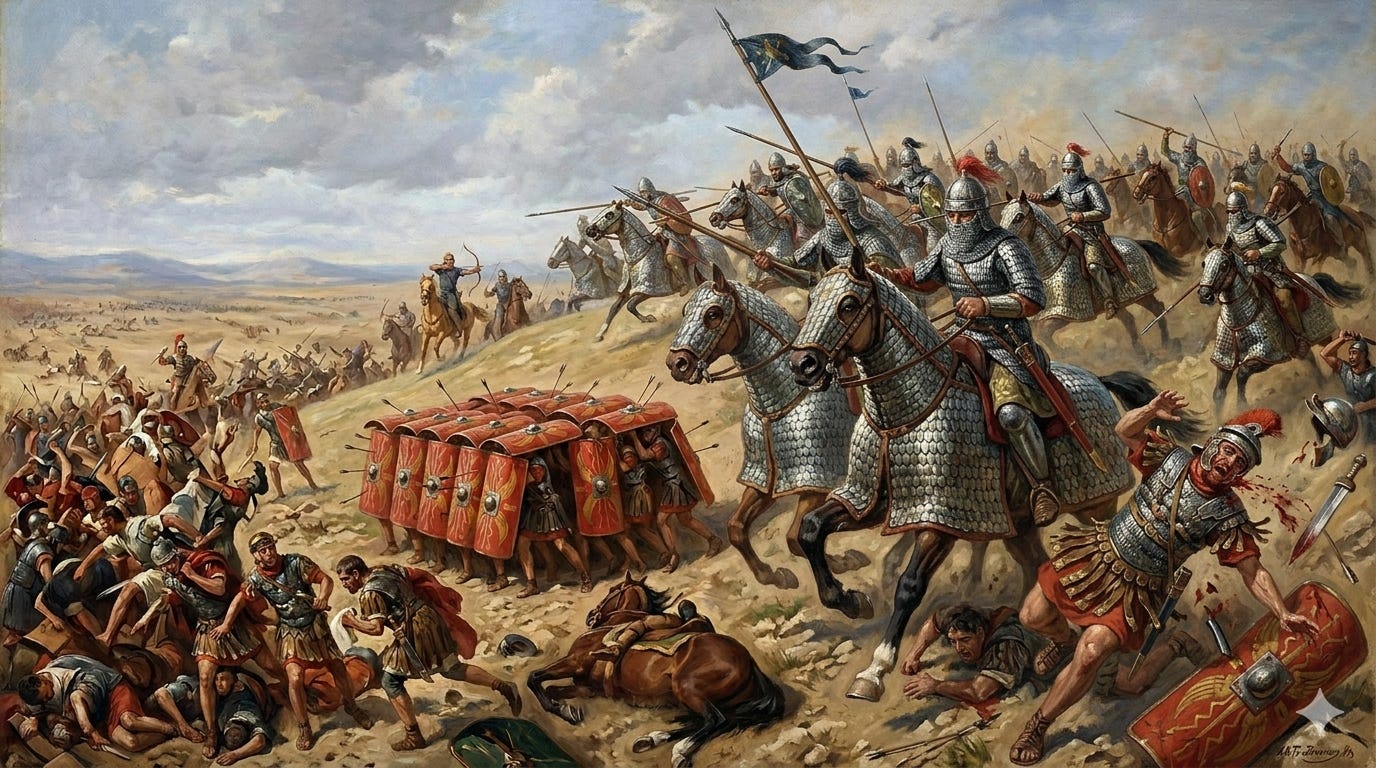
Cataphracts were fully armored soldiers on top of armored horses.
The first time Europeans will do that — put a fully armored man on top of an armored horse — is 14 centuries later. At the end of medieval Europe. The Persians were technologically 14 centuries ahead of any European society in terms of heavy cavalry.
1,000 cataphracts were far superior to 8,000 Roman cavalry because they were tanks. There was almost nothing you could do to them. And they’re charging down the hill as the Romans are charging up. The Romans charging up are trying to stop, shouting to the guys behind them: stop running! But the guys behind them can’t really hear — some of them are still on the other side of the hill, and there’s all the noise. And the guys in front can’t stop running because if they do they’ll get knocked down and trampled to death. So they’re forced to run straight into these cavalry. They can’t get into formation. And the cataphracts cut through them like a hot knife through butter. It’s a catastrophe. Romans dying everywhere. The cataphracts get to the top of the hill, turn around and come back through. Get to the bottom, turn around, come back through. The Romans are doing everything they can to create order and get back into combat formation. And they can’t do it.
Eventually Crassus’s son — Publius, who is commanding from higher up the hill — gets identified by one of the Persian warriors. They kill him, cut off his head, stick it on a spike, and jam it into the ground so that his father can see it.
The Romans are completely disheartened.
Crassus comes up with a new strategy. While the cataphracts are going up and down the hill, the horse archers have returned and they’re just shooting arrows at the Romans, who can’t get into formation, let alone testudo. And so the Romans are getting hammered by arrows and cut to pieces by the heavy cavalrymen. And Crassus decides: we’ll just fight this until the Persians run out of arrows.
It’s always a bad day when your goal is to get the other side to run out of ammo because they’re shooting at you. You know what I mean?
It’s also a really bad day when the Persians brought 1,000 camels loaded with 1,000 arrows each. They had a million arrows. And as the Persian horse archers are firing, the camels just ride up and hand them more.
For all intents and purposes — a million arrows versus 40,000 men. The Persians had unlimited ammo. Crassus’s strategy is a disaster, and the Persians — 9,000 soldiers — are tearing these Romans to pieces.
The only thing that saves the Romans is that the sun goes down. The Persians and Romans basically call it. They break into camps to eat and cook and sleep. In the morning, Crassus comes out and says: let’s talk. And the Persian general — his name is Surena — is on horseback. And Surena says: there’s nothing to talk about. He has a stick with him. He draws a line in the ground and says: this side is Persia. This side is Rome. That line is the Euphrates River.
Crassus says no. And when he does, one of the Roman soldiers freaks out, reaches over, and grabs the reins of Surena’s horse. The Persians see that — swords come out — and they tear the Romans to pieces again.
On the second day, about 10,000 Romans escaped. About 10,000 were captured, including Crassus. And 20,000 Romans were killed.
We don’t have firm numbers, but about 200 Persians died.
When you outnumber the enemy five to one and they kill you at a ratio of 100 to one — that’s a bad day.
They wait until the Persian Emperor arrives. His name is Orodes II. Orodes brings Crassus into his tent. Crassus is wounded, in bad shape. The Persian surgeons have been treating him because they wanted to keep him alive so that Orodes could have a proper conversation with him. They bring him forward, get him on his knees in front of the emperor.
And Orodes says: the most important thing in Persian culture is to be a good host.
You are my guest in the Persian Empire. You came here for gold.
I will provide.
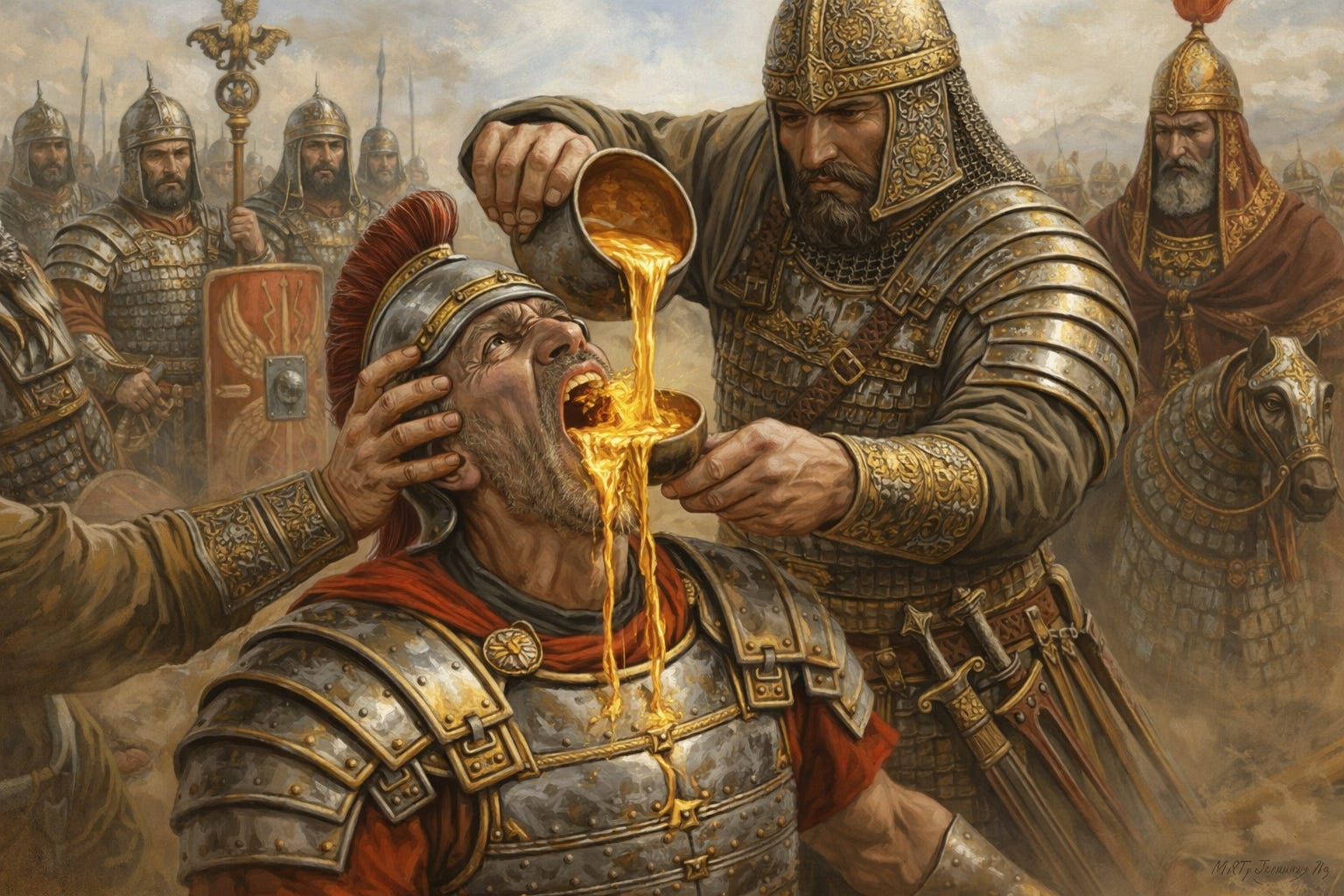
They pried open Crassus’s mouth, and they poured molten gold down his throat.
That event triggers almost 700 years of back-and-forth warfare between the Romans and the Persians. Just back and forth.
All of it, arguably, because one rich man looked east and thought there was gold out there.
The Parthians who destroyed Crassus at Carrhae were an Iranian people — the Arsacid dynasty, originating from what is now northeastern Iran/Turkmenistan. They spoke an Iranian language, practiced Zoroastrianism, and considered themselves heirs to the Achaemenid Persian tradition. Their imperial core was in modern Iran.
If you’re not a subscriber but enjoyed this piece, feel free to chip in
—every bit helps me keep creating more like it.
Two thousand years ago rich people were getting poor people’s children killed in aggressive wars waged to make the rich people richer?
So glad it’s not like that now…
What a fun read! I actually think my grandson would enjoy hearing that there were cool battles like that prior to video games! Of course, it needs to be written in a way that is "entertaining". On the other hand, I am sure, in person, it wasn't "fun", "cool", or "entertaining". But thanks for sharing - a bit of (oft repeated) history that I didn't know.