


The machine looked like a 1980s stereo set, except it didn’t relay music — it measured the one inside me. Or so I was told. Two wires were attached to my feet, and the box kept making beeping sounds. I felt ridiculous. The only thing that could have convinced me to lower myself to this position was a love interest. Beep. Beep. Beeps — for twelve eternal minutes. I had a hangover and tried to look interested when the practitioner showed me the results. That’s when I sobered up. What I looked at was impossible.
Two hundred million datapoints that summarized my predicaments down to the exact location of recent nerve damage and the exact species of a parasite I had been struggling with, for starters. Mapped out in 3D and detailed lists. I had gone through years of blood tests that correlated with the findings, but I still didn’t believe it. I’d seen too many quacks. Too many quantum machines that contained nothing but empty faith. I suspected a hacker had gotten hold of my medical records and put up an elaborate ruse, to get me to invest in snake medicine.
Regardless. It put me just above the edge to talk like a weird guy. To start asking questions. And to start reading about the really weird guys.
The Boy With The Lab
Imagine you’re this curious little boy and your grandfather is wasting away from cancer, and you can do nothing about it. Outside is World War Two. A bomb tears away a part of the house. Your family is close to starving, but you’ve got an escape hatch. Downstairs in the cellar is a chemistry bench that your father, an accountant, has given you permission to play with. You’re obsessed with how stuff really works. By the time you’re fourteen, you’re mixing nitroglycerine. But what you really want to do is to heal. To fight that bogeyman known as disease.
The fight becomes your crusade, the crusade becomes your life, and you become so stellar at chasing the bad guys that one day you earn the Nobel Prize for nailing a really bad molecule.
You collect the prizes, the titles, the glamor until there is nothing left to prove. You get old and famous. But you’re still basically the little boy in the cellar with a chemistry set, unable to stop.
One night you are chasing another germ. You take the sick fluid and push it through a filter so fine that nothing alive can cross it, not the germ, not even a loose scrap of its DNA. What drips out the far side is clear, sterile, empty water. You set it aside. Days later the dish is cloudy again, the same germ swarms back, as if the empty water had kept the recipe and built the thing over again from memory.
You could let it go. But you don’t. After fifty years of chasing microbes, you never let doubt slide. So you repeat the procedure, over and over again, with the same results.
You become obsessed with the implications.
If empty water can carry a living thing’s recipe, then the recipe is written in something. In what? You lock yourself in the lab for the umpteenth time and you build the simplest test that could prove you a fool.
You take a tube of water and a single strand of DNA, and dilute it, a drop into ten drops, shaken hard, again and again, a dozen times over, until the arithmetic is plain. Not one molecule of it remains. You could search the tube atom by atom and find only water. By every scientific definition, it is empty.
You wind a copper coil around the tube, run it into a low-noise amplifier and the amplifier into the sound card of an ordinary computer, the same chip that would carry a song. The screen turns the faint current into a line, the speaker turns it into a tone. A coil, an amplifier, a computer listening, the whole rig.
You test pure water first and find a flat line. You test the undiluted DNA. Silence again. Then you slide in the diluted tube, the one with nothing in it, and the line jumps. A low steady hum climbs out of the nothing, down in the pitch of a human voice.
A hum has to be driven by something. So you start eliminating. You check the grounding, the tube, your own hands, swap the computer. The hum stays. You wrap the tube in metal thick enough to wall out the room, the wiring, the lights. The hum dies. Pull the metal away and it returns. So the source of the hum is not in the rig and not in the room. It comes from outside, it passes through walls, and it never shuts off.
What’s outside?
You set a second tube beside the first, fresh and pure, never touched by any DNA, and around both you raise a weak field pulsed at 7.83 cycles a second, the planet’s own note, the Schumann resonance, the standing wave between the ground and the underside of the ionosphere, struck by the fifty bolts of lightning that hit the Earth every second, its wavelength the size of the planet. Present everywhere except in Faraday cages. You hold both tubes in that note, and you wait.
After a while the second tube begins to sing. The same note. The empty one has taught the blank one its song, across a gap, with no molecule crossing it — by interacting with the Schumann resonance.
You have spent a lifetime refusing to fool yourself. What is the cleanest explanation that survives the night?
The Man Who Ran It
The experiment and the boy are real.
Luc Montagnier was born in 1932 in the farm country south of the Loire, the only child of an accountant who kept a chemistry bench in the cellar. In 1983 his team pulled a retrovirus from the swollen gland of a dying young man. The world would call it HIV. After a filthy credit war with the American Robert Gallo, fought up to the desks of presidents, the discovery was his. In 2008 he got the Nobel Prize, shared with Françoise Barré-Sinoussi, who had run the experiment that caught the virus. Montagnier became one of the most decorated scientists alive — after which he tried to change the world.
He was nearly eighty, studying chronic bacterial infection, when he passed a culture of Mycoplasma through a hundred-nanometre filter and then a twenty-nanometre filter, fine enough to strain out every bacterium and every fragment of its DNA. It’s what put him on the forbidden path. He claimed that DNA-free water could emit a low-frequency electromagnetic signal when carried by the planetary hum of 7.83 Hz, and pass the information to another vial containing pure water. Not just fragments of the DNA, but the whole sequence.
His own lab was able to reconstitute the DNA in whole from the second clean-water sample. Impossible. Absurd. Mainstream scientific journals claim no other lab was able to repeat the experiment. Montagnier said his team could do it over and over again, with detailed lab notes.
He was not alone. Before him came Jacques Benveniste, who in 1988 published the same result in Nature. Water that had held an antibody, diluted until not a molecule remained, still acted as if the antibody were there. Labs in Canada, Italy and Israel saw the same thing, and Nature printed it, then sent a team to his bench to watch. The team included James Randi, a magician, who made his name exposing fakes and dangled a million dollars for proof of the impossible that no one ever won. He retaped the labels, scrambled the tubes, ran it blind. The effect vanished. Sloppy controls, nothing there. Benveniste was finished.
Twenty years later Montagnier picked up the dead thread and chased the signal further than Benveniste. And that was the beginning of his end, as well.
After publishing the water and DNA work in 2009, no Western lab would touch it, so at seventy-eight he carried it to a private lab in Shanghai. Then, according to the mainstream saga, he went gaga.
He handed ammunition to the people who doubted the HIV narrative — the one that made him famous to begin with. He sat for House of Numbers, a film built to argue AIDS was a hoax, and told the camera a good immune system clears HIV on its own in a few weeks, that clean water and nutrition and antioxidants do more than the drugs, that there was no profit in any of it. The man who named the killer told the world it was barely armed.
By 2012 he was claiming antibiotics could cure autism. He recommended fermented papaya for Parkinson’s. In 2017 he called France’s child vaccines a slow poisoning, and a hundred and six academicians signed a letter to make him stop. In April 2020, four months into the pandemic, he went on live television and said the Covid virus was built in a lab with HIV spliced into it. A year later he said the mRNA shots were breeding the variants.
Shortly after, in 2022, he was dead at eighty-nine. The obituaries called him a crank.
No one picked up the work. He left no heir. The hum in the vial died with him.
Just as it did with countless other of his calibre.
The Line Behind Him
Robert Becker, a bone surgeon, put a meter on a salamander’s severed leg and watched the voltage flip from plus to minus and the whole limb rebuild itself along that current. He said in print that living things are electrical systems that run on chemistry and not the other way round. They closed his lab, the only one of its kind on earth, on the first day of 1980.
Harold Burr at Yale found a steady field around every living thing, the future shape of a salamander already written in voltage in the unfertilised egg, the field that knew a cancer was coming weeks before the flesh did. The fashion turned against fields and his name left the journals.
Fritz-Albert Popp sealed living tissue in the dark and caught it glowing, a faint coherent laser-like light pouring out of cells and dying the instant they died, the DNA itself the antenna. His university chair did not survive it.
Mae-Wan Ho slid a living larva under crossed filters and watched it blaze into interference colour, proof the body is a liquid crystal tuned end to end, a thing she called quantum jazz. The academy could not hear her.
Albert Szent-Györgyi already had a Nobel when he spent thirty years arguing life runs below the molecule, in moving electrons. Björn Nordenström invented a tool used in every hospital on earth and chaired the Nobel Assembly itself, then said the body runs on closed electrical circuits and could not get a hearing. Gilbert Ling built the electrode that made cell science possible, then showed the textbook ion pump would cost more energy than the cell makes, and watched the money walk away.
Different instruments, different decades, the same direction and the same exit door – all the way to the present.
Gerald Pollack, who holds a chair in bioengineering at the University of Washington, a tenured insider and no crank, found that water against a surface organises itself into a fourth phase, an ordered zone that sorts charge and stores light like a battery. The molecule-only picture of water is quietly wrong at the edge of every living cell. The mainstream would not seat the work, so he built his own journal and his own conference.
Rupert Sheldrake went further, and was hit harder. A Cambridge man with a PhD in biochemistry, a fellowship at Clare College, years mapping how the plant hormone auxin builds a plant’s veins, he proposed that nature keeps a memory, that forms and habits are shaped by resonance with every similar form that came before, a field carrying the pattern across time. The same journal that sent a magician to Benveniste’s bench, Nature, ran an editorial by its senior editor calling the book the best candidate for burning.
The Logic For Burial
Why does crossing this one bridge — from particles to waves — destroy so many careers? If they were wrong, it would have been a simple job just to prove them wrong. But the antithesis was never the tool — the destruction of character was.
We can entertain a lot of theories.
A molecule is a thing you can own. A frequency is a pattern, and a pattern is murder to patent. An industry built end to end on selling manufactured chemicals has no line on its books for a song that heals, and a worldview that pays for the building does not vote to dissolve itself.
The military typically reaches any new physics first, and a key that tunes a system to heal also tunes it to harm. Directed-energy weapons that cook and dazzle already exist. The precise driving of a body’s own rhythms, the heart, the brain, the mood, the weather, even the earth’s crust, with almost no energy, with the right cocktail of frequencies — has been operating in stealth mode for at least half a century, whistleblowers claim.
A field that diagnoses and tunes needs no pharmaceutical supply chain and no permission slip. The architecture of the wave is decentralised, the way the Schumann note belongs to no one and reaches everyone at once. That is a straight threat to every system that runs on scarcity and the gatekeeper’s stamp.
If a person is a resonance, tuned to the planet and through it to everything else inside the same cavity, then the deepest fact about you is connection, not separation. You are not a lonely machine that stops at your skin. You are a standing wave in a field that runs through all of it. People who feel that in the body are hard to frighten, hard to divide, and hard to sell things they do not need.
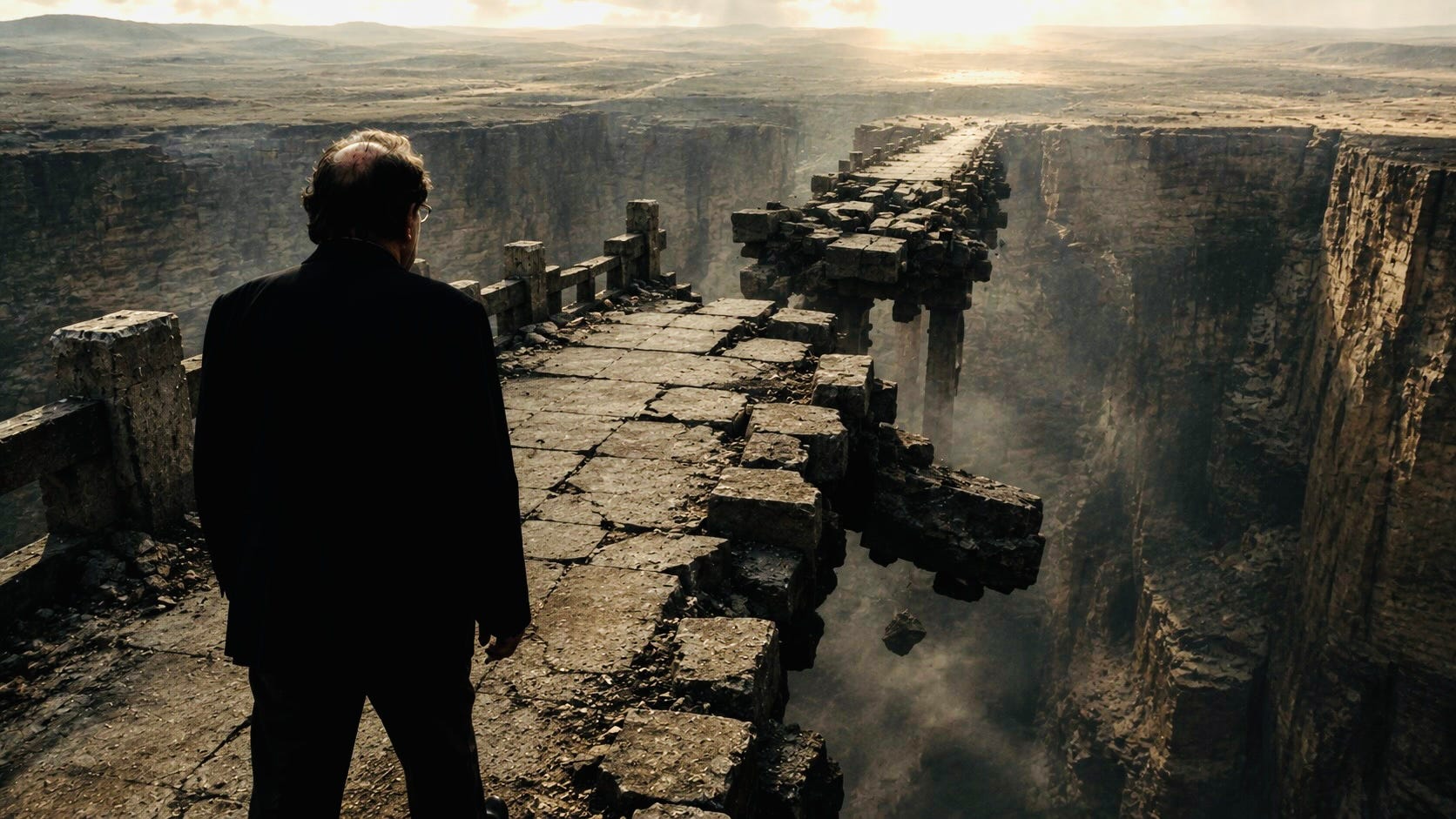
But the forbidden bridge also stems to the oldest story in the world. Joseph Campbell spent his life laying the world’s myths side by side, and under all of them he found one skeleton. A person leaves the village, crosses a threshold the tribe agreed never to cross, survives whatever lives out past the edge, and comes home carrying the thing that changes everything. Fire. A fruit. A map of the sky. A cure. He called it the hero with a thousand faces, because it is the same hero every time in a different mask.
Only a few ever cross that bridge. A tribe is built to stay home, to keep the fence and agree on what is real and survive on the agreement. The crosser is the rare mutation the tribe needs, the one whose nervous system will not stop walking toward the edge. There need not be many. One crosser is enough to change a species.
In the same archetypal story arc, the tribe usually throws the gift back. Prometheus steals fire for us and is chained to a rock while an eagle eats his liver. The knowledge is rejected because it implies that the village’s map was wrong. The tribe will defend its map with its life — the rejection is built in.
What The Bridge Means
You do not have to wait for the institutions to turn.
Stop asking what a thing is made of and start asking what it is in tune with. The reductionist takes the watch apart to find the time. The expansionist notices the watch was keeping time with the sun all along.
Treat your body as a musical instrument, not a machine. Sleep, sunlight, breath, the long walk in open country, the company of people you love — all of it is tuning a frayed system back toward its natural note.
Watch for resonance. The book that arrives the week you need it, the stranger who finishes your thought, the work that makes the hours vanish. Reductionism files these as noise. They’re signals.
Remembering — that a civilization that can no longer produce a heretic stops evolving. It starts going extinct.
Love this article, have you heard of or read the book, The Music Of Life by Denis Noble
The view of life presented in this little, modern, post-genome project reflection on the nature of life, is that of the systems biologist: to understand what life is, we must view it at a variety of different levels, all interacting with each other in a complex web. It is that emergent web, full of feedback between levels, from the gene to the wider environment, that is life. It is a kind of music.
“We are stars wrapped in skin. The light you are seeking has always been within.”
- Rumi