


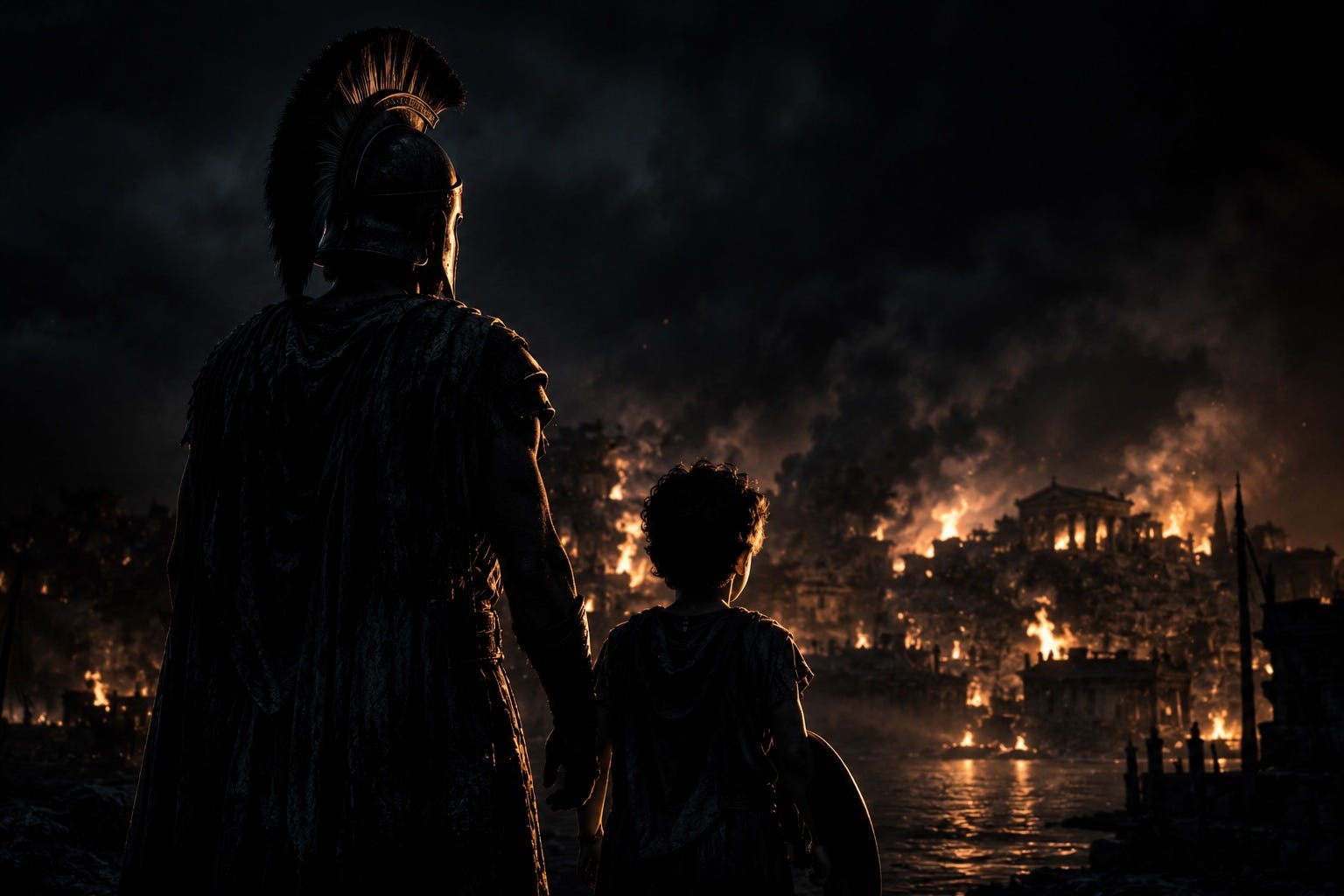
Christopher Nolan is arguably one of the greatest living directors of our time. I have loved every single one of his movies. Many of them a dozen times over. Yet after twenty seconds of his Odyssey trailer I wanted to throw my gyro against the screen. To purge a seething, low-frequency flush so intense it could not possibly be rational. It is just a movie. Right?
Then I saw the numbers rolling in like weather reports from a war zone. Trailer downvotes seven to one. More than a million dislikes stacked up like bodies at the wire. Musk calling Nolan a worm on the app he owns. The Odyssey’s comment sections sealed shut in a hurry, the way you seal a room where you buried a corpse. All of it for a two hundred and fifty million dollar epic shot on IMAX.
My own movie-fanatic friends got so crazy that I told them to chill out. And seeing my insanity as a reflection of theirs got me thinking more analytically. The rage was out of scale to the point where it could not possibly be about the subject matter.
The atomic reaction could not be about a casting choice, or a feminist translator, or the dark poem your grandfather used to recite to you at bedtime, being handed back to you in a rainbow wrapper.
It was something older and heavier and buried, some primordial fuckup twanging the piano wire that runs through every living Western nervous system.
It was bigger. Gigantically, enormously, humongously bigger.
Big enough that we need to travel back a hundred and nine years to Petrograd, Russia, to find the anchor the wire is tied to.
October 1917 — Winter Palace
Lenin and the Bolsheviks storm the Winter Palace and by morning the Tsarist state is no more. Weeks later Russia holds its first free election. The Bolsheviks lose. So they send a sailor to walk into the winning parliament — the Constituent Assembly, the first democratically elected legislature in Russian history — step onto the podium before dawn, and tell the deputies to go home because the guards are tired. Within a year the country is at civil war and the Cheka — Lenin’s new secret police, founded in December 1917 with a licence to arrest, interrogate, and execute without trial — is killing anyone who might have opposed anyone at any time, sorted by ledger, in cellars nobody talks about after.
The promise going in is equality. Workers own the factories. Peasants own the land. No aristocracy. No elites. No priest. No Tsar. Everybody equal under a red banner in a workers’ paradise, comrade, please pass the vodka. The reality by 1929 is Stalin, a party of a few million ruling a country of a hundred and fifty million with a boot on the neck and a quota in the ledger. By the mid-thirties the collectivisation of Ukrainian grain has starved somewhere between three and seven million peasants to death — whole villages emptied of the sound of children, bread requisitioned by cart while mothers stood on the porch. By the end of the forties the estimates of total dead under Soviet rule are in the tens of millions. Robert Conquest put the Stalin era alone at twenty million. Solzhenitsyn cited sixty million across the whole seventy-four years.
The old rulers are gone. A new rulership sits in the same chairs, richer, meaner, and unaccountable to anyone. The peasant who was told he would own the land now cannot leave the collective farm. The worker who was told he would run the factory now works for a foreman appointed by the party. The word equality has done its work. What arrived was a new class of officials wearing equality as a mask, and the people who spotted it early got shot in cellars.
That is the trick.
Notice the shape of it. The old order stands accused of hierarchy. The new order arrives door-to-door dressed as the cure. The cure installs its own hierarchy, harder to see because everybody is wearing the same colour and singing the same anthem. Complaining about the arrangement makes you the enermy.
Bolshevism was one form of the trick. The Fabians in London had already invented another. They did not arrive out of nowhere.
Twenty years earlier, in 1864, the naturalist Thomas Henry Huxley and eight friends had founded the X Club — a monthly dining society dedicated to displacing the clergy from the leadership of British science. Herbert Spencer. John Tyndall. Joseph Hooker. Nine men, an inner ring, meeting once a month at a London hotel for the next thirty years. By the 1880s they had captured the Royal Society, founded the journal Nature, taken over the British Association for the Advancement of Science, and installed themselves as the power behind the throne of British intellectual life. Their working principle was that inquiry should be free of religious dogma. Their practical work was replacing hereditary and clerical authority with expert authority.
The Fabians, meeting a few miles across town in the same decade, were the political extension of the same instinct. Founded in 1884, named after the Roman general Fabius Maximus who beat Hannibal by refusing to fight him in the open, wearing him down over years of patient manoeuvre. Their logo, chosen by Sidney Webb and painted by George Bernard Shaw for their stained-glass window, was a wolf in sheep’s clothing. They said the quiet part on their own crest and hung it on the wall. The Fabians did not want revolution. They wanted permeation. They founded the London School of Economics in 1895 to train the officials who would run the future state. They founded the Labour Party. They wrote the blueprints for a welfare bureaucracy that could deliver socialism through the civil service without anybody having to storm a palace.
Fabianism is the polite version of the same trick. Bolshevism kicks the door in. Fabianism walks in through the servant’s entrance with a clipboard and a friendly nod and stays for the rest of the century.
Bolshevism, Fabianism, and the X Club before them all drank from the same London well. Karl Marx spent thirty-four years in that city writing Das Kapital in the British Museum reading room, and died in 1883, a year before the Fabians founded their society a mile away. Lenin returned to that same reading room five times between 1902 and 1911, working under the alias Jacob Richter. The Fabians kept Marx’s critique and threw out his method. Lenin took the method and threw out the patience.
The Tavistock Clinic, when it arrived in London in 1920, drank the same water. A psychiatric institute founded supposedly to treat shell-shocked veterans of the trenches and quietly turned, over the next two decades, into the laboratory of British group psychology — how crowds panic, how soldiers break, how morale can be steered. Same city as the Fabians. Same class of educated Englishmen. Same conviction — that religion and inheritance had failed to run the human organism and that a trained expert class should take over the job.
All of them end in a managerial class ruling in the name of the workers it does not consult.
November 1918, Germany.
The Kaiser abdicates in a railway carriage in the Netherlands. Workers’ and soldiers’ councils form in every major German city. For a season it looks like Germany might follow Russia over the same cliff — one more European power turned by the same key.
The men trying to steer it there are Karl Liebknecht and Rosa Luxemburg of the Spartacus League. Liebknecht is a Protestant lawyer’s son. Luxemburg is a Polish-born Jewish Marxist theorist and one of the sharpest political minds of the century. In Munich the journalist Kurt Eisner declares a socialist republic. Eisner is Jewish. That spring, Eugen Leviné, Ernst Toller, Gustav Landauer, and Erich Mühsam — all Jewish — take Bavaria for six weeks and call it a Soviet Republic.
The men who actually take national power are Friedrich Ebert, Philipp Scheidemann, and Gustav Noske of the Social Democrats. Not Jewish. Not planning a revolution. Ebert is a Lutheran tailor’s son who wants order the way a shopkeeper wants a locked till.
On the night of November 9, Ebert takes a call from General Wilhelm Groener of the High Command. They cut a deal in the dark, sealed with a handshake nobody will admit to for another decade. The army will back the new government if the government crushes the radical left. It becomes the Ebert-Groener Pact.
By January the Freikorps have shot Luxemburg and Liebknecht and thrown Luxemburg’s body in a Berlin canal. By February Eisner is dead in the street with a bullet in the back of his head. By May the Bavarian Soviet Republic is crushed. By summer the Weimar Republic exists, and the German revolution has become the German near-miss.
By any liberal measure this is a good outcome. Germany has a republic, universal suffrage, women’s vote, legal unions, an eight-hour day, no more Kaiser, and no Soviet death machine down the tracks.
To an orthodox Marxist it is a catastrophe. Marx had said capitalist collapse triggers proletarian revolution. Germany had just delivered the deepest capitalist collapse of the century. The proletariat, offered the trick, refused it and went home to make dinner.
Somebody needed to rewrite the script. Not for Russia. Russia had already worked.
For everybody else.
1923. The Institute For Diagnosing Discontent.
The name of the room where the rewrite is engineered is the Frankfurt School, and the man who paid the rent was not a philosopher, or a professor, or a party official. He was a rich kid with a conscience and a grain empire in South America underwriting it.
Felix Weil is thirty-five and worth a fortune from his father’s Argentine grain business. He is also a communist, a combination that only makes sense in the Weimar Republic and only for about ten years. His close friends are Georg Lukács, the Hungarian Marxist who has just written History and Class Consciousness, and Karl Korsch, the German legal philosopher rewriting Marxism from the inside. In the summer of 1922 the three of them convene what they call the First Marxist Work Week at a country hotel outside Frankfurt. A month of argument in the dining room, most of it about one question. Why did the German worker not do what Marx had said the German worker would do.
They come out convinced that classical Marxism is missing an organ. A theory of the factory, yes. A theory of the state, yes. A theory of the mind, no. And the mind, it turns out, is where the trick failed.
Weil bankrolls an institute at Goethe University to build the missing organ. Institute for Social Research. He hires philosophers, sociologists, psychoanalysts, most of them German-Jewish, most of them Marxist. Marx on their left. Freud on their right. Weber behind them. Hegel watching from the ceiling like an old aunt at a wedding.
Nobody has to push them toward Marxism. Marxism in 1923 is the ambient intellectual water of the European left the way liberalism is the ambient water of a modern American law school. They swim in it because it is what serious young leftists in Central Europe swim in. Bolshevism has just won the biggest country in the world. Wilhelmine authority has just collapsed. The only working script for what comes next is being written in Moscow, and if you are a bright young German-Jewish intellectual with a taste for structure and a grievance against the old order, you read Marx because everyone worth reading is reading Marx.
By 1930 Max Horkheimer runs the place. He tightens the project around one question, which is not the workers’ question anymore but the one under it and slightly to the left.
How does modern power get inside a human head without being asked in.
The answer, worked out over the next fifteen years in three languages and roughly forty thousand pages of prose nobody outside a graduate seminar has ever read all the way through, is that twentieth-century power does not live in the visible institutions. Not primarily. Power lives in what people read, sing, watch, buy, want, and pass on to their children. In the school. In the family. In the pop song. In the magazine advertisement on the streetcar. The German worker chose the wage over the workers’ state because a thousand small daily cultural inputs, every day of his working life, had already made the wage feel more real to him than the workers’ state, and by the time the workers’ state was on offer he had a mortgage on a semi-detached in Charlottenburg and a wife who wanted a dining-room set.
Theodor Adorno hits it from the culture side. He is in Los Angeles during the war, listening to American radio and drinking bad coffee in an apartment paid for by a foundation grant, and he notices that the feeling the pop song is putting in his chest was not his. It was manufactured, packaged, and scheduled. He and Horkheimer call the thing that makes it the culture industry, and in their reading it is the twentieth century’s most powerful instrument of quiet compliance — the wage envelope with a rhythm and a beat.
Herbert Marcuse extends it. The West’s whole apparatus of reason, expertise, and progress has become an instrument of domination that people cannot see because they are inside it, breathing it, and paying tax on it. He calls the person shaped by it one-dimensional.
The founding move is diagnostic. Expose the mechanism, they think, and the person walks free.
That is the pure form of the tool. It does not stay pure. Tools never do. Frankfurt gets captured.
1948 to 1973
1948, London. Horkheimer sits down with the British psychiatrist John Rawlings Rees at a table in some Georgian committee room that has seen worse. Rees had been wartime head of British Army psychiatry, and before that a founding director of the Tavistock Clinic. By 1947 it was reorganising as the Tavistock Institute of Human Relations, and its work would sit at the operational edge of everything Frankfurt had been describing in theory. Rees’s own proposal, before the war, had been that psychiatry needed shock troops to work on populations at scale. He had partners now, and the partners had money.
Under UNESCO letterhead the two men co-found the World Federation for Mental Health.
The letterhead is not incidental. And this is where the name Huxley returns.
UNESCO’s founding Director-General is Sir Julian Huxley. Evolutionary biologist. Founding member of the World Wildlife Fund. President of the British Eugenics Society. Brother of the Aldous Huxley who had written Brave New World in 1932 as a warning that everyone read as a novel. Grandson of Thomas Henry Huxley of the X Club, the nine-man dining society that had spent the 1860s clearing the clergy out of British science. Three generations of the same family running the same operation in a different key, each generation refining the toolkit, each generation more polite about the payload.
In his 1946 manifesto for UNESCO, Julian Huxley wrote that the organisation’s role was to construct a unified pool of tradition for the human species as a whole. That political unification in some sort of world government was the definitive attainment of that stage. And that although any radical eugenic policy will be for many years politically and psychologically impossible, UNESCO’s job was to see that the eugenic problem was examined so that, in his own words, much that now is unthinkable may at least become thinkable.
Read that last line twice, if you have the stomach for it. It is the manifesto for making the outrageous eventually obvious. Written on UNESCO letterhead. Signed by the President of the British Eugenics Society. Filed in 1946.
That is the letterhead. Frankfurt’s diagnosis. Tavistock’s scalpel. A eugenicist internationalist with a Fabian intellectual lineage providing the umbrella. Three streams braided into one London conference room in 1948, with a UN stamp on the door and no reporter within a mile of the building.
Public documents. No secrecy required.
1953. The CIA begins MK-ULTRA. One hundred and forty-nine subprojects across universities, hospitals, prisons, and safehouses on three continents. LSD without consent. Electroshock without consent. Sensory deprivation. Depatterning — a technique in which a subject’s memory and identity are broken down over weeks of induced sleep and drugs until nothing is left, and then rebuilt from zero into a shape more useful to the person paying for the depatterning. The stated aim, in the agency’s own internal language, is controlling an individual to the point where he will do our bidding against his will and even against such fundamental laws of nature as self-preservation.
Frankfurt had the theory. Tavistock had the protocol. MK-ULTRA had the black budget.
1973. CIA Director Richard Helms orders the files destroyed. Sidney Gottlieb and four staff spend a day feeding 152 files into a shredder and a fire in the parking lot behind the building. The head of the CIA records centre objects in writing. He is overruled and told to go home.
On the record the programme ends.
May 13, 2026. CIA whistleblower James Erdman III testifies to the Senate Homeland Security Committee that the agency physically retrieved forty boxes of JFK and MK-ULTRA files from the Director of National Intelligence’s office in January 2026, immediately after a declassification task force set up by then-DNI Tulsi Gabbard was dissolved. The files remain unreleased.
June 30, 2026. Representative Anna Paulina Luna gavels in the first congressional hearing dedicated to MK-ULTRA in forty-nine years. Investigative journalist Tom O’Neill testifies under oath that CIA psychiatrist Louis Jolyon West treated Jack Ruby before Ruby’s trial and Charles Manson before the Sharon Tate murders, and that West was a confidant of Sidney Gottlieb.
The nutty conspiracy ceases to be one, and instead becomes a claim on the House Oversight docket, in prime-time video, with a witness under oath and a stenographer in the room.
Frankfurt’s diagnostic became somebody’s operating manual. The men who wrote it are all dead. The men now using it never met the founders, never read them, and would not have recognised them in the elevator.
The tool loses its founders and end up in the editing bay of an IMAX release a hundred years and three thousand miles from the Weimar-era hotel room where it was drafted.
Critical Theory, Hollywood, 1960s.
The reflex that reads a Greek poem as a document to be inspected for whose voice is centred and whose voice has been erased — was born in a Frankfurt research institute in 1923 as a way to understand why a workers’ revolution had failed. It reached the American academy in the 1960s in the form of critical theory, then critical race theory, then feminist theory, then queer theory, then postcolonial theory, each one a specific rifling of the same diagnostic barrel. It reached the studios in the 1990s. It reached the funding rules in the 2020s. And here we are.
Emily Wilson’s Odyssey is one of the products of that arrival. Wilson is a professor of classical studies at Penn, born in Oxford, an excellent scholar, a self-declared feminist, and the first woman to publish a complete English translation of the poem in the four hundred years the poem has been translated into English. Her stated project is to strip four hundred years of male translators’ smuggled assumptions off the Greek. Whether that reads as fidelity or as revision depends where you are standing. What is not in dispute is the method. Read the canonical text for whose voice has been silenced. That method is not Homer’s. It is not classical philology’s. It is Frankfurt’s, applied to a poem, by an honest scholar who inherited the lens with the field the way a young doctor inherits the stethoscope with the coat.
She is not a co-conspirator. She is a specimen. The same lens sits in every screenwriter’s room, every producer’s memo, every casting call, every review, every syllabus in the humanities for the last thirty years. The lens was polished in Frankfurt in the 1930s and mounted under Huxley’s UNESCO letterhead in the late forties. By 2026 it sees the whole world.
Watch what that looks like in the funding rules.
The Academy of Motion Picture Arts and Sciences, starting with the 96th ceremony in March 2024, requires that any film competing for Best Picture meet two of four Representation and Inclusion Standards. Standard A covers the cast — a lead or significant supporting character from an underrepresented racial or ethnic group, or at least thirty percent of the general ensemble drawn from at least two underrepresented groups (women, ethnic minorities, LGBTQ+, disabled). Standard B covers the crew. Standard C covers paid internships. Standard D covers marketing executives. Under these rules, 12 Angry Men would not qualify — twelve white men in a room, deliberating a murder trial, no. Neither would Patton. Neither would The Godfather. Neither would Schindler’s List. Lawrence of Arabia might sneak through on the technicality of Peter O’Toole being closeted.
Some Best Picture nominees satisfied the rules through backstage arithmetic. 1917 had a nearly all-white male cast — historically accurate, since the film is about British soldiers in a French trench in 1917 — and passed because six women on the crew earned Oscar nominations for producing, writing, makeup, hair, and sound editing. Oppenheimer, all-white cast in a room full of theoretical physicists building a bomb, passed because Universal Pictures had internal DEI initiatives across marketing and distribution. In practice the standards do not block most films. They audit them. The audit produces a demographic dossier for every project. The dossier is what the standards are actually for.
Britain’s national film funding body has run BFI Diversity Standards since 2014. Ireland’s Screen Ireland fund runs the same. Netflix, Amazon, Disney, Warner Bros, Sony each maintain internal diversity metrics attached to production budgets and executive compensation. A screenplay now runs a gauntlet of demographic gates before a single dollar is committed, and every gate is administered by somebody with a checklist and a job title that did not exist in 1990.
The gates are all dressed as fairness. That is the Fabian tell. Nobody is going to argue publicly against inclusion, any more than a Petrograd peasant in 1918 was going to argue publicly against equality. The dressing is not the payload. The payload is a managerial class of narrative auditors sitting between the story and the audience, with a checklist and a corner office and a quarterly bonus, adjusting the operating system of a civilization one product at a time.
The Romans understood the mechanism, though they ran it the other way. Once Rome took a province, the province’s people got woven into the imperial culture. Native gods folded into Roman ones. Native names Latinised. Native elites pulled to Rome as hostages and clients with wine and a townhouse and a seat at the games. Within three generations a Gaul was a Roman with a memory of having once been something else and no operational access to the something else. Rome absorbed you into itself.
Twenty-first century Rome does it in reverse. It leaves you where you are and pulls the roots out from underneath you. Old stories get retold with the endings sanded off. Old holidays get re-branded and merchandised. The old canon becomes an object of suspicion instead of an object of love. Meanwhile the mass migration into every Western capital changes the demographic ground under the story at the same rate the story is being rewritten above it. Two pressures, same press, same output — a population that no longer has a coherent sense of where it came from and therefore no coherent basis on which to object to where it is being taken.
The stated destination is one-world coherence. A single humanity. A single market. A single set of managed narratives. A single administrative class in blue suits at the top of every glass tower. Precisely what Julian Huxley outlined in his 1946 UNESCO manifesto. Precisely what the Fabians had been designing since 1884. Precisely what the Bolsheviks had installed by shooting the alternative and burying it in the cellar.
Ask a Ukrainian grandmother in 1933 how the last version of one-world coherence went for her.
Bolshevism installed the elite by shooting the opposition, Fabianism installed the elite by writing its curriculum, the X Club had already installed the elite of British science eighty years earlier over a plate of poached fish, Frankfurt gave the whole project its diagnostic instrument, Tavistock and MK-ULTRA weaponised the instrument, Huxley provided the international umbrella, and Hollywood, in the year 2026, hands the audience a redecorated version of the oldest story in the West and calls the redecoration inclusion.
The bill for one-world coherence, historically, gets paid in graveyards. The current version dresses better than the Russian one. The dressing is what makes it a Fabian job and not a Bolshevik one, and the sheep on the wolf’s back is what makes the audience clap when it enters the room.
Which brings us back to a film.
Nolan, 2026.
Christopher Nolan is not part of any of this in any conscious sense.
He is one of the two or three best filmmakers of his generation. Memento. The Prestige. The Dark Knight. Inception. Interstellar. Dunkirk. Oppenheimer. Films that combine old-fashioned craft with structural risk almost nobody at his budget level takes. He shoots on film. He builds practical sets. He refuses shortcuts. He won Best Director in 2024 for Oppenheimer and deserved it.
The Odyssey is probably great. Early reviews are calling it staggering. Nolan has the taste, the discipline, and Hoyte van Hoytema on the camera. He can make a version of the poem that survives its politics on the strength of the filmmaking alone. Or he does not. Sometimes a great director makes a film inside a headwind he cannot see, and the film loses its footing halfway across the strait.
Either way, Nolan is not the story. The film is not the story. The casting is not the story. The story is a hundred and sixty years old, running from the X Club dinners of 1864 through Huxley’s UNESCO desk in 1946 to a shuttered comment section in Los Angeles in the week of release, and it does not need the director to know it is happening in order to keep happening through him.
Maybe, considering all of the above, the rage that follows a trailer before the movie is even released is not as irrational as it looks. Maybe it is a healthy reaction. A collective gut jerk against a century of misdirection. The we-have-had-it supernova finally reaching the surface. The last sign that we are not yet, unanimously, zombies ready for one-world hegemony.
Today, Everywhere.
Somewhere a father is reading the poem aloud to a boy. They are on the twelfth book.
Odysseus has just left Circe’s island. She has told him what is coming. The Sirens. Then a strait. On one side, Scylla, a six-headed monster who reaches down from her cave and takes six men off every ship that passes below. On the other, Charybdis, a whirlpool that swallows a whole ship and spits nothing back. No third channel.
Odysseus asks if he can fight Scylla. Draw his sword, stand at the prow, defend his men. Circe says no. Fight her and she will take another six, then another six, because she has six heads and they do not stop. Row past her. Accept that six of your best men will die screaming in the next minute and you cannot save them. That is the price of coming home.
The boy is eight. He wants Odysseus to draw the sword. The father is trying to explain why Odysseus should not.
This is the moment the boy meets an idea he will need for the rest of his life. Some losses cannot be prevented. Some straits cannot be widened. A man who insists on fighting every monster loses more than he saves. The road home passes through a place where you must accept the death of your best men and keep rowing.
He does not learn it in one reading. He is eight. The poem is a slow-release capsule for wisdom he will not need for another twenty years. The father is not there to explain it. The father is there to plant it.
Odysseus, incidentally, ignores Circe’s warning. He puts on his armour and stands at the prow with a spear in each hand, trying to see Scylla before she strikes. He fails. Six of his best men are pulled from the deck screaming his name. He watches. He cannot save them. He rows on.
Homer teaches it the honest way. The hero tries the shortcut and fails, and the boy who reads the scene absorbs both halves — the instinct to fight, and the cost of that instinct.
Father to boy. Grandfather to father. Backwards through every reader for twenty-seven centuries.
The relay is what has been captured.
The classroom does not read the whole poem anymore. The curriculum contextualises it. The screenplay conference trims the scene. The critic reframes the killing. The film sands the ridge that would have cut the boy on the way through. Somewhere down the line the boy meets a version of the story cleaned of the sharp edge that was going to save him.
One day the boy hits his own strait. He draws his sword. Scylla eats his crew, then his ship, then him. Not because he is weak. Because nobody handed him the poem in time.
PS. I’m betting the movie is a masterpiece, regardless.
If you found value in this article and would like to support future work,
you can buy me a coffee.
Mr. Wellmann, that essay of yours is the best thing I have read this summer. Thank you so much. “The first step in liquidating a people is to erase its memory. Destroy its books, its culture, its history. Then have someone write new books, manufacture a new culture, invent a new history. Before long the nation will begin to forget what it is and what it was.” ― Milan Kundera Not only a nation, but all of Western civilization.
Superb article. You are right. Not seeing the film is an act of defiance against a world that is heading in a scary and horrific direction.