


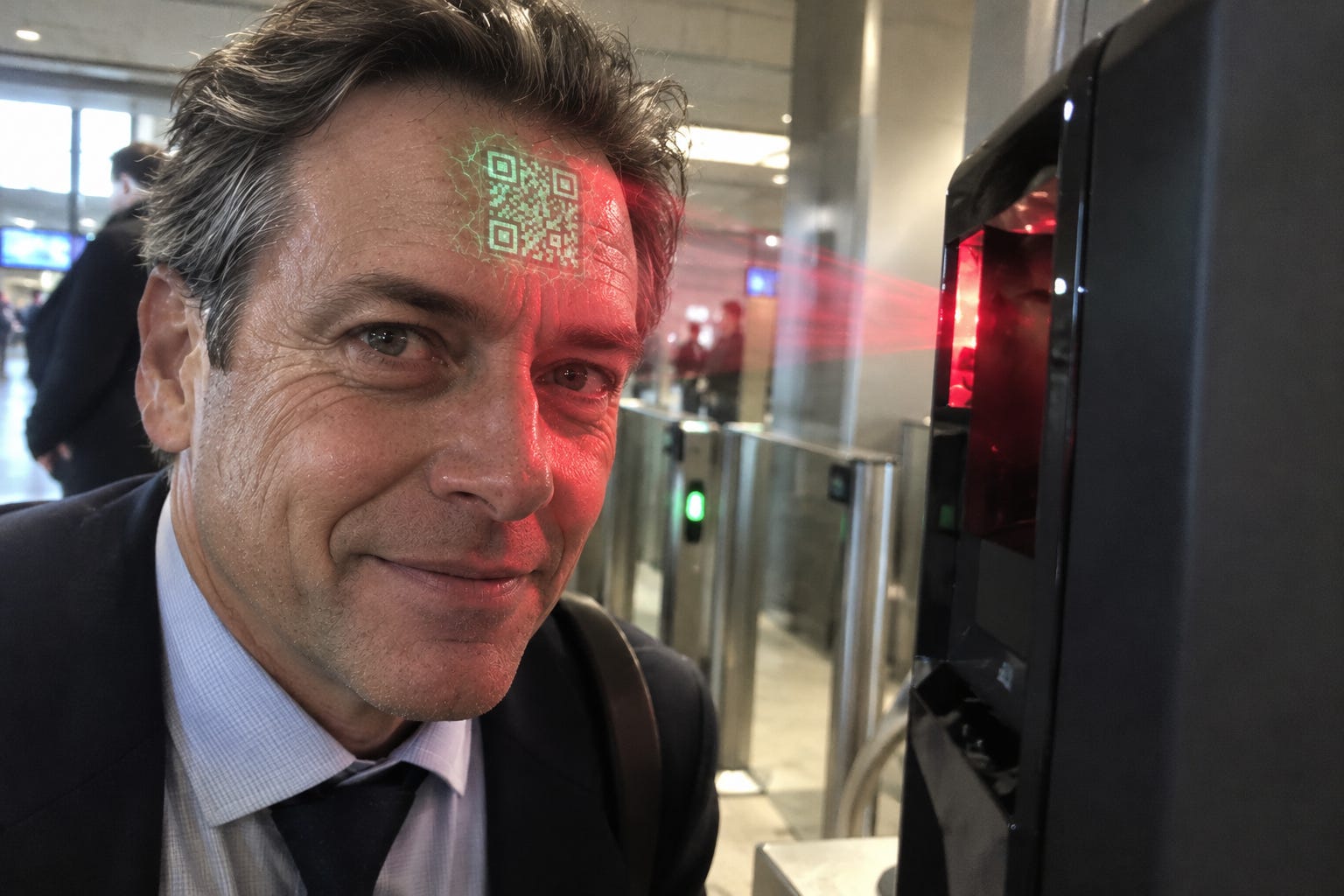
The recent media silence around Digital ID feels about as reassuring as the calm in the eye of a Category 5 hurricane. In case you haven’t kept up with the rollout, a quick note: the damn thing is right on top of us.
It’s not just the silence that’s creepy. It’s the sheer number of fantastically inventive ways our attention is being steered towards everything except the one thing that will alter the course of human history in ways no war, plague or celebrity meltdown could ever aspire to.
A hurricane can shake, rattle and rearrange your home and your neighbourhood, but you can still build it all back. Digital ID will shake and rattle the blueprint of your life, and the decision on how to rebuild it won’t be yours anymore. It will belong to the arbitrary whims of whoever holds the keys to the mother algorithm.
Ergo. The circus of diversion. Gas prices. Looming WWIII. Militant mobs burning down the centres of culture. Cyberattacks. Government warning to prepare for 3-10-30 day shutdowns. Another virus with a Greek letter. An American midterm election, a pop star’s divorce, a footballer’s haircut.
Underneath them runs an invisible thread of supposedly benevolent regulations, made by unelected bureaucrats, locked in baby steps. Nobody is forced. But refusing them will cost you your seat at the table, your place in the queue, and then some.
How close is it? Eight weeks. On 24 December every EU country owes its citizens a digital identity wallet, and a week later an age-check app built on the same blueprint is due in all of them. On 2 January Germany’s wallet goes live. Around 18 January America’s GENIUS Act takes full effect, and licensed digital dollars arrive with a built-in switch to freeze them. On 10 July 2027 Europe ends anonymous bank and crypto accounts, and by the following Christmas Eve every bank in the union must accept the wallet. The rest of the calendar is at the end, if you have the stomach for it.
In Philip K. Dick’s Ubik, published in 1969, Joe Chip’s own front door refuses to let him out until he pays it five cents, and he ends up arguing with it in his dressing gown, and losing. It was meant as a joke.
How we got here
It began, as these things do, with an emergency everybody agreed on.
In the summer of 2021 Europe gave its vaccinated citizens a QR code. Within weeks a café in Lyon wanted to see it. So did the train to Milan. In parts of France, so did an entire shopping centre.
That November Austria, where I live, confined everybody over twelve without the code to their homes. They were allowed out for work, exercise and groceries. Nobody was dragged anywhere. People were left outside, and outside turned out to be persuasive enough.
Other countries taught the same lesson with fewer manners. In February 2022 Canada froze more than two hundred bank accounts linked to a trucker protest. That June, depositors in Henan set off to protest about their frozen savings and found their health codes had turned red. They went home.
Then the emergency ended. The code stayed.
Brussels handed its certificate framework to the World Health Organization in 2023. In April 2024 it passed the law that gives every European a digital identity wallet. By the end of that year its crypto rules were stamping a name on every transfer.
America has refused a national ID card for two and a half centuries, and is proud of it. In May 2025 it began enforcing REAL ID, and airports started accepting a phone instead of a licence.
In January 2025 Washington had banned a central bank digital currency by executive order. Six months later it passed a law letting private firms issue regulated digital dollars instead. Same dollar, different logo.
In July 2025 Britain started checking faces at the door of the adult internet. The Supreme Court let Texas check ages too. China launched a national internet ID, voluntary in the way a tollbooth is voluntary.
2026 was the year the children were enlisted.
Australia banned social media for under-sixteens and shut 4.7 million accounts in five weeks. The world took notes. Spain, Austria, France and Germany drew up versions of their own.
Japan let its paper health cards expire. Russia put its state messenger on every phone, ordered every shop to accept its ID and told its biggest banks to offer the digital ruble.
On 15 October, while the news was about something else entirely, the Bundestag passed the law for Germany’s wallet. It arrives on 2 January 2027, nine weeks from now.
You might comfort yourself that all this is about the digital age. About security and safe borders. About catching criminals, sparing a minority, saving paper and making the trains run on time. If so, congratulations. You have been had by the oldest trick in the manipulator’s bible.
The lab notes
The trick is older than the internet. Psychologists worked out how to steer people decades ago, some in university labs with clipboards, some in secret programmes funded by spies.
The least respectable was in Montreal. In 1953 the CIA approved MKUltra, a programme run by a chemist named Sidney Gottlieb to find out whether a mind could be steered from outside. Some of its money reached a psychiatrist called Ewen Cameron, who put patients into weeks of drugged sleep and played them the same taped sentence through a speaker under the pillow, by some accounts hundreds of thousands of times. He called it psychic driving. In 1973 the agency’s director ordered the files destroyed, and four years later about twenty thousand pages turned up anyway, misfiled among the finance records. We will never know the full extent of MKUltra. We do know its lesson outlived it, and went mainstream under a friendlier name, gentle persuasion.
Gentle, because the drugs and the electroshocks turned out to be unnecessary. To steer human behaviour, the fear of being left out is enough, the spectre of social exclusion. Strip away the jargon and every method that follows comes down to one hunger, the approval of the people around us.
In March 2020 a group of behavioural scientists advising the British government wrote that the perceived level of personal threat needed to be raised among the complacent, using hard-hitting emotional messaging. Frighten the complacent into doing good first, and the reluctant follow the herd.
The strategy runs the same way every time. Frame the measure as a kindness to others, so that saying no makes you sound selfish, or worse, unwell. Then hand the people who say no a label. Anyone who preferred to strengthen their immune system with sleep, sunlight and good food, rather than with the shot on offer, became “anti-vaccine”. The label did the arguing, and the question of how to stay healthy never came up.
Then you cut a slightly different key for every lock, one for the child and another for her grandmother, and a whole continent walks itself through the door, humming.
Ten doors
Nobody needs to persuade a whole population. A population is ten different people, and each of them has a door.
The child is the easiest. The first request comes dressed as her protection, and nobody wants to be the parent who voted for strangers, pornography and the algorithm.
Why the child goes first was measured in 1966. Two psychologists in California, Jonathan Freedman and Scott Fraser, asked householders to put a tiny sign in their window urging safe driving. Nearly everybody agreed. Who is against safe driving? Weeks later the psychologists came back and asked to plant a large, ugly billboard on the front lawn. About three in four of the sign people said yes. Fewer than one in five of their neighbours did. Start with a request about a child’s safety, and the big requests that follow get waved through.
A small yes turns you into the kind of person who says yes. The psychologists called it the foot in the door.
The age check is the little sign in the window. The billboard arrives later, when the wallet that let a twelve-year-old watch dance videos asks for her bank account, her medical record and the key to her front door.
The parent is persuaded by other parents, who work for free.
A parent can ignore a minister in Berlin. He cannot ignore the class WhatsApp group. One message nobody answers, one birthday party his daughter is not invited to, and a family learns exactly where it stands. Parents trade in each other’s approval, and the system has learned to print it.
Grown-ups like to think peer pressure ends at school. It follows them to every parents’ evening. In the early 1950s Solomon Asch measured how strong it is. He sat volunteers at a table with actors who all gave the same wrong answer about the length of a line, and about one time in three the volunteer sided with the room against his own eyes. In 2003 a team at UCLA found out why it hurts to resist. They cut people out of a simple ball-tossing game on a screen, and being left out lit up the same parts of the brain as physical pain. A parent feels it twice, once for himself and once for his child.
Now put that table in a classroom in Bielefeld. A father asks at the parents’ evening why a child should show state papers to use an app, and the room goes quiet. A mother in a fleece says she cannot believe a grown man would put data protection before her daughter’s mental health. Two other mothers nod. Nobody looks at him on the way out, and by the car park he has become the man who does not care about children.
By Advent he has downloaded the app to prove to the other parents that he loves his daughter. Nobody asked him to adopt an ID. They asked him to protect a child, and the ID came in the box, like the toy in a packet of cereal.
The teenager is persuaded by being allowed to win.
Jack Brehm called it reactance in 1966, the urge to push back the moment a freedom is taken away. You cannot stop a fifteen-year-old with a rule. You can only let him beat it.
When Britain’s age checks began on 25 July 2025, VPNs took five of the ten top free spots in Apple’s British store within days. A boy in Leeds borrows his mother’s face for the selfie check and feels like a master criminal. By lunch he is a hero in the group chat, the only approval a fifteen-year-old cares about.
The lesson he carries into adulthood, I suspect, is that verification is a game you can always win. Grown men sign anything in that frame of mind.
Nobody tells the grandmother to give anything up. The system waits for her card to die of old age.
In 1968 Robert Zajonc showed how she will come round. He flashed Chinese characters at American students who could not read a word of them, some once, some twenty-five times, and asked which ones meant something good. They picked the ones they had seen most. Put the wallet logo on the bank door, the chemist’s window and the tram stop, and one day it will feel like an old friend, which is also how most marriages work.
In 2003 Eric Johnson and Daniel Goldstein looked at organ donors. In Germany, where you tick a box to become one, about one person in eight had. Next door in Austria, where you are a donor unless you tick a box to refuse, almost everybody was. Same language, same sausages. The only difference was which box came already ticked. Britain was so impressed that in 2010 it opened a government office devoted to the idea and called it the Nudge Unit.
Japan let its paper health cards run out on 1 December 2025, and some eighty-seven million people linked their national ID to their health cover. Brazil’s old identity cards die on 28 February 2032.
People march against a law. Nobody has ever marched against an expiry date.
The newcomer, the foreigner who came for work or for safety and lives here on a permit, cannot march at all. He has no vote, no lobby, and a clerk can cancel his right to stay. That is why every new identity system is tried out on him first, and on everybody else later.
Colonial Britain made African men in Kenya carry a pass called the kipande from 1920. The idea outlived the empire, the way ideas do. At the end of 2024 Britain took the plastic cards from its foreign residents and gave them an online eVisa instead. On 12 October 2025 the EU began fingerprinting non-EU visitors at its borders. Vietnam wants every account a foreigner holds tied to its state ID by 30 June 2027.
A nurse from Manila works nights in a London hospital. She has no card anymore, only a code on her phone, and every new contract means logging in to prove she is still allowed to look after the sick. Her British colleagues on the ward never notice. They will, when the same login is asked of them.
The worker obeys whoever looks official, and at work the most official thing in the building is a form.
In 1961 Stanley Milgram had volunteers at Yale give ever stronger electric shocks to a man in the next room. The man was an actor and felt nothing, though the volunteers did not know that. About two thirds went all the way to the highest switch, because a calm man in a grey coat said the experiment required it. Researchers still argue about what Milgram proved. In an office the man in the grey coat has become a form from HR, and it says the same thing. The process requires it.
Since 18 November 2025 every new company director in Britain has had to verify their identity through the government’s One Login. From 1 July 2030 a carpenter in Linz who invoices a client in Passau must send an electronic invoice that the tax office sees in near real time.
A man will argue with his government for twenty years. He will not argue for twenty seconds with the form he needs to get paid.
The saver is persuaded by the fear of losing what he has.
Daniel Kahneman and Amos Tversky showed in 1979 that losing a hundred euros hurts about twice as much as finding a hundred euros pleases. Nobody downloads a wallet for a discount. Everybody downloads one rather than lose the use of their card.
Around 18 January 2027 America’s GENIUS Act turns dollar stablecoins into licensed money whose issuers, as I read the law, must be able to freeze or seize them on a lawful order. On 10 July 2027 the EU ends anonymous bank accounts and caps cash payments to traders at ten thousand euros. The same year the European Central Bank pilots its digital euro, with a planned cap on how much of it any one person may hold. From 24 December 2027 every bank in the union must accept the wallet. By then the branch round the corner may well be a vape shop, and the only counter left will be on your phone.
The patient is persuaded by fear, which the British advisers wrote down in March 2020 and which has never needed writing down again. Health is where people argue least, because they are ill.
Austria’s electronic vaccination record already takes mandatory entries, with no right to object, and runs in full from 1 January 2029. The European Health Data Space starts applying in 2027, with an opt-out from research use that most people will never hear about.
A woman in Graz with a chronic cough will find, around 2029, that her medical record follows her across every border in Europe. It may save her life one day, which is what makes it so hard to refuse.
The shopkeeper is persuaded by his own customers.
Robert Cialdini called it social proof in 1984. People decide what is right by watching what other people do, and they decide faster when they are not sure.
From 1 September 2026 every shop in Russia had to accept the state messenger’s ID, and paper stayed legal, so nobody could call it compulsory. The cashier sighs at paper. The sigh does more work than the law.
The EU spares small firms the duty to accept the wallet from 24 December 2027. A kiosk owner in Kraków buys the reader anyway, because the queue behind the old woman fumbling with her plastic card has started to grumble. Nobody may ever need to make it compulsory, as long as the fast lane does the persuading.
The objector is the uncle in the cellar who reads the regulations and quotes Article 5a over Christmas dinner, while everybody else passes the potatoes. You cannot persuade the objector, and a well-built system never tries. It teaches him instead that pushing back changes nothing, and waits for him to stop pushing. Psychologists call it learned helplessness, and they learned it from dogs.
In 1967 Martin Seligman strapped dogs into harnesses and gave them shocks they could not escape. Later he put them in a box split by a wall no higher than a dog’s shoulder. One hop over it and the shocks stopped. Most of the dogs never tried. They lay down and whimpered and took the shocks. China shows the human version. Its court blacklists kept people who owed money off planes and fast trains, with more than twenty million ticket purchases refused by 2019. The depositors in Henan were never argued with. Their health codes turned red, and most of them stayed home. Officials were punished afterwards, which proves the switch existed and somebody flipped it.
In Europe the objector gets gentler treatment. The family rolls its eyes when he speaks, the label follows him round the dinner table, and the queue at the bank moves a little slower. My guess is that it works on most of us, slowly, the way it worked on Seligman’s dogs.
So what do you do?
Lay the ten doors side by side. The foot in the door, conformity, reactance, mere exposure, the default, obedience, loss aversion, social proof, learned helplessness. Under all of them sits one hunger, the approval of the people around us.
Knowing the names will not save you, any more than knowing about sleight of hand helps you find the card. In 1999 Daniel Simons and Christopher Chabris asked people to count basketball passes in a short film. Half of them missed the woman in a gorilla suit who strolled through the middle of the game. A good magician is counting on you to watch.
Which leaves the one move he cannot plan for. You can say no.
It will hurt. Being left out registers in the brain like a blow. Take the blow anyway. The alternative does not hurt at all, which is what makes it dangerous, a slow, warm glide into a bog, one convenience at a time, until you can no longer tell which of your choices were ever yours.
Asch found the antidote at his own table. When he planted one honest ally who gave the right answer, the volunteers caved in about one round in twenty instead of one in three. One voice gave everybody else permission to trust their eyes.
History agrees. In 1943 Dimitar Peshev, deputy speaker of Bulgaria’s parliament, refused to leave the interior minister’s office until the deportation of the country’s Jews was called off, and some forty-eight thousand survived. In 1983 a handful of West Germans took the census to court and won a new right to decide who knows what about them. Australia dropped its national ID card in 1987 after the marches. Britain shredded its identity register in 2011.
So take the shock. Say no where no is still legal, out loud, so the next table hears it. Keep cash, keep paper, keep a garden, know your neighbours. Where an opt-out exists, like the one for research use of your health records, find it and use it while you are well. Seligman’s dogs learned to escape after they were dragged over the wall again and again. People only need to see one other person jump.
The Calendar
Next time the screen is all gas prices and a pop star’s divorce, look at the calendar instead. Christmas Eve, the EU wallet deadline. Nine days later, Germany’s wallet. A couple of weeks after that, America’s stablecoin law. In between, anybody who asks a question at the dinner table will be told, kindly, that they must not care about the children.
Every line below is already law or already scheduled.
24 December 2026. Every EU country owes its citizens a digital identity wallet.
31 December 2026. An age-check app, built on the wallet’s blueprint, is due in every EU country. In Vietnam, every non-bank account a foreign resident holds must be tied to the state ID.
1 January 2027. Greece bans social media for under-fifteens.
2 January 2027. Germany’s wallet goes live.
January 2027. France checks the age behind every existing social media account.
Around 18 January 2027. America’s GENIUS Act takes full effect. Licensed digital dollars arrive, and their issuers must be able to freeze them.
Spring 2027. Britain’s under-sixteen rules arrive.
2027. The European Health Data Space starts applying, and the digital euro enters its pilot.
30 June 2027. Foreign residents’ bank accounts in Vietnam follow.
10 July 2027. The EU’s anti-money-laundering rules end anonymous accounts, check every crypto transfer above a thousand euros and cap cash payments to traders at ten thousand.
24 December 2027. Every bank in the EU must accept the wallet.
1 January 2029. Austria’s electronic vaccination record runs in full. The Health Data Space follows the same year, and so do the first digital euros, at the earliest.
2030. The EU’s Digital Decade programme wants eight in ten Europeans using a digital ID, and the United Nations wants a legal identity for every person on earth.
1 July 2030. Invoices between EU countries go digital and report to the tax office in near real time.
28 February 2032. Brazil’s old regional ID cards stop being valid.
From here things will likely get more surreal, as they usually do.
Around 2043 the Borg finally arrive, and they are disappointed. Their cube parks over Brussels and broadcasts the old line about resistance being futile. Brussels answers with a cookie banner. Accept all, or manage preferences.
Their scanners find four hundred and fifty million Europeans already verified, age-checked, linked and humming. There is nothing left to assimilate. The Borg Queen asks to speak to a manager and is told, kindly, to download the app.
Only the uncle in the cellar fails to show up on the scan. He sits among his tins with a paper map and a wind-up radio, and the cube cannot find him, because he exists in no database. When the front door asks him for five cents, he climbs out through the cellar window.
Philip K. Dick told an audience in Metz in 1977 that we are living in a computer-programmed reality. I’ve decided to take him at his word, and to add one rule of my own. You don’t score points in this game by being good and likeable. You score by resisting when the odds are stacked against you.
Resistance may be futile. But it’s the only game in town.
Before you go
I believe the most powerful way to fix what’s wrong with the world is to start with ourselves.
When something goes wrong with your body, field, mindset, or spirit, the answer often lies in the fundamentals of how you live. Yet what gets sold is another pill, another subscription, another dependency.
That’s why I built Energeia.now — a website with an intelligent assessment designed to identify the root causes of energy loss, informed by thousands of measurements and natural protocols that address the fundamentals. Six minutes to discover where your habits may be costing you the most energy. Take the reading →
If you find my writing worthwhile, consider sharing it with others, subscribing, or buying me a coffee. Your support helps keep this work going.
I have always said and will continue to say no. Never having had a cell phone makes it much easier.
Ok is Africa going to be the only "free" place on earth. It is goinf ro real diffixult implementing that here. I think I will stay here then and not leave.