


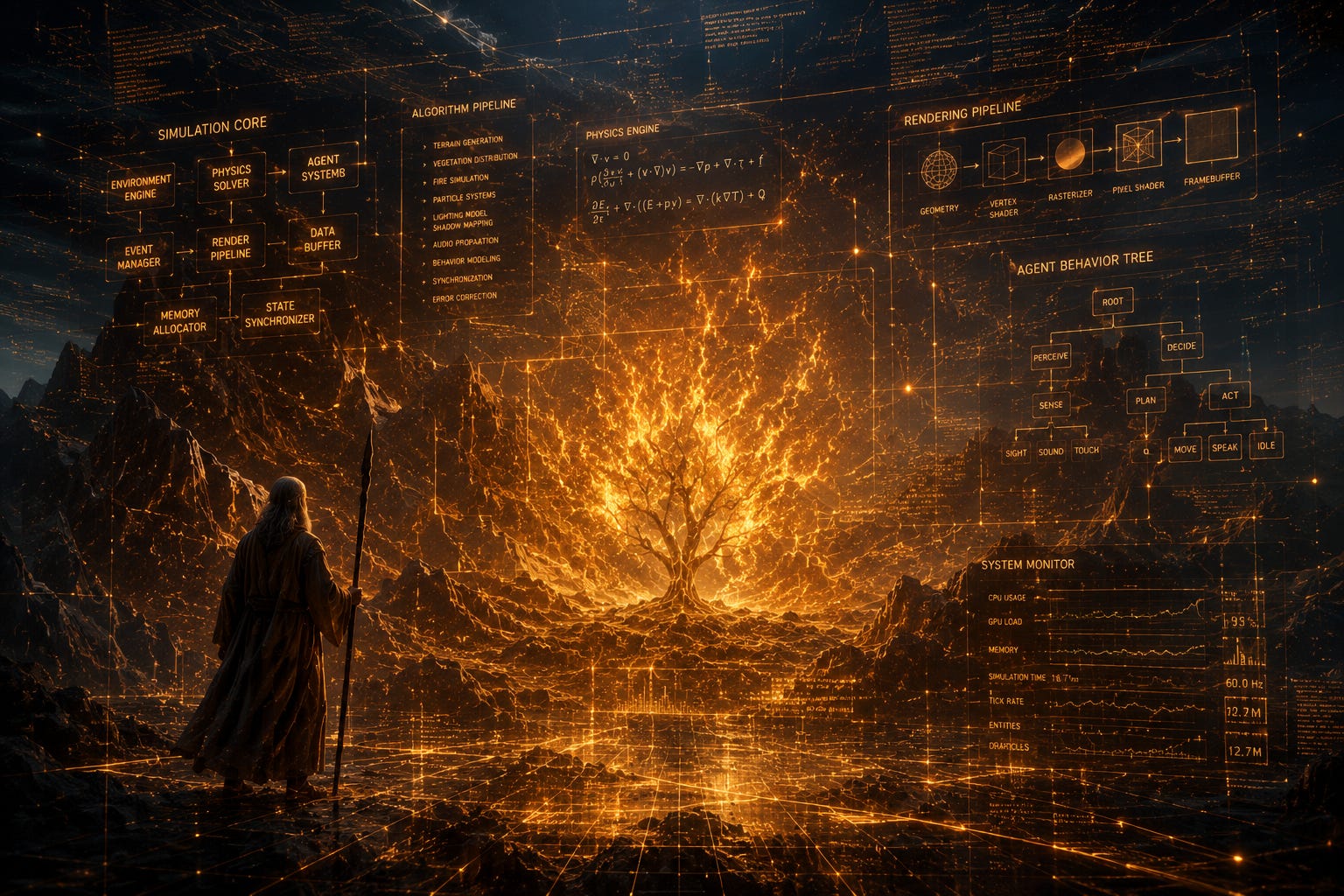
We don’t choose our faith. Religion. Guiding principle. Compass. God. Whatever you call it. We inherit it before we’re old enough to have an opinion about it. Just like a computer that gets an OS before it exits the factory. The kid born in rural Alabama in 1980 is Baptist with the same inevitability that the kid born in Tehran that year is Muslim and the kid born in Mumbai is Hindu. Another kid born into a Luciferian cult will spill blood on his graduation day, as certain as the moon waxes and wanes. Pretty much none of us arrived at our particular faith through revelation. There are a handful of exceptions, but for the remaining nine billion, it’s safe to say that certainty in one’s particular faith does not come from understanding, but from exposure to a program.
That program usually serves the purposes of another program, or another man. Some type of control narrative. Faith also forms a self-reinforcing loop, which is why the most dangerous theological positions in circulation are held by the people who have examined them least.
Growing up, I inherited a curious mix of faith systems.
My father was an aviator who kept a spiritual life running quietly underneath the ledgers — not a man who made pronouncements, but you could sense it from his behavior. I once sat next to him as a seven-year-old while he was piloting a twin-engine Beechcraft over an icy Baltic Sea when both engines cut out simultaneously at around 10,000 feet. Prut-prut-pruuuut… the cylinders croaked gently. I looked at him, prepared to panic, and saw tranquility incarnate. He met my eyes, gave me an assuring nod, and asked me to reach down beside my seat and feel for two handles. 8,000 feet. I fumbled. 7,000 feet. It’s OK, he said, pressing switches, tapping instruments, chill as a sommelier fondling the wine bottles. 4,000 feet. Try again. I reached deeper and found one handle, then another. Good boy. Now turn them both to open. Fuel shutoffs. At around 1,500 feet one engine sputtered back, then the other. We climbed into a glorious golden hour above the clouds, and he told me, jokingly, not to tell my mother.
That implicit trust in something greater, regardless of the situation, became part of my program before I ever heard the word religion. It has helped me stay level in bonkers situations. It’s not a verbal faith. It’s a frequency you can tune into, if you’ve been initiated. But it’s still a program. An inherited one.
The opposite side of my imprint came from my mother, who was an artist yet deeply atheist. As soon as I was old enough to ask questions about the nature of the universe, she became defensive, reciting a Newtonian, mechanistic universe that followed mathematical certainties. Modern man had figured out the grand mystery long ago — otherwise we’d still be living in the Middle Ages, pouring manure out of kitchen windows. The universe was no more conscious or intelligent than a Swiss watch. Any insinuation towards any other possibility was hogwash. Her cynicism came with a black turtleneck — the message being that the search is pointless, that the honest position is to stop asking. Focus on material security and follow societal norms, because otherwise, boy, you’re going to end up a bum. Or worse: spiritual.
How they ever found each other and managed to produce three children also produced in me another form of faith: that marriage is a highly dubious construct, driven by zero logic and infinitely powerful chemical cocktails. But that’s another story.
They had, just like me and everyone else, entered their particular pools of faith long before they could test the temperature. I fell in between as a half-construct — partly cynical, partly trusting, never on entirely sure footing. If the two people who knew me best couldn’t agree on whether there was anything beyond the material, the reasonable response seemed to be that nobody knew — a form of mental paralysis called agnosticism.
After my brief and self-obsessed youth, I began searching for answers again — with whatever tools seemed useful. That included a sustained engagement with entheogens — what started as a ‘great way to get messed up’ grew increasingly into a disciplined method for dismantling fixed frameworks. I also read widely. Rebels in robes, gowns, and lab coats, spinning theories across quantum physics, information theory, Gnostic theology, Vedic cosmology, Buddhist epistemology, wave physics. If you dig far enough into that terrain, you notice there is no answer. No 42. Everyone is seeking to define the question. Something like: who the hell is rendering this reality and for whatever purpose?
Most serious thinkers in that terrain agree the observer cannot be cleanly separated from what is observed. The world is not just ‘out there’ — it is also rendered by a glob of grey gunk between our ears, contextualizing a field of potential outcomes with an individual formula, in which faith plays an integral part.
Which leads to the question: is there a formula that helps us render a better reality? A Faith 2.0?
You had better believe such a formula exists, or it definitely won’t — even if it does. That is how powerful the glob is.
But to get to Faith 2.0, we need to first figure out what went wrong with Faith 1.0. Can it be debugged?
The Record (Every Major Faith, Briefly and Unfairly)
Carl Jung spent a career documenting what he called archetypes — recurring patterns in human mythology that appear independently across cultures with no contact. Joseph Campbell called it the monomyth: the hero’s journey, the dying and rising god, the descent to the underworld and the return transformed. The virgin birth, the god who dies for humanity’s sins, the resurrection after three days, the twelve disciples: these patterns predate Christianity by centuries. Osiris dismembered by Set, resurrected by Isis. Horus, born to the virgin Isis, performs miracles, gets betrayed. Mithras, the Roman soldier’s god, born in a cave, celebrated a last supper, rose from the dead. Dionysus: divine father, mortal woman, wine miracles, killed, resurrected.
The question is not whether the Gospel writers were plagiarists — the details differ enough that ‘plagiarism’ is the wrong word. The question is why the same archetypal story keeps surfacing across every civilization that has ever tried to explain human suffering and transcendence. Jung’s answer: these are the recurring fingerprints of something real in the human psyche, or in the structure of reality itself, breaking through in whatever mythological costume the local culture provided. Worth holding onto as a clue to Faith 2.0. We’ll come back to it after examining Formula 1.0.
The Theistic Traditions
Living by the words of the original prophets has no doubt produced ample quantities of well-meaning, law-abiding, morally centred citizens. The institutionalization of the same words didn’t fare that well.
Christianity began with a teacher who told the powerful they were doing it wrong and got executed for it. Love your neighbor, do not judge, sell what you own and give it to the poor. Three centuries later the institution hiding in catacombs became the official religion of the empire that killed the founder. What followed: the Crusades (a Pope redirecting European nobles who couldn’t stop killing each other toward Jerusalem), the Inquisition (which eventually concluded that women who owned cats were probable witches), the Thirty Years’ War (began as a dispute about whether Christians should be Catholic or Protestant, ended when it had killed roughly a third of the German population), the theological underwriting of the transatlantic slave trade, the systematic institutional protection of child-abusing priests, and the prosperity gospel — the innovation that God specifically wants you to be rich, pioneered by theologians who are themselves very rich, funded by congregations that tend not to be.
Islam arrived with genuine social innovations for its time, was in civil war over succession within forty years of the Prophet’s death, and has been generating the Sunni-Shia split’s variations on sectarian violence for fourteen centuries since. Apostasy laws on the books in fifteen countries, where leaving the faith is a capital offense. Buddhism gave the world a Nobel Peace Prize laureate who stood by while monks coordinated a genocide. Hinduism’s caste system has sorted human beings by birth for three thousand years, with two hundred million people at the bottom as the ongoing result.
The Faith of Capital
The Enlightenment saw the faults in institutionalized religion and replaced it with secular faiths that have since produced the modern world. Same architecture, different branding.
Market capitalism in its fundamentalist form is a complete belief system. Scripture: Adam Smith’s invisible hand, Hayek’s spontaneous order, Ayn Rand’s consecration of individual self-interest as the highest moral act. Saints: the self-made billionaire, the disrupting entrepreneur, face on magazine covers in poses that would not look out of place in a cathedral. Heretics: the environmentalist who argues externalities are real, the labor organizer who argues workers have interests, the regulator who argues markets require rules. Eschatology: the free market, left sufficiently alone, will eventually solve everything, including the problems the free market created.
Herbert Spencer, not Darwin, coined ‘survival of the fittest’ as a social principle. Darwin’s biology described how species change through natural selection. Spencer applied it to human social hierarchies to argue that the poor deserve to be poor and the wealthy deserve to be wealthy because evolution ordained it. Darwin explicitly distanced himself from this reading. Spencer’s Social Darwinism became one of the most useful ideological tools in the history of wealth accumulation — it transforms a political arrangement into a natural law, which makes questioning it feel like arguing with gravity. It underwrote modern reductionist science and symptomatic medicine along the way.
Thomas Piketty documented r > g: the return on capital consistently exceeds the growth rate of the economy, which means wealth concentrates automatically without countervailing force. A structural feature of the system, running in the background, like entropy. The rich get richer not because they work harder but because the algorithm of capital accumulation runs in their favor by design. Eight people currently own as much as the bottom half of humanity combined. The faith system built around this arrangement considers it a natural outcome.
The Faith of Nothing
Then there is scientism — not science, which is a method and has produced the best results of any human epistemological practice by a significant margin, but scientism: the metaphysical claim that the scientific method is the only valid path to knowledge, that consciousness is a byproduct of brain chemistry with no further significance, and that the universe itself is an engine running toward heat death, taking everything we have built or loved with it.
This is a faith. The entropy of the universe is real. The conclusion that human experience is therefore meaningless is a philosophical move, not a scientific finding. Thomas Nagel, in ‘Mind and Cosmos,’ argued that the materialist neo-Darwinian conception of nature is almost certainly false as a complete account of reality — not on religious grounds, but because it cannot account for consciousness, reason, or value without circular reasoning. It omits syntropy, the natural tendency toward order in living things, for a reason. Total control requires humans to perceive themselves as machines. Richard Dawkins gave us humans as gene-propagation machines, a frame so reductive that even Dawkins spent years explaining what he didn’t mean. Stephen Hawking declared, with the confidence of a man who had just located God’s absence between the equations, that philosophy is dead.
A universe that began with a Big Bang, runs toward maximum entropy, produced consciousness as an accidental byproduct, and ends in heat death while meaning nothing — this is the creation myth of the secular West. It produces nihilism in some, frantic distraction in others, and persistent background anxiety in almost everyone. It is also the perfect cosmological excuse for greed, the accumulation of things at whatever cost, and the building of fences around personal wealth, until kingdom come.
In considering Faith 2.0, it’s worth noting that every faith on this list — theistic, capitalist, materialist — shares the same design flaw. It offers a fixed answer and prohibits the question. The certainty is the point. The certainty is also the source of every catastrophe in the audit.
What Rose From The Wreckage
By the mid-twentieth century, a generation looked at that record and walked out. Can’t blame them. Churches had run their empires, blessed their wars, protected their predators, and dressed it all in the vocabulary of love. The secular replacements produced gulags and atom bombs. The invisible hand had been picking pockets for two centuries and calling it freedom. The counterculture of the 1960s showed up with flowers, acid, and a genuine intuition that Western materialism had cut us off from something important.
The diagnosis was right. The prescription turned out to be considerably more complicated.
The early counterculture had serious thinkers in it. The Beats drew on Eastern philosophy and indigenous plant medicine to construct an alternative to the postwar consumer consensus. The civil rights movement ran on genuine spiritual coherence rooted in Black church tradition — a collective field organized enough to move a nation. Then something happened to it.
The CIA’s MKUltra program ran systematic experiments with LSD and other psychedelic compounds on unwitting subjects from the early 1950s through at least 1973. Ken Kesey got his first dose through a CIA-funded experiment at Stanford in 1960. Timothy Leary’s Harvard research operated in an environment of government interest that Leary only partially understood. Declassified materials show the intelligence community found that high-dose psychedelic states produced profound suggestibility, dissolution of individual identity, and what one researcher called ‘cosmic acceptance’ — a mental state roughly as useful for organized political resistance as a warm bath. Whether the subsequent transformation of the counterculture from politically serious movement to lifestyle of personal elevation was engineered or simply convenient is a gap that stays open. The CIA had motive, means, and documented interest in exactly this outcome. In either case, the pacification was real, the timing was convenient, and political effectiveness dropped in almost direct proportion to the adoption of the personal-spiritual model over the collective-political one. A population that loves everything that moves, wraps itself in endless positivity, and prioritizes its own elevation above all else represents a negligible threat to a war machine. Someone noticed.
The spiritual supermarket that followed kept the vocabulary — consciousness, vibration, energy, awakening — and dropped the politics. A theology of personal elevation with the same structural bones as the prosperity gospel it claimed to replace. Prosperity gospel tells you God wants you rich. New Age tells you the universe wants you as your highest self. Both locate the problem and the solution inside the individual, which suits any arrangement that prefers individuals stay unorganized. Real exceptions exist — Thich Nhat Hanh’s engaged Buddhism, the liberation theology priests who paid for the Sermon on the Mount with their lives in El Salvador and Guatemala, the Standing Rock water protectors in 2016. Against those: an Instagram spirituality that monetizes the language of connection while producing, by every available metric, more isolation. Spiritual bypassing at industrial scale.
In considering Faith 2.0, it’s worth noting that any faith based on self-elevation may not be producing a coherent community that is also ready to tackle adversity, recognize imminent threats, and act on them. It is too self-obsessed and biased.
What the Tribes Knew
Before the institutional faiths, the secular replacements, the New Age supermarket — something older was running. No doctrine, no theology, no Sunday morning performance. Just people inside a reciprocal relationship with the land, the seasons, the animals, the dead, and each other.
The evidence is anthropological. Hunter-gatherer societies show lower chronic disease rates, stronger social cohesion, and a quality of present-moment engagement that post-industrial populations pay therapists to approximate. The ǁKung San of the Kalahari covered their material needs in roughly fifteen hours a week. The Hadza of Tanzania carry near-zero rates of the metabolic diseases defining modern mortality. Indigenous cultures across the Amazon, Pacific, and Arctic maintained ecological relationships so precisely calibrated that European settlers consistently mistook managed landscapes for untouched wilderness.
Finished systems, refined over tens of thousands of years. Nobody proclaimed their faith because it showed up in every decision — when to hunt, what to take, what to leave, how to address the river before crossing it. The belief was the lifestyle. No maintenance required outside of living it. The shaman served the tribe. The service carried accountability, reciprocity, consequence. No gap between the spiritual and the practical because they were the same transaction.
Three hundred years of colonial efficiency later, most of it was gone. You can’t mine a mountain that is your grandmother. You can’t dam a river that is your brother. The first order of business in every colonial project was destroying the relational cosmology that made extraction feel like sacrilege. That project is nearly finished. The last intact tribal systems face active pressure from resource extraction, climate displacement, and a digital information environment doing to remaining coherent cultures what smallpox did to the Americas.
Going back is not an option. But the tribal model scores higher than anything else on the only measurement that actually matters — how much order does this system produce versus consume. A system refined over fifty thousand years without producing an ecological emergency is optimized better than one running for three hundred years that did.
Which gives us the strongest clue in how to build a formula for Faith 2.0.
Coherence.
How much coherence does this system generate versus consume? How long does it run without depleting its substrate? Tribal and indigenous systems score highest by every metric, having run for fifty thousand years without producing an ecological emergency. Early founding faiths score well initially, then drop sharply once the institution takes over from the original teaching. Mature institutional religion, market capitalism, and scientism all generate high entropy outputs — violence, inequality, nihilism — with no built-in correction mechanism. New Age spiritualism scores moderate for individuals, near zero for collective function. The systems that lasted longest and depleted least were the ones with direct feedback loops between belief and consequence. The ones that broke down fastest were the ones that severed that connection and called it doctrine.
The tribal system had no word for faith because the connection was direct, continuous, and embedded in every transaction with the world. That directness as a principle is what we need for Faith 2.0. A faith you don’t need to proclaim because it shows up in how you live.
Building The Algorithm
The same physics and mathematics that dismantled the naive God of the ancient world have, in the last century, produced something that sounds almost identical to what the mystics were saying all along: that the fundamental substrate of the universe is not matter or energy but information. That reality follows rules — an algorithm — all the way down. That consciousness is not an accident of chemistry but something the universe has been building toward for thirteen billion years.
Max Tegmark at MIT argues mathematical structure is not a description of reality but is reality. John Wheeler concluded, late in a career including nuclear physics and black holes, that the fundamental currency of the universe was information: ‘It from Bit.’ Nick Bostrom ran the probability math and concluded that if advanced civilizations ever run reality-level simulations, we are almost certainly already in one. Not mystical positions. These are where the physics leads when you follow it far enough without flinching.
So ask the question differently. Not ‘is there a God?’ — that question has been answered badly by too many people with too much institutional interest in the answer. Ask instead: if this reality is a designed system running an algorithm, what is it optimizing for? What does thirteen billion years of increasing complexity and the emergence of conscious beings suggest the system is trying to produce? And if we can read that intention — even imperfectly — can we align our individual operation with it more deliberately than any inherited mythology has managed?
A religion defends itself from the evidence. A method updates when the evidence changes. The faith traditions had the questions right. They had the update mechanism wrong. The tribal systems had the update mechanism right — direct feedback from reality, built in by default — and lost the transmission when the lifestyle was destroyed. What we need is the method the tribal systems used, running on the physics the modern period has uncovered.
An algorithm is a set of rules for solving a problem, applied step by step. A recipe. GPS directions. The process your body runs to maintain its own temperature. Evolution producing the human eye over four hundred million years: a very slow algorithm running on biology instead of code. The difference between a good algorithm and a bad one is what it’s optimizing for. The tribal systems were running good algorithms. The institutional faiths ran algorithms that served their institutional interests rather than their members. Social media runs an algorithm that serves its advertisers’ interests. The question is whether we can write a better one.
Can we build it from the ground up, one variable at a time? We already have one term: coherence. The tribal model gave it to us. Now we need to find the others.
Here’s a useful frame. The universe is 99.9% plasma — ionized, electromagnetically active matter that self-organizes, carries current, and behaves like a living medium. Stars, galaxies, the space between them: all plasma, all governed by electromagnetic fields rather than gravity alone. Life, it turns out, is also fundamentally electric. Before it is chemical, before it is biological, before it is anything you can see under a microscope, life is a field phenomenon. It runs on charge, on gradients, on the invisible architecture of electromagnetic interaction. Which means if we’re building a formula for how life works, we should probably be speaking the language it actually speaks.
So let’s investigate. Tentatively. One variable at a time.
Investigating The Variables
Before asking what drives consciousness or purpose or life force, ask what drives anything at all. What makes a system go?
In physics, the answer is always a difference. A gradient. Something higher wanting to equalize with something lower, and the current that flows in between. The technical term is potential difference — voltage. The gap between two states that makes electrons move, that makes work happen, that makes any process occur at all. Remove the gradient and you have equilibrium. Equilibrium is another word for dead.
In a battery it’s the gap between the positive and negative terminals. In a neuron it’s the difference between the charge inside and outside the cell membrane: roughly negative seventy millivolts in a healthy cell, actively maintained by protein pumps that never stop working. Robert Becker, a surgeon who spent thirty years measuring bioelectric fields in living tissue, found that this organized voltage does not just power the cell — it governs healing, growth, regeneration. The gradient is the template. The field comes first. The chemistry follows.
So here’s the question for our formula: what is the human equivalent of voltage? What is the gap that makes a life go?
It seems to be the distance between where you are and where you are becoming — and the energy that gap generates. The person burning to build something is running high potential difference. The person going through the motions is running near equilibrium. Equilibrium, again, being another word for not quite alive. When potential difference is high and everything else runs well, the output has a specific quality that people tend to call charisma, or presence, or aliveness — which, looked at through this lens, is just organized charge visible at a distance. Marcus Aurelius had access to every pleasure the most powerful empire in the world could supply and chose, every morning, the discipline instead — a field desk on the Danube, a plague killing five million, a war in its fourteenth year, private notes about how to be better. Maximum potential difference, minimal scattering. The Meditations were written for nobody and have changed more lives than most texts written for everyone.
Call this variable ΔV — potential difference. The engine. It seems worth including.
The Second Question: Is Raw Energy Enough?
So we have two terms: coherence (C) from the tribal model, and potential difference (ΔV) from the physics of living systems. Are they sufficient?
Probably not. Consider what happens when you have enormous energy without organization. A power surge doesn’t illuminate the room more brightly. It blows the circuit. A person with enormous drive and completely fragmented attention doesn’t produce more — they produce noise. The two terms need each other: potential difference provides the engine, coherence provides the direction. High voltage run through an organized signal. That combination starts to look interesting.
But there’s still something missing. Even organized energy running coherently — what does it run against?
The Third Question: What Is Everything Fighting?
The second law of thermodynamics is the most reliably confirmed finding in all of physics: in any closed system, disorder increases. Your desk gets messy without intervention. The relationship drifts without tending. Every structure not actively maintained degrades. This is not a poetic observation. It is the background condition of existence, running continuously, whether or not you are paying attention.
Erwin Schrödinger, in a small book published in 1944 called ‘What Is Life?’ that directly inspired Watson and Crick’s discovery of DNA, argued that the distinguishing feature of living systems is precisely that they fight this law. They import order from their environment and export disorder, maintaining local organization at the cost of global entropy. He called what organisms live on ‘negentropy.’ Life is an ongoing fight against a force that always wins eventually. The question is how much you build in the interval.
So does entropy belong in the formula? As a denominator — something you divide by, something you’re fighting against — it seems essential. High entropy load means lower effective output, even with identical voltage and coherence. Viktor Frankl spent three years observing this in Auschwitz. Total external entropy, maximum adversity. The prisoners most likely to survive were the ones who had maintained something the camp could not reach: a manuscript to reconstruct, a person to return to, a testimony to give. The entropy term was catastrophic for everyone. The ones who made it were the ones whose other terms held.
Entropy as resistance: S. It belongs in the denominator.
The Fourth Question: Is Everything Just Being Pushed?
Here is where it gets genuinely strange, and where the formula starts pointing at something the physics usually avoids.
Everything so far describes a system being pushed by its past: driven by gradients already formed, organized around patterns already established, resisting decay already in motion. This is the standard picture. Cause and effect. Past determining present determining future. Physics as a one-way street.
But in 1942, an Italian mathematician named Luigi Fantàppie noticed something uncomfortable in the equations. The standard physics equations for wave and particle behavior have two solutions. The first describes waves moving forward in time, spreading out, dispersing — entropy in mathematical form. The second describes waves that converge: organizing around a future point, pulled toward something not yet real. Both solutions are mathematically valid. Physics has a word for the first type: entropy. Fantàppie proposed calling the second type syntropy — and suggested that living systems, unlike inorganic matter, operate on it. That they are not just pushed by their past but pulled by their future.
The mathematics is established. The biological interpretation is speculative. But it maps precisely onto what every serious tradition has described about purpose, and onto what Frankl observed in the camps. The prisoners pulled toward a specific future — a testimony to give, a child to return to — survived at higher rates than those without one. Purpose, in this framework, is not a motivational concept. It might be a physical force. A lock onto a specific future state that organizes everything else around it.
Joan of Arc was seventeen, illiterate, no military training, from a village nobody had heard of. She arrived at the French court claiming the saints had told her how to win the war. What she had — whatever you want to call it — reorganized the coherence of every field around her. The army took Orléans in nine days after a six-month siege. When the English burned her, the army went back to losing. They were locked to her signal. The tribal systems embedded this structurally — your role in the community, your obligation to the land, your relationship to the ancestors and the descendants — so that nobody had to search for purpose. It came with the territory.
So: does a forward-pulling attractor belong in the formula? It seems to. Call it Ω — the syntropy term, the purpose variable, the pull from the future. The most speculative term in the set, and possibly the most important one.
The Fifth Question: What Modulates All of It?
There is one more variable worth investigating before attempting assembly.
Notice that everything discussed so far — potential difference, coherence, entropy resistance, purpose — operates differently depending on the emotional state of the system running it. The same person, in a state of fear, produces a different output than in a state of genuine courage. The physics supports this more concretely than intuition might suggest. The HeartMath Institute found that emotional states produce measurable changes in the body’s electromagnetic field — the heart generates the strongest EM field in the body by a factor of forty to sixty over the brain. Your emotional baseline is not just an internal state. It is physically broadcasting into the space around you, and it is modifying the coherence, the effective voltage, the entropy resistance, and the syntropy lock simultaneously.
The Stoics called managing this the highest human art — the hegemonikon, the ruling faculty that decides what relationship to take to events. The tribal systems built it into collective practices — ceremony, music, shared ritual — that maintained the emotional field of the whole group. It functions less as a separate variable and more as a gain control: a multiplier sitting outside the other terms, amplifying or suppressing everything else depending on its setting.
Call it 𝓔m — the emotional gain control. The volume knob on everything else.
Toward A Formula
So here’s where we are. We went looking for what a formula for Faith 2.0 might contain, using the physics of life as our starting language. We found five candidates: coherence (C), potential difference (ΔV), entropy as resistance (S), a syntropy attractor (Ω), and an emotional gain control (𝓔m).
These are not arbitrary choices. Each one surfaces from a different direction — the tribal coherence model, the biophysics of living cells, thermodynamics, the mathematics of wave convergence, HeartMath’s field measurements — and each one points at something every serious tradition was also pointing at, in its own vocabulary. The fact that they converge from so many different directions is the most interesting thing about them.
If we were to write them together — tentatively, as a hypothesis rather than a finding — it might look something like this.
Call Φ the output. Life force. The degree to which the whole system is running.
Φ = 𝓔m × (ΔV × C / S) × e^(+iΩt)
Read it left to right. The emotional gain control multiplies everything. Then: potential difference times coherence, divided by entropy resistance. Then the whole result scaled by the syntropy attractor — the purpose pulling you toward the future.
Run this well at the individual level and the outputs are specific: energy that doesn’t deplete, creative output that compounds, the psychological freedom that comes from low disorder and clear direction. Happy, creative, free, evolving. The tribal systems ran this continuously, embedded in lifestyle, without calling it anything. They just called it living.
Scale it to a group and something interesting happens. Wave physics tells us that two fields in phase generate something the sum does not contain. The interference bonus — the extra output from aligned fields — is real, measurable, and disproportionate to what either individual could produce alone.
Φ_tribe = Φ_A + Φ_B + 2√(Φ_A × Φ_B) × cos(δ)
The third term is the bonus. It scales with the coherence of the alignment. This is why coherent tribes outperform collections of individuals. Why certain groups seem to operate beyond the sum of their parts. Why the Standing Rock water protectors, the early civil rights movement, Alexander’s Companions, held fields that individual analysis would not have predicted. The algorithm was always running. The tribal systems were just the ones that figured out how to run it well.
The membrane voltages, Popp’s biophoton measurements, Schrödinger’s negentropy, Prigogine’s dissipative structures — documented science. The synthesis above is a speculative map. Its purpose is to explore whether we can measure behavior against an equation rather than a myth, and update the assumptions based on feedback. Every term is testable. Increase coherence — does output improve? Strengthen the purpose lock — does adversity tolerance go up? Manage the gain control — does everything else compound? Run the experiment. Report back.
The Field Manual
Now go back to Jung and Campbell’s monomyth — the pattern that wouldn’t stop surfacing across dozens of disconnected cultures. The hero who leaves the known world, descends into darkness, undergoes trials, returns transformed and bearing something that raises the community. Campbell concluded it was structure, not coincidence.
Run the formula against the story and something clicks.
The call to adventure is the Ω attractor firing — the syntropy pull toward a future not yet real, calling the hero away from the inherited program. The pool they got wet in before they could swim. The threshold crossing is the moment the inherited faith gets left behind. The trials are entropy at maximum: voltage tested, coherence threatened, the adversity that either breaks the system or compresses it into something more durable. The return and the gift to the tribe is the interference law in action — the hero comes back with something that raises the collective Φ, the surplus energy from transformation distributed into the field.
Every civilization that paid careful attention to how consciousness develops noticed this sequence. They encoded it in narrative because narrative was the most portable transmission format available. The myths were not fiction. They were field manuals for running the formula, translated into the vocabulary of the local culture. The formula was always the same. The costume changed.
Campbell told Bill Moyers near the end of his life that he didn’t think about the meaning of life. He thought about the experience of it. About feeling fully alive.
That is Φ. Running at maximum. And the monomyth is the oldest description we have of how to get there.
Create Your Own
Nobody’s handing you a new Bible here. The formula is a sketch, not a decree, and I’m sixty years old — the god complex ship has sailed.
The point is to examine what your current program is producing, and to update it when the results say so. We call it science when we apply it to the external world.
What’s clear is that the inherited programs are producing shitty results. The tribal model was better. But it’s also dead. The physics keeps pointing at variables worth examining: coherence, potential difference, purpose, the gain control. Whether these constitute the universe’s actual optimization targets or just a useful map is above my paygrade.
If this is a simulation — and the physics stopped laughing at that question a while back — then understanding what it’s optimizing for is probably the most useful thing you could do. Whether that gets you to level 2 or 3 is also above my paygrade. But running on the original install because it’s just the way it’s done, and how mom ‘n pop and dude in the cloak did it too, is like a suboptimal strategy for a conscious being.
You have the capacity to examine your own source code. Revise your operating assumptions. Choose your own optimization target. That’s the basic responsibility that comes with being the only known species in the universe that can do it.
Create your own Φ = 𝓔m × (ΔV × C / S) × e^(+iΩt) · Φ_tribe = Φ_A + Φ_B + 2√(Φ_AΦ_B)cos(δ)
Or do you have something better to do?
Thanks, Jan. Great read. I am not like many people who will appreciate this article, as I went through a deconstructing faith process and ended up back where I started. Having grown up non-religious with Atheistic parents, I found myself always conscious of a larger sense of order. Even as a young teen, it seemed like something was behind it all. In high school, I encountered someone my age whose life had been radically changed by his faith in Jesus, and that led me into my own faith.
However, after walking in that faith and becoming a Pastor, life hit me hard, and I began to deconstruct what I believed and why. In the end, I came to one question. Is Jesus who the Bible says he is? Take away all the religion, dogma, religious violence perpetrated by man, theology, and whatever else you can come up with to avoid it; it really comes down to that one question. Nothing more, nothing less. His claims are so extreme that, as one person put it, Jesus was either a liar, a lunatic, or the Lord. Not a good man, nice guy, or prophet. The latter is just self-delusion and avoidance mechanisms.
Regarding our growing understanding of consciousness as primal energy, the Bible hints at it in Colossians 1:17, when speaking of Jesus. "He is before all things, and in Him all things hold together." This verse does not tell us how he holds it all together, just as much of the Bible does not explain scientific reality in many forms. If the form of energy, consciousness that we are discovering is this layer of how it is held altogether, then it in no way weakens the question above.
C.S. Lewis, Josh McDowell, Lee Strobel, and others have all done the hard work of researching the evidence around that question. They set out to prove the answer was no, and ended up with a yes. Jesus is who the Bible says he is. Even after all of the deconstructing that I went through, I came back to yes. I love to dialogue around that, and welcome that from anyone interested.
Thanks for the hard work. Your stuff is always engaging.
Great work! I love it! The monks kept saying that science was only part of the answer. That it cannot explain why we are here and what is going on. But once you actually explain scientifically everything in our light universe you can better understand God and God's domain. Why this is important is because only when we combine a spiritual Renaissance and a knowledge Renaissance can we reach wisdom. Otherwise we will just use more science to roll the dice on global experiments and we've seen how that's turning out and we will continue to use more science to lord over people. That is not loving. That's why this second stage of Jesus had to go through this complicated procedure of waiting 2,000 years. Try reading my article about the deep roots of this paradigm shift, and then read my article: guess what just happened. I think you'll find it exciting cuz it really adds teeth to your article but also eliminates the need for Blind Faith so that this can actually sweep as a living miracle across the land.