


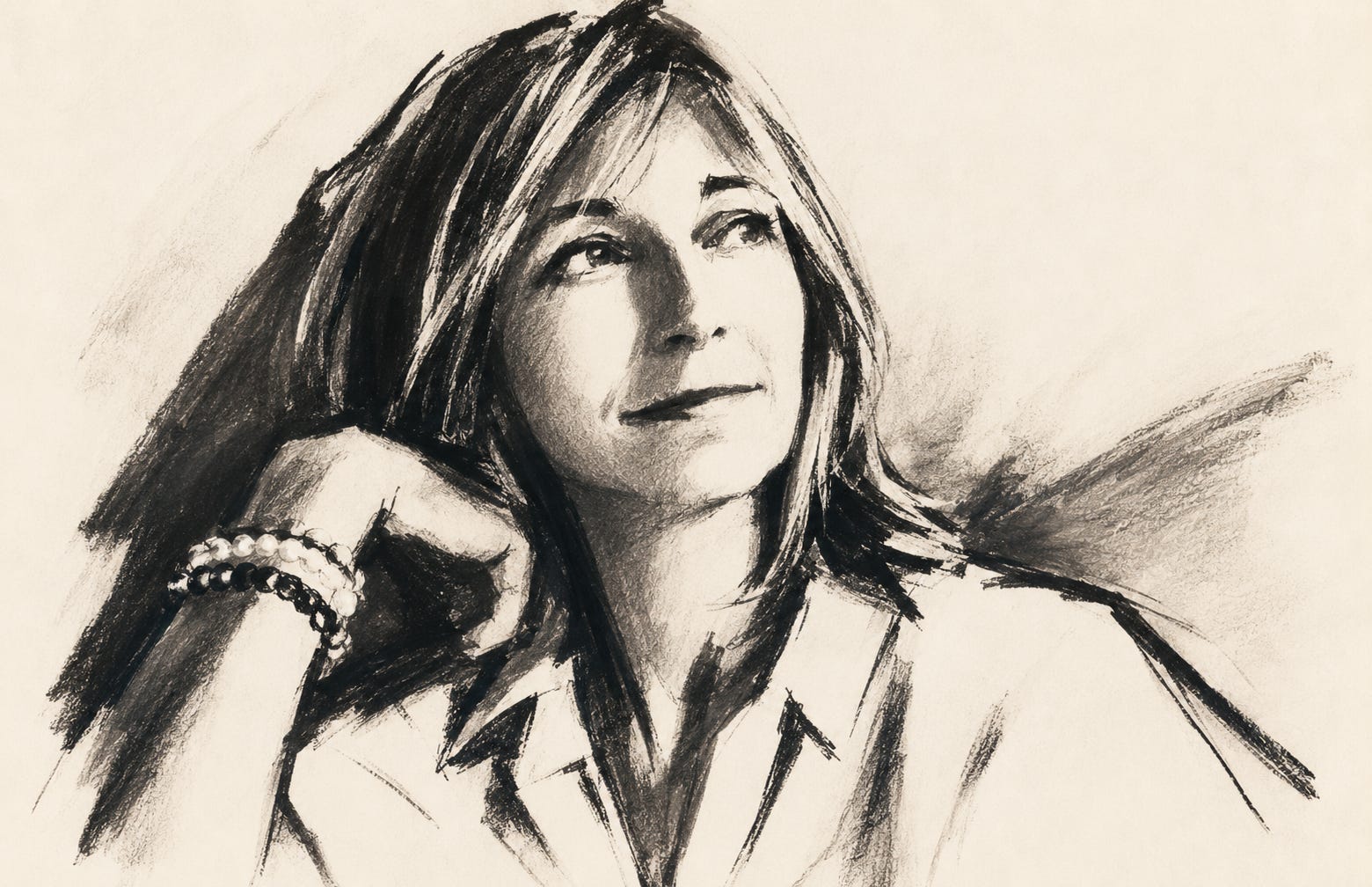
Christine Cotton loved numbers. She stared at them for days on end while she built her business in statistical analysis, scrubbing data for the pharmaceutical clan. She was French, a Toulouse-trained biostatistician who specialized in drug trials. After two decades in the same grind, she became part of the establishment, an insider with a sheriff’s badge — the last person the industry should have worried about.
December 2020. Deep in an audit, Christine spots an anomaly in a set of trial data: a disconnect between the product shipped and the product tested. Product: COVID vaccine. Client: Pfizer. Deduction: the dose injected wasn’t the dose tested.
She drills into case file C4591001, the phase-3 trial document Pfizer filed with the FDA, EMA, and ANSM. She vacuums up thousands of pages released under the Freedom of Information Act to verify the gap between what’s reported and what’s real. She finds a series of further anomalies — among them the data behind the famous “95% effective.” Namely, pixie dust.
In early 2022, Christine files a criminal complaint against Pfizer-BioNTech in French court. Charge: deception, and administration of a substance without consent. She files abuse-of-power actions and petitions, and publishes her reports on her own site, updating them constantly on X.
Pfizer’s response? Cool as a chess wizard. Zero confrontation, zero threats. Instead, they jiu-jitsu her with a cold shoulder. The silent treatment. Her complaint gets shelved, unread. She gets one meeting, behind closed doors, and the record gets buried. Her investigating judge gets the boot, quietly, in the shadows. Her petitions gather dust. For three years, nothing changes.
By early 2025, her report has grown past four hundred pages of documented fraud. There’s a book. 110K followers. Alt-media articles. But in the mainstream she stays invisible. Christine who?
Then, mid-2025, her body begins to fall apart, and she begins to disappear in earnest — in slow motion.
First, a burning from the waist down. Like standing on coals. She consults neurologists, rheumatologists, psychiatrists; swallows pain-clinic drugs by the fistful; and none of it touches the fire spreading through her nerves. The doctors call it idiopathic, the word for we don’t know. The fire spreads for another year, hotter, fiercer, until she can’t bear it. She can’t work. She can’t put up a fight. She loses the appetite to live.
On the second of June, 2026, she leaves a note.
“It is June 2, 2026. By the time you read these lines, I will have left this world…”
She crosses into Switzerland, where it is legal to die by assisted suicide, and she departs.
The news of her passing reaches Dr. Peter McCullough, the cardiologist who lost his hospital post for breaking with the COVID line, who passes it to his writing partner John Leake — a true-crime author who has spent years reconstructing how people are quietly murdered. When Leake reads through her symptoms, he recognizes a signature.
The signature is thallium. A poison with no taste and no smell, its atom so close to the size of potassium that the cell’s own pumps carry it in and take it for food. It takes weeks to surface, and it looks like an ordinary illness, which is why it has been the assassin’s poison for a hundred years. The KGB used it on the defector Nikolai Khokhlov in 1957. Saddam Hussein used it on the men who crossed him. The CIA, as the Church Committee laid out in 1975, planned to put it in Castro’s shoes to make his beard fall out.
Except there is no proof it was thallium, because no one tested her for it — which is its own strange fact. Thallium is a heavy metal, not an organic toxin that breaks down; it does not leave the body after death, it stays fixed in the tissues. In a buried or preserved body it remains detectable for years, even decades. The test is still there to be run. It simply never has been.
And it likely never will be. John Leake keeps the question alive, her supporters doubt the suicide and call for an inquiry, but none of it becomes action, no prosecutor, no autopsy, no toxicology order, no exhumation. An officially self-chosen death triggers no homicide investigation, so the file is closed before it opens.
She is not the first to leave this way. A Boeing man who flagged the cracked planes was healthy on a Monday and dead inside two weeks, a galloping infection no one could name, his family asking for an autopsy and getting silence. A Merck saleswoman who turned on the industry warned her friends that if she were ever found dead it would be no accident — and then she was found dead, and the cause was filed as natural. Further back, a nuclear whistleblower whose car left an empty road on her way to meet a reporter; a journalist with two bullets in him ruled a suicide; a weapons scientist found in the woods. None of it was ever proven, which is part of the norm today. We do not know that any hand was laid on Christine Cotton. We know only the shape that keeps repeating, and that it has her size.
If a hand was laid, consider the mind behind it. It was not a mind trying to win an argument; the argument was finished, her petitions already buried, her judge already gone. It wanted something slower than silence. A bullet ends a person in a clean second and leaves a hole for a coroner to find. This was a long burning from the waist down, with a familiar signature. Harm that comes on quietly and can always be explained as something else. Roughly the shape of the product she had given her last years to expose.
Her last wish had nothing to do with justice or autopsies. She asked the people who loved her to pray that her soul reach the light of the Creator as soon as possible.
It may have been far more subtle than thallium. I have electro-magnetic hypersensitivity since 2016 and the symptoms are as Christine Cotton describes. You don't mention them all in your piece, Jan. The hair and tooth loss is especially alarming. The extreme breathlessness too. The burning sensations can be managed but abstaining from wifi and keeping earthed are essential for that. I am just very sorry that I did not hear about Christine until she died. I could have helped her a lot.
Money kills many things, including people. Tragic story Jan. Thanks for sharing.