


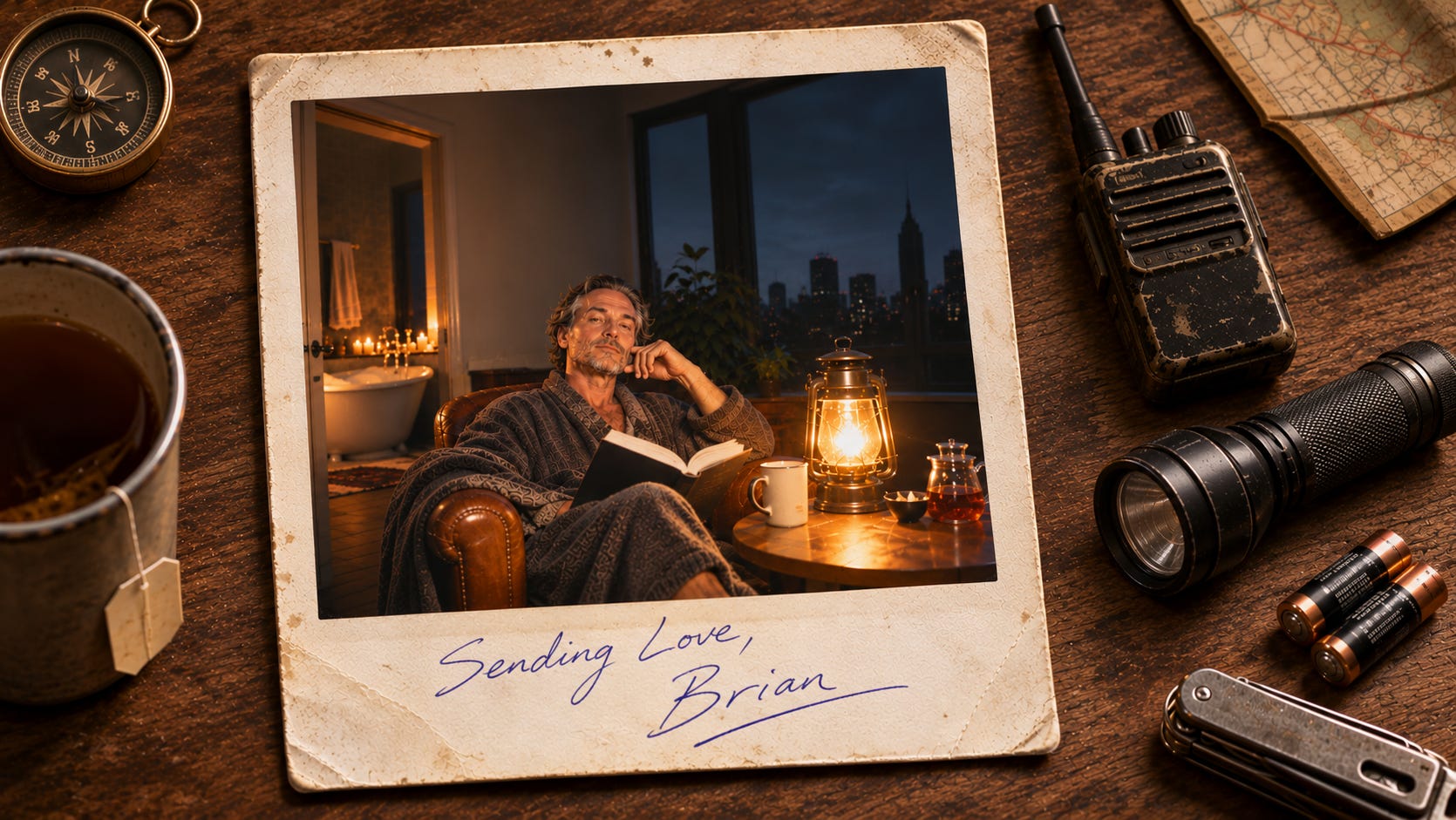
Turn on any screen this week and the world is ending, in at least six flavours.
Channel one, a war in red arrows. Channel two, hackers warming the fridges of seven hundred supermarkets. Channel three, a virus with a number for a name. Channel four, a man in a fleece drawing a months-long blackout on a whiteboard. Channel five, UFOs, under oath. Channel six, an EU Commissioner packing a survival kit on camera.
Bombs, bugs, bytes, blackouts or little grey men. The advertisers do not care which, because a spooked viewer does not change the channel.
“I must not fear. Fear is the mind-killer.” A line lifted straight from Jessica Atreides in Dune: Part One.
They taught her well. Your body runs on two gears. One is for running from a lion. Heart up, breath short, digestion and repair switched off. The other is for everything else, including sleep, procreation, healing and thinking straight.
The lion gear does not check its sources. A missile on a screen switches it on almost as well as a missile over the roof, and a month of headlines leaves you tired, wired and worse at planning, because the part of the brain that plans goes quiet while the part that panics drives.
In March 2020 a spooked continent answered a respiratory virus by buying every roll of toilet paper in Europe, and went home with eighty rolls of quilted paper and no water. Fear makes people stupid in a hurry, and that is exactly where they want your attention. Fear is the best control mechanism for wholesale discount. A frightened viewer watches longer, clicks faster, buys whatever is left on the shelf and agrees to whatever comes next. So. Turn the channels off. Your adrenal glands will send a gift card.
Expect the Best. Prepare for the Not-So-Good.
The opposite advice, that nothing ever happens, is equally wrong. Maybe wronger.
Texas in 2021, when the man running the grid admitted it had been “seconds and minutes” from a blackout lasting months. All of Spain and Portugal dark for an afternoon in April 2025. Berlin, twice in four months, after somebody set fire to its power cables.
And notice who is now telling you to stock up. Sweden mailed a booklet called “If Crisis or War Comes” to every household in the country. The EU asked all its citizens to hold seventy-two hours of supplies. Germany’s civil-protection office recommends ten days, Austria’s fourteen. Germany even keeps a law on the books that lets the state ration food in an emergency. Governments do not print and post millions of pamphlets for fun. Some of it is theatre, and some of it is people who read the same risk reports we never see quietly covering themselves. Either way, the pamphlet is a better guide than the panic.
No fear. But prepare. Most people only ever hear one half. Most people don’t know how fast a city falls over.
Picture the grid going down on a January evening, seen from your kitchen.
Minute one. Lights out, router dead, fridge silent. Mild annoyance.
Hour one. The heating stops, even if it burns gas, because the pump and the controller run on electricity. The lift stops between floors. Card machines die, and so do cash machines.
Hour six. The phone is on twelve percent. The mobile masts are running on batteries, and the batteries are running out. Nobody can tell you how long this will last, because nobody can reach anybody.
Day one. The flat is down to fourteen degrees and falling. In tall buildings the booster pumps are off, so the top floors lose water first. The toilet flushes once, from the cistern, and never again.
Day two. The supermarkets, which keep only a few days of stock and need power for tills, doors and freezers, are shut or stripped. The freezer at home is now a warm cupboard of defrosting regret. Pharmacies close. Petrol stations cannot pump.
Day three. A person can last weeks without food and about three days without water. If the mains pressure has dropped, the tap water may need boiling, and the stove is electric.
Day four onward. Germany’s own parliament modelled this in 2011 and concluded that after a few days the state can no longer reliably supply the population with the basics. The help comes, but it comes street by street, and it does not reach the eighth floor first.
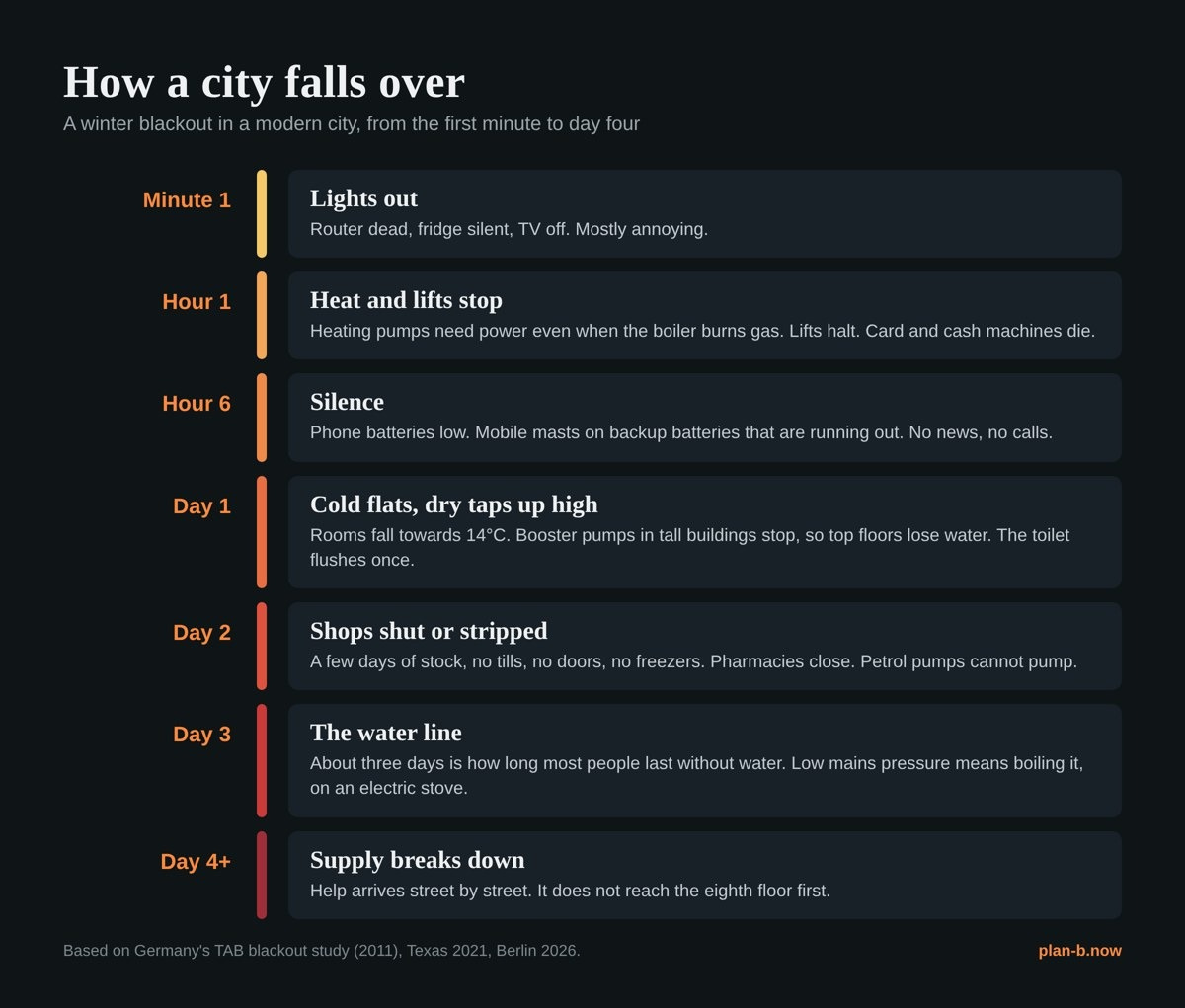
How a city falls over. A winter grid-down, hour by hour.
Even without the fear mongering, we have precedents.
Houston, February 2021. A freeze knocked out the Texas grid, homes built for heat turned into iceboxes, and families sat in running cars to keep warm, one of them dying of the fumes in a closed garage. Then the water pressure collapsed and fourteen million Texans were told to boil their tap water. The state’s final count of the dead passed two hundred.
Berlin, January 2026. An arson attack on a cable bridge cut power to 45,000 households in the snow, at minus ten. Heating, phones and lifts went with the power, and the old and frail on the upper floors stayed stuck in cooling flats while the city filled sports halls with camp beds. It took four days to restore everyone. On the last afternoon an eighty-three-year-old woman was found dead in her flat. The group behind it said next time they would pick a warmer season. Considerate.
Plan-B… streamlined
You do not need four survival manuals, a week of research, or a forum full of men in beards ranking water filters to figure out the basics.
Start with water. Two litres a person a day for drinking and cooking, for two weeks, is twenty-eight litres each, and bottled from the supermarket it costs ten to twenty euros a person. Add two twenty-litre canisters and a bucket for washing and flushing, and fill the bathtub at the first warning.
Then heat, light and a way to cook without the socket. Then food that keeps and that you will happily eat. Then your daily medicine, cash in small notes and a battery radio. The order matters more than the amount, and the right order depends on your home, your city and your budget, which is the part no book can work out for you.
I built Plan-B platform while exploring the positive side effects of AI, to figure out the minimum level of preparedness we actually need. Plus, I was tired of two kinds of advice: the kind that sells you a bunker and the kind that tells you to relax.
Plan-B is a free assessment at plan-b.now. Under five minutes, twelve categories, from water, food and energy to medical, sanitation and budget, tested against nine scenarios, from a short supply shock to the long ugly ones. What comes back is a calm, costed plan sized to your actual household, with a budget split, an action timeline for this week, this fortnight and the next three months, and a short personal analysis. The full report lands in your inbox. For each item it also hands you the top few options inside your budget range, which saves you an evening comparing forty water canisters.
Behind it sit plain guides on drinking water, food reserves, power cuts and heating, written for flats rather than ranches, an optional weekly briefing that tells you what changed without shouting.
It’s free, of course. A few recommended products carry affiliate links, so if you buy through them Plan-B earns a small commission and you pay the same price.
Remember. The world has been ending since roughly the invention of the newspaper. Stay centered. Give the person in front of you your full attention. Switch off the BS. Make something with your hands. But prepare for the gremlins anyway, because they show up whether you watched the news or not. Finding out how ready your home is takes under five minutes.
Take the free Plan-B assessment
Do it on a calm evening, news off, something warm in a cup, lion gear parked.
Thank you for your attention to something else than panic.
Before you go
Coherent Reality is paid for by its readers, so nobody here needs you frightened. If this earned its place in your inbox, share it with the one relative who owns eighty rolls of toilet paper and no water, subscribe, or buy me a coffee. Your support is what keeps this work independent. And since calm comes easier in a body that holds up, meet energeia.now, the Plan-B for your health. No gadgets to charge. No pills to refill. A free reading shows where your energy is leaking, and simple practices, most of them costing nothing, keep you running whether or not the lights stay on.
For those of us who have been watching this build for decades, it's a phase transition. The real issue is what emerges and how can it incorporate the lessons this status quo has been ignoring with all its might.
https://substack.com/@johnmerryman/p-193985079
This might also help. I hope it is relevant.
The tools are simple. Take responsibility for the meaning you assign to events. Use your imagination for what you want rather than what you fear. Live in the present. Choose what does the most good. Accept what is. Trust. Listen to your pain. Schedule your worrying. Be happy now. Breathe from your diaphragm. Peace in the world begins with peace in each person. Peace begins with me (2005) {Ted Kuntz, M.Ed}
https://substack.com/home/post/p-224994649